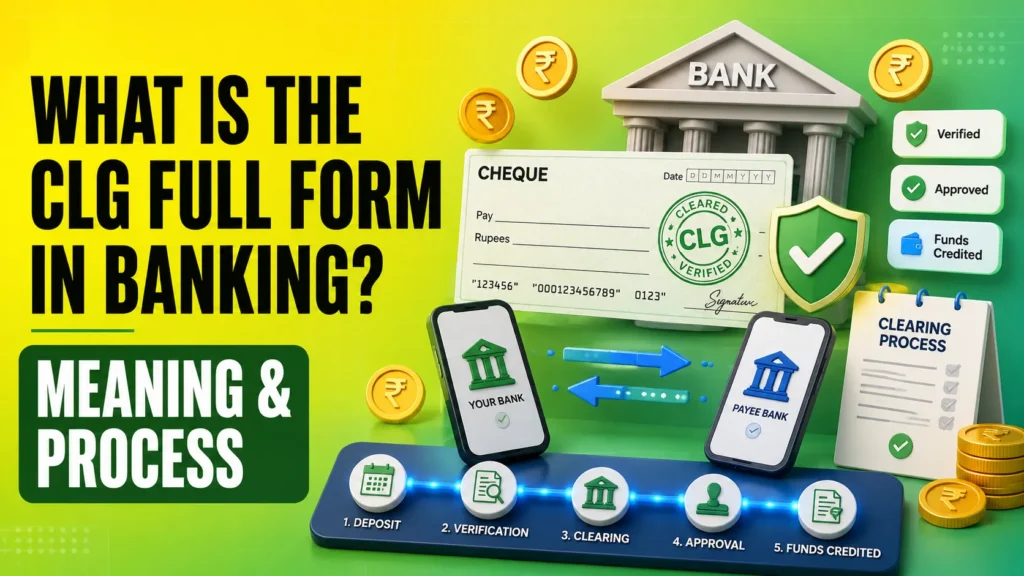
In this article, you will learn the meaning of CLG, what “By CLG” means in your passbook, how the cheque clearing process works, and why it is important in banking.
What Is the CLG Full Form in Banking?
CLG stands for Clearing.
In banking, CLG refers to the cheque clearing process, where a deposited cheque is verified and processed before the amount is credited to the beneficiary’s account.
When you deposit a cheque, your bank does not transfer the money immediately. Instead, it sends the cheque through the clearing system to the bank that issued it. The issuing bank verifies the cheque and confirms whether the payment can be made. Once the verification is complete, the funds are credited to the recipient’s account.
What Does “By CLG” Mean in a Bank Passbook?
If you see “By CLG” in your bank passbook or account statement, it means that the amount has been credited through the cheque clearing process.
For example, if someone gives you a cheque and you deposit it into your bank account, the bank first sends it for clearing. Once the cheque is successfully verified and approved by the issuing bank, the amount is credited to your account. The transaction may then appear as “By CLG” in your statement.
Similarly, if a cheque cannot be cleared due to insufficient funds or a signature mismatch, the amount will not be credited and the cheque will be returned.
Also read: Dormant Account in Banking
How Does the CLG (Cheque Clearing) Process Work?
The cheque clearing process involves several steps to ensure that funds are transferred securely between banks.
Step 1: Cheque Deposit
The process begins when a customer deposits a cheque at a bank branch, cheque deposit machine, or authorized collection center.
The bank receives the cheque and records the transaction in its system.
Step 2: Verification by the Bank
Before sending the cheque for clearing, the bank verifies important details, including:
- Cheque number
- Account number
- Date on the cheque
- Signature of the account holder
- Amount written in words and figures
- Visible alterations or damage
If any required information is incorrect or missing, the cheque may be rejected.
Step 3: Sending the Cheque for Clearing
After verification, the cheque is sent through the banking clearing system to the bank on which it is drawn.
Step 4: Approval by the Issuing Bank
The issuing bank performs another round of verification before releasing the payment.
It checks:
- Account status
- Available account balance
- Signature authenticity
- Stop-payment instructions
- Validity of the cheque
If all details are correct, the bank approves the payment.
Step 5: Credit of Funds
After approval, the amount is transferred to the beneficiary’s bank account.
The customer can then see the transaction reflected in the account statement, often with the description “By CLG.”
Also read: Lien in Banking
What Is a Clearing House?

A Clearing House is a banking system that facilitates the exchange and settlement of cheques between different banks.
Instead of each bank sending cheques individually to every other bank, the Clearing House acts as a central platform where banks exchange cheque information and settle payments efficiently.
Its main responsibilities include:
- Receiving cheque details from banks
- Exchanging cheque information between banks
- Calculating settlement amounts
- Facilitating secure inter-bank payments
- Reducing delays in cheque processing
With the introduction of the Cheque Truncation System (CTS), most cheque clearing is now performed digitally using cheque images, making the process faster and more secure.
Why Is CLG Important in Banking?
Cheque clearing is an essential banking function because it ensures that payments are processed securely before funds are transferred.
Some of the major benefits of CLG include:
- Verifies the authenticity of every cheque.
- Helps prevent fraudulent transactions.
- Ensure sufficient funds are available before payment.
- Maintains accurate banking records.
- Supports secure inter-bank settlements.
- Reduces payment errors and disputes.
- Improves transparency in cheque transactions.
Without a proper clearing process, banks would face higher risks of fraud, duplicate payments, and transaction errors.
Common Reasons Why a Cheque May Be Returned
Not every cheque successfully completes the clearing process. Banks may return a cheque if it does not meet the required verification standards.
Some common reasons include:
- Insufficient balance in the issuer’s account
- Signature mismatch
- Incorrect or incomplete cheque details
- Stale cheque (presented after its validity period)
- Post-dated cheque presented before the specified date
- Altered or damaged cheque
- Stop-payment instruction issued by the account holder
- Overwriting without proper authentication
If a cheque is returned, the beneficiary will not receive the payment until a valid cheque is provided.
CLG vs CTS
Although CLG and CTS are related to cheque processing, they are not the same.
| CLG | CTS |
|---|---|
| Stands for Clearing | Stands for Cheque Truncation System |
| Refers to the cheque clearing process | Refers to the technology used for digital cheque clearing |
| Includes verification and settlement of cheque payments | Uses digital cheque images instead of physical movement |
| Part of banking operations | Technology adopted by banks to speed up cheque clearing |
In simple terms, CLG is the process, while CTS is the technology that makes the process faster and more efficient.
Conclusion
CLG Full Form in Banking is Clearing. It is the process that allows banks to verify, process, and settle cheque payments securely before transferring funds to the beneficiary’s account.
Whenever you see “By CLG” in your bank passbook or statement, it usually indicates that a cheque has been successfully cleared and the amount has been credited to your account.
Even in the era of digital banking, cheque clearing remains an important part of the financial system, especially for business, corporate, and government transactions. Understanding how CLG works can help you better interpret your bank statement and know why cheque payments may take some time to be processed.
Frequently Asked Questions