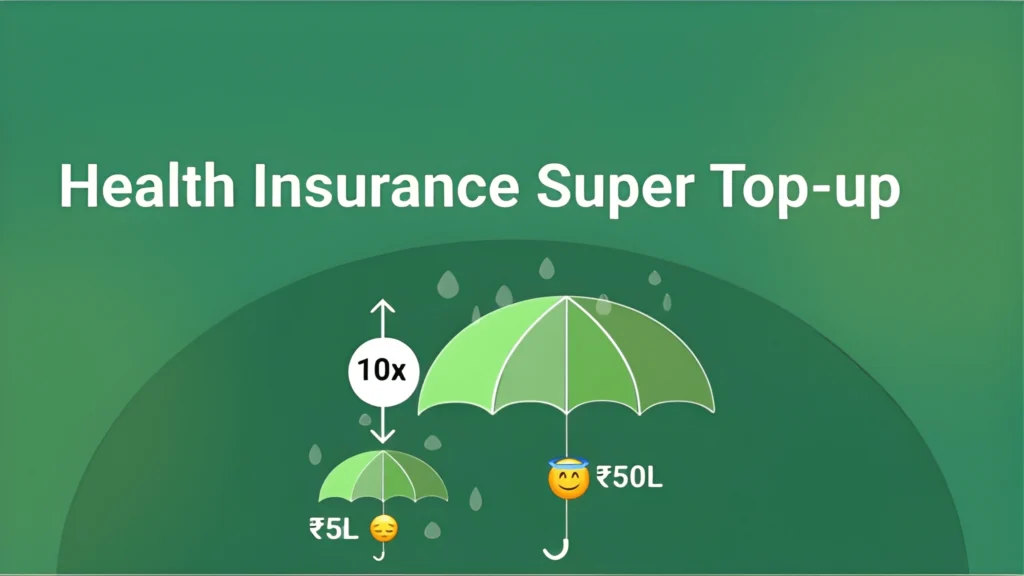
A serious illness can exhaust a ₹5 lakh or ₹10 lakh health policy faster than expected. Cancer treatment, cardiac surgery, ICU admission or repeated hospitalisations can leave a large part of the bill uncovered even when you already have health insurance.
Buying a much larger base policy is one solution, but it can significantly increase the premium. A carefully selected super top-up plan can provide another layer of coverage after your annual deductible is crossed.
The best super top up health insurance plans are not necessarily those with the highest sum insured or lowest premium. The deductible must match your base policy, while the waiting periods, room eligibility and claim conditions must suit your needs.
Before comparing individual plans, understand how super top-up health insurance works and when its aggregate deductible becomes applicable.
This comparison covers five of the best super top up health insurance plans in India based on current product features, coverage flexibility and important restrictions.
Best Super Top Up Health Insurance Plans in India
A super top-up policy considers the total eligible hospitalisation expenses incurred during a policy year. Once these expenses cross the aggregate deductible, the plan can pay the eligible amount above that threshold, subject to its sum insured and policy conditions.
For example, suppose you have:
- A ₹5 lakh base health policy
- A ₹20 lakh super top-up
- A ₹5 lakh aggregate deductible
- Total eligible claims of ₹9 lakh during the year
The base policy may cover the first ₹5 lakh. The super top-up can then cover the remaining eligible ₹4 lakh.
Here is a current comparison of the shortlisted plans:
| Plan | Available Cover | Aggregate Deductible | Standard PED Waiting Period | Room Eligibility | Main Strength | Important Watch-Out |
|---|---|---|---|---|---|---|
| Care Supreme Enhance | High-cover combinations reaching ₹95 lakh | ₹5 lakh–₹15 lakh | 36 months | Check selected option and schedule | High coverage with automatic recharge | Fewer low-deductible choices |
| HDFC ERGO Medisure Super Top Up | ₹3 lakh–₹20 lakh | ₹2 lakh–₹5 lakh | 36 months | No room-rent sub-limit stated in the current brochure | Simple structure with lower deductibles | Maximum cover is lower than several competitors |
| Aditya Birla Super Health Plus | ₹3 lakh–₹95 lakh | ₹1 lakh–₹15 lakh | 36 months | As specified in the selected schedule | Wide choice of cover and deductible combinations | Room-category breach may cause proportionate deductions |
| ICICI Lombard Activate Booster | ₹10 lakh to unlimited | ₹3 lakh–₹20 lakh | 36 months | Single private AC room under standard cover | Very high coverage and extensive customisation | Several features may depend on add-ons |
| Niva Bupa Health Recharge | ₹2 lakh–₹95 lakh | ₹1 lakh–₹10 lakh under super top-up option | 36 months | Depends on selected sum insured | Flexible sum insured and family coverage | Room eligibility and sub-limits vary by option |
Information checked in June 2026. Product availability, underwriting, premiums and policy terms can change. Check the latest Customer Information Sheet, prospectus and policy wording before buying.
Care Supreme Enhance

Care Supreme Enhance is designed for buyers who already have reasonable base coverage and want a substantial additional protection layer.
The official product information lists high-cover configurations reaching ₹95 lakh, with deductible options between ₹5 lakh and ₹15 lakh. It offers individual and family-floater coverage and can be purchased for one, two or three years.
Important benefits include:
- In-patient hospitalisation up to the applicable sum insured
- All listed day-care procedures
- Advanced medical treatments
- Pre-hospitalisation expenses for 60 days
- Post-hospitalisation expenses for 180 days
- Domiciliary hospitalisation
- Organ-donor cover
- AYUSH treatment
- Cumulative bonus
- Unlimited automatic recharge
- Unlimited general-physician e-consultations
The standard initial waiting period is 30 days. Listed illnesses and procedures have a 24-month waiting period, while accepted pre-existing diseases have a 36-month waiting period.
The main attraction is the combination of high coverage and automatic recharge. However, the minimum deductible is relatively high. It may not suit someone with only ₹2 lakh or ₹3 lakh of base insurance.
Best suited for: Families or individuals who already have at least ₹5 lakh of dependable base cover and want a high additional sum insured.
HDFC ERGO Medisure Super Top Up
HDFC ERGO Medisure offers a simpler set of sum insured and deductible combinations than many newer plans.
Its available combinations provide coverage between ₹3 lakh and ₹20 lakh, with aggregate deductibles from ₹2 lakh to ₹5 lakh. This makes it easier to match with smaller base policies or employer insurance.
The current brochure includes:
- In-patient hospitalisation
- ICU and room expenses
- Day-care procedures
- Pre-hospitalisation cover for 30 days
- Post-hospitalisation cover for 60 days
- Expenses related to accepted pre-existing diseases after the waiting period
- Individual and floater options
- Lifelong renewal
The brochure states that in-patient coverage does not carry separate room-rent sub-limits. It also applies a 36-month waiting period to pre-existing diseases and a 24-month waiting period to specified treatments.
The biggest limitation is its maximum sum insured of ₹20 lakh. This may be sufficient for buyers seeking a moderate enhancement, but it is less suitable for someone who wants ₹50 lakh or ₹1 crore of additional cover.
Best suited for: Buyers with a ₹2 lakh–₹5 lakh base policy who want straightforward additional coverage rather than an extremely high sum insured.
Aditya Birla Super Health Plus
Aditya Birla Super Health Plus offers one of the widest sets of sum insured and deductible combinations in this shortlist.
Depending on the selected plan and option, the available sum insured ranges from ₹3 lakh to ₹95 lakh, while deductibles range from ₹1 lakh to ₹15 lakh.
The policy includes:
- In-patient hospitalisation
- Day-care treatment
- Pre- and post-hospitalisation expenses
- Home treatment under specified conditions
- ICU charges
- Medical practitioner and nursing charges
- Medicines and eligible consumables
- Individual and family-floater options
- One-, two- and three-year policy periods
The standard pre-existing disease waiting period is 36 months, while specified diseases and procedures carry a 24-month waiting period.
Its strongest advantage is flexibility. A buyer can choose a lower deductible with moderate coverage or a higher deductible with a much larger sum insured.
However, room eligibility is linked to the policy schedule or selected benefit table. Admission to a room category above the permitted level may result in proportionate deductions on associated medical expenses.
Best suited for: Buyers who need a specific combination of deductible and coverage that is unavailable under plans with fewer options.
ICICI Lombard Activate Booster
ICICI Lombard Activate Booster offers the highest potential coverage among the shortlisted plans. Its annual sum insured starts at ₹10 lakh and can extend to an unlimited option, while the deductible ranges from ₹3 lakh to ₹20 lakh.
The deductible applies on an aggregate basis to eligible hospitalisation expenses during the policy year.
The standard cover includes:
- In-patient hospitalisation
- Single private AC room eligibility
- Day-care treatment
- Modern medical procedures
- Pre- and post-hospitalisation expenses
- AYUSH treatment
- Road ambulance
- Organ-donor expenses
- Domiciliary hospitalisation
- Home-care treatment under the applicable plan
- Bariatric surgery subject to conditions
The standard waiting period is 36 months for accepted pre-existing diseases and 24 months for specified diseases or procedures.
Activate Booster also offers several optional covers, including:
- Reduction of the PED waiting period
- Reduction of the specified illness waiting period
- Room-category modification
- Claim Protector for eligible non-medical expenses
- Inflation-linked enhancement
- Domestic air ambulance
- Deductible reduction
- Selected chronic-disease support
These options increase flexibility, but they also make comparison more complicated. Benefits advertised around waiting-period reduction, unrestricted room choice or non-medical expenses may require additional premiums and should not be assumed to be part of the standard policy.
Best suited for: Buyers seeking very high coverage who are comfortable selecting and paying for only the add-ons they actually need.
Niva Bupa Health Recharge
Niva Bupa Health Recharge offers sum insured options from ₹2 lakh to ₹95 lakh. Under its super top-up structure, annual aggregate deductibles are available from ₹1 lakh to ₹10 lakh in multiples of ₹1 lakh.
The plan covers:
- In-patient hospitalisation
- Day-care treatment
- Pre-hospitalisation expenses for 60 days
- Post-hospitalisation expenses for 90 days
- Domiciliary treatment
- AYUSH treatment
- Organ-donor expenses
- Modern treatments
- Mental health treatment, subject to applicable sub-limits
- HIV/AIDS treatment
- Unlimited e-consultations
- Loyalty additions on eligible coverage levels
Room eligibility depends on the selected sum insured. Higher coverage options generally provide single-private-room eligibility, while lower options can carry a room-rent cap. The exact room category must therefore be confirmed in the policy schedule.
The standard PED waiting period is 36 months. Specified illnesses and procedures generally have a 24-month waiting period, subject to the policy terms.
The wide range of deductibles makes the policy easier to pair with both personal and employer health insurance. Buyers planning family coverage should first compare suitable family health insurance options to ensure that the base policy provides adequate protection below the deductible.
However, buyers must compare room eligibility, ambulance limits and treatment-specific sub-limits for their selected option.
Best suited for: Individuals and families looking for flexible aggregate-deductible choices and coverage that can be adjusted around an existing health policy.
Which Super Top-Up Plan May Suit You?
There is no single plan that will be best for every policyholder.
| Your Main Requirement | Plan Worth Evaluating |
|---|---|
| Very high or unlimited additional cover | ICICI Lombard Activate Booster |
| Flexible deductible and sum insured combinations | Aditya Birla Super Health Plus |
| Lower deductible with a simpler structure | HDFC ERGO Medisure Super Top Up |
| Large cover with recharge benefits | Care Supreme Enhance |
| Flexible family-floater and deductible options | Niva Bupa Health Recharge |
This table is a shortlist, not a personalised recommendation. Age, medical history, city, premium, base coverage and underwriting can change the final suitability.
How to Choose the Right Super Top-Up Health Insurance
Match the Deductible With Available Base Cover
The most important decision is not the sum insured. It is the deductible.
Your deductible should be supported by one or more of the following:
- Personal base health insurance
- Employer health coverage
- Another eligible indemnity policy
- An emergency fund you can genuinely use
Suppose you purchase a super top-up with a ₹10 lakh deductible but have only ₹5 lakh in base insurance. If your total eligible claim is ₹12 lakh, your base plan may cover ₹5 lakh and the super top-up may start only after ₹10 lakh.
This can leave a ₹5 lakh coverage gap before the super top-up becomes payable.
Never choose a larger deductible only because it produces a lower premium.
Confirm That It Uses an Aggregate Deductible
A regular top-up generally checks whether an individual claim crosses the deductible.
A super top-up considers cumulative eligible hospitalisation expenses during the policy year.
For example, with a ₹5 lakh deductible:
- First eligible claim: ₹3 lakh
- Second eligible claim: ₹4 lakh
- Total eligible claims: ₹7 lakh
A super top-up can consider the combined ₹7 lakh and may cover the eligible amount above ₹5 lakh. A regular top-up may pay nothing because neither individual claim crossed the ₹5 lakh threshold.
Check the wording carefully instead of relying only on the product name.
Compare Room Eligibility and Proportionate Deductions
Room restrictions can affect more than the room charge.
When a policy permits a single private room but you choose a higher category, the insurer may apply a proportionate deduction to:
- Room rent
- Nursing expenses
- Surgeon’s fees
- Doctor’s fees
- Operation-theatre expenses
- Other associated charges
A plan with unrestricted room eligibility may therefore be more valuable than a slightly cheaper policy with a strict room cap.
Read Also: What Is a Sub-Limit in Health Insurance and How Does It Affect Claims?
Compare Waiting Periods Separately
Your base plan and super top-up can have different waiting periods.
For example, a disease may already be covered under your old base policy but remain excluded under a newly purchased super top-up for up to 36 months.
Compare:
- Initial waiting period
- Pre-existing disease waiting period
- Specified disease waiting period
- Waiting-period reduction add-ons
- Portability or migration credits
- Fresh waiting periods on enhanced coverage
A super top-up should ideally be purchased before a major medical condition develops, not only after the base policy becomes insufficient.
Read Also: Waiting Period in Health Insurance: Meaning, Types and Claim Impact
Understand How Claims Will Be Coordinated
Your base policy and super top-up do not have to be issued by the same insurer. However, using different insurers may require more documentation.
The super top-up insurer may ask for:
- Base insurer’s settlement letter
- Deduction details
- Hospital bills
- Discharge summary
- Proof that the deductible was crossed
- Certified copies of documents retained by the first insurer
- Payment and reimbursement records
When both plans offer cashless health insurance, confirm whether the hospital can coordinate authorisation with both insurers. In some cases, one insurer may settle cashlessly while the second claim has to be filed separately.
Using the same insurer can make coordination easier, but it should not be the only reason for choosing a weaker policy.
Do Not Depend Completely on Employer Insurance
Corporate health insurance can help meet the deductible, but employer coverage is not permanent.
It may:
- End when you leave the job
- Reduce after a policy revision
- Exclude parents in the future
- Carry sub-limits
- Change insurers
- Provide insufficient cover during retirement
A group mediclaim policy may support the deductible while you remain employed, but you should have a separate plan for maintaining the base layer after changing jobs.
Super Top-Up vs Increasing the Base Sum Insured
| Factor | Higher Base Health Policy | Base Policy With Super Top-Up |
|---|---|---|
| Coverage begins | From the first eligible amount | After the aggregate deductible is crossed |
| Premium | Usually higher for the same total protection | Often more cost-effective |
| Small hospital bills | Covered, subject to policy terms | May remain below the deductible |
| Large claims | Limited to the base sum insured | Gets an additional protection layer |
| Claim process | Usually simpler | May require coordination between policies |
| Best suited for | Buyers who prefer simple, broad coverage | Buyers seeking affordable protection against large bills |
A higher base policy can be better when simplicity and frequent smaller claims are important.
A super top-up can be more cost-effective when you already have adequate base protection and mainly need cover against large or repeated hospital bills.
In many cases, a balanced combination works better than choosing only one: a meaningful base policy for regular claims and a high super top-up for major expenses.
Read Also: Best Health Insurance Plans for Family: How to Compare
Conclusion
The best super top up health insurance plans should be compared on more than their advertised coverage.
HDFC ERGO Medisure may suit buyers who want a relatively low deductible and simple structure. Aditya Birla Super Health Plus offers a wider choice of deductible combinations. Care Supreme Enhance provides high coverage with recharge benefits. Niva Bupa Health Recharge offers flexible family and deductible options, while ICICI Lombard Activate Booster is worth considering for very high coverage and customisation.
Before choosing among the best super top up health insurance plans in India, make sure the deductible matches your base policy. Check the room category, waiting periods, co-payment, treatment sub-limits and claim-document requirements.
A ₹50 lakh super top-up can still leave you underinsured if you cannot manage its deductible. The right plan is the one that creates a continuous protection layer without leaving an avoidable gap.