Your health insurance premium may remain manageable for several years and then increase noticeably at renewal. This does not always mean the insurer raised your price because you made a claim. You may simply have entered the next health insurance premium age slab.
Age slabs influence the premium charged when you buy or renew a policy. They can also affect family-floater pricing, senior-citizen costs and the long-term affordability of your cover.
Understanding how age bands work can help you choose a policy that remains practical not just today, but also when you turn 40, 50 or 60.
What Is a Health Insurance Premium Age Slab?
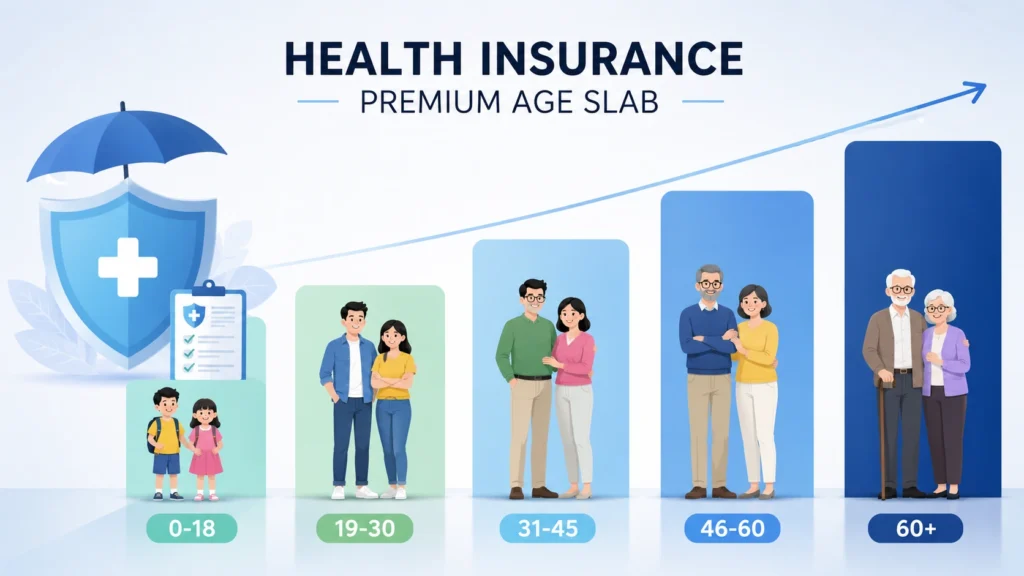
A health insurance premium age slab is an age range used by an insurer to price a health policy. People within the same age band may be charged a similar base premium, while moving into the next band may result in a higher renewal premium.
Possible age bands may look like this:
- 18 to 25 years
- 26 to 35 years
- 36 to 45 years
- 46 to 55 years
- 56 to 60 years
- 61 years and above
These ranges are only examples. There is no universal age-slab chart followed by every health insurer.
Some policies use five-year age bands, while others may use wider bands or calculate premiums for each individual age. Therefore, always check the premium chart of the specific policy you are considering.
Entry Age vs Attained Age: What Is the Difference?
Entry age and attained age are related, but they do not mean the same thing.
| Term | Meaning | Why It Matters |
|---|---|---|
| Entry age | Your age when you first buy the policy | Affects eligibility, initial premium and underwriting |
| Attained age | Your current age at purchase or renewal | May determine the premium slab applicable now |
| Maximum entry age | The highest age at which a new customer can enter the policy | Varies by insurer and product |
| Renewal age | Your age when the policy is renewed | Premium can change even when coverage continues |
Buying health insurance early usually gives you a lower starting premium. However, it does not normally freeze the same premium for your entire life.
The main benefits of buying early are:
- Lower initial pricing
- Easier medical underwriting
- Earlier completion of waiting periods
- Longer policy continuity
- Coverage before major illnesses develop
Why Does the Health Insurance Premium Age Slab Matter?
Your Premium May Jump After Entering a New Slab
A premium does not always increase on every birthday. It may remain within the same pricing band for several years and increase when you cross the next age boundary.
For example, suppose a policy uses these age bands:
- 36 to 40 years
- 41 to 45 years
- 46 to 50 years
A customer may pay a similar base rate between ages 36 and 40. At the renewal after turning 41, the next age-band rate may apply.
The health insurance premium age slab will depend on the insurer, product, sum insured, city and other pricing factors.
It Affects Long-Term Affordability
A policy that appears inexpensive at age 30 may become costly after age 45 or 55.
Before buying, look beyond the current quote and examine:
- The next age-band premium
- Premiums near ages 50 and 60
- Senior-citizen pricing
- Age-based co-payment
- Deductibles and sub-limits
- Changes in benefits at older ages
The cheapest first-year premium does not always produce the lowest long-term cost.
It Can Change Family-Floater Pricing
The age of family members plays an important role in family-floater pricing.
In many plans, the eldest member’s age has a strong influence on the premium. However, insurers may also consider the age and risk of every person covered.
For example, a floater covering a 32-year-old, a 30-year-old spouse and two children may have one premium. Adding a 62-year-old parent can substantially change:
- The premium
- Medical-test requirements
- Underwriting
- Co-payment
- Policy conditions
In such cases, compare these arrangements:
- One floater for all family members
- A floater for the couple and children
- A separate policy for elderly parents
Separate policies are not automatically cheaper, but they may provide better pricing and dedicated coverage when the age gap is large.
It Helps You Prepare for Senior-Citizen Costs
Health risks and expected treatment costs generally increase with age. Insurers may therefore charge more for older age groups.
Senior-citizen policies may also include:
- Mandatory co-payment
- Disease-wise sub-limits
- Room-rent restrictions
- Medical screening
- Deductibles
- Longer underwriting reviews
A low premium alone does not make a senior-citizen policy suitable. A policy with a 20% co-payment may leave the customer paying ₹20,000 from an admissible claim of ₹1 lakh.
Coverage restrictions must therefore be checked along with the premium.
It Can Influence Portability Decisions
A sharp renewal increase may encourage you to compare another insurer. However, waiting until the policy becomes unaffordable may reduce your options if new medical conditions have developed.
Before entering a higher age slab, review:
- The upcoming renewal premium
- Similar policies from other insurers
- Portability requirements
- Waiting-period continuity
- Medical underwriting
- Cashless hospitals near you
- Co-payment and sub-limits
Portability allows you to apply to another insurer while carrying eligible continuity credits, but acceptance is subject to the receiving insurer’s underwriting decision.
Illustrative Health Insurance Age-Slab Table
The following table explains how pricing considerations may change across life stages. It does not represent the premium structure of every insurer.
| Life stage | Possible pricing effect | What to check |
|---|---|---|
| 18–25 years | Usually lower base premium | Adequate cover and future family addition |
| 26–35 years | Premium may remain relatively manageable | Maternity needs, restoration and waiting periods |
| 36–45 years | Higher bands may begin in some products | Lifestyle-disease protection and sum insured |
| 46–55 years | Age-based increase may become more noticeable | Medical tests, PED terms and co-payment |
| 56–60 years | Approaching senior-citizen pricing | Renewal affordability and hospital network |
| 61 years and above | Higher expected claim risk may affect pricing | Co-payment, sub-limits and service support |
Note: Actual premiums depend on the insurer, product, sum insured, location, family structure, medical history and selected benefits. Obtain a personalised quote for exact pricing.
Does Health Insurance Premium Increase Every Year?
Not necessarily.
Your health insurance premium can remain unchanged for a period and then rise because of an age-slab change, product repricing, increased coverage or another pricing factor.
The main reasons are explained below.
Age-Slab Increase
You enter the next pricing band under the policy’s premium chart.
This increase is connected with your attained age and may happen even when you have not made a claim.
Product-Wide Premium Revision
An insurer may revise the premium rates of a product based on its overall claims experience, medical costs and pricing assumptions, subject to applicable regulatory requirements.
Such a revision may affect many customers covered under the same product, even when they have not crossed an age slab.
Coverage-Related Increase
Your premium may rise when you:
- Increase the sum insured
- Add a spouse, child or parent
- Purchase an add-on
- Remove a deductible
- Move to a higher room category
- Change the policy variant
This is not an age-slab increase.
Underwriting-Related Loading
Medical loading may apply when you first purchase a policy, apply for portability or request additional coverage that requires underwriting.
At normal renewal, an insurer should not carry out fresh underwriting simply because you made a claim or developed an illness, provided you are not requesting an increase in the sum insured.
When the sum insured is increased, underwriting may apply to the additional amount.
What Happens When You Enter the Next Age Slab?
The renewal premium may be calculated through the following process:
- The insurer checks your attained age.
- It identifies the age band applicable under the product.
- The relevant base premium is applied.
- Other pricing factors are considered.
- Add-ons, discounts and applicable charges are included.
- The final renewal premium is shown in the notice.
When your premium rises, compare the renewal notice with the previous year and check whether the difference is caused by:
- Movement into a new age band
- Product-wide repricing
- Increased sum insured
- Addition of a family member
- New add-ons
- Removal of a discount
- Changes in policy structure
You can calculate the percentage increase using this formula:
Premium increase percentage = (New premium − Old premium) ÷ Old premium × 100
For example, if the premium rises from ₹20,000 to ₹23,000:
₹3,000 ÷ ₹20,000 × 100 = 15% increase
Health Insurance Age Slab vs Product-Wide Repricing
These two increases are often confused.
| Age-slab increase | Product-wide repricing |
|---|---|
| Linked to the insured person’s age band | Linked to the insurer’s pricing for the product |
| May occur when an age boundary is crossed | May affect many policyholders in the product |
| Based on the product’s age structure | May reflect claim costs and product experience |
| May not happen every year | Can occur even when your age slab remains unchanged |
Ask the insurer for the reason when a renewal premium increases sharply. The renewal notice or customer support team should help you identify whether the change is age-related or product-related.
How Does the Age Slab Work in a Family Floater?
A family-floater premium may be affected by:
- Age of the eldest member
- Age of each insured person
- Number of adults and children
- Relationship between members
- Sum insured
- Medical history
- City or pricing zone
- Product-specific family discounts
The eldest member’s age is important in many plans, but it is not correct to assume that every insurer calculates the entire premium only on that basis.
Consider separate health insurance for parents when:
- There is a large age difference
- Parents require specialised coverage
- Adding them causes a sharp premium increase
- The floater has a high co-payment
- Separate sums insured provide stronger protection
For example, if parents and children share one ₹10 lakh floater, a major claim by one member could reduce the amount available to everyone else.
Separate policies may avoid this problem.
What Should Senior Citizens Know About Premium Increases?

For the relevant regulatory direction, a senior citizen means a person aged 60 years or above.
IRDAI directed general and standalone health insurers offering indemnity-based individual health products to senior citizens not to revise their premium by more than 10% per year. Prior consultation with IRDAI is required where a higher increase is proposed.
This should not be misunderstood as a guarantee that every senior-citizen premium will remain unchanged. An increase of up to the applicable limit may still occur, and the direction applies to the specified category of health products.
Senior citizens should:
- Compare the renewal notice with the previous year
- Ask for the reason behind the increase
- Check whether the policy or sum insured changed
- Confirm whether the increase is age-based or product-wide
- Review co-payment and deductibles
- Contact the insurer’s senior-citizen support channel
- Avoid allowing the policy to lapse during a dispute
The policy should not be cancelled only because the premium has increased. Replacing an old policy may become difficult when serious medical conditions already exist.
Factors Other Than Age That Affect Health Insurance Premium
Age is important, but it is not the only factor used in pricing.
| Factor | Possible effect on premium |
|---|---|
| Sum insured | Higher coverage generally costs more |
| Medical history | May affect underwriting at purchase or for additional cover |
| City or zone | Treatment costs vary across locations |
| Family size | More covered members increase the overall risk |
| Policy type | Individual and floater pricing differ |
| Deductible | A higher deductible may reduce premium |
| Co-payment | Greater out-of-pocket sharing may reduce premium |
| Add-ons | Additional benefits increase the total premium |
| Lifestyle risk | May affect underwriting where applicable |
| Product repricing | Rates may be revised for the product category |
Do not compare two premiums unless the coverage, location, sum insured and policy conditions are similar.
How to Compare Health Insurance Age Slabs Before Buying
Ask for More Than the Current Premium
Check indicative premiums for important milestone ages, such as:
- Your current age
- The next age band
- Age 50
- Age 60
- Age 65
Future premiums cannot be guaranteed because product rates may change. However, the current age-band chart can help you understand how the product is structured.
Compare the Same Coverage
Keep the following details identical while comparing policies:
- Sum insured
- City
- Number and age of members
- Room-rent eligibility
- Co-payment
- Deductible
- Add-ons
- Policy term
A ₹15,000 policy with a high deductible cannot be fairly compared with an ₹18,000 policy without one.
Read the Premium Chart and Policy Wording
Check whether the product uses:
- Annual age pricing
- Fixed age bands
- Eldest-member pricing
- Separate senior-citizen pricing
- Age-based co-payment
- Age-related benefit restrictions
Also read the Customer Information Sheet, which summarises major benefits, exclusions, waiting periods, deductibles and sub-limits.
Calculate Affordability Beyond the First Year
Consider how the policy may fit your budget after:
- Entering the next age slab
- Increasing your sum insured
- Adding family members
- Reaching retirement
- Entering the senior-citizen category
A slightly more expensive policy with fewer restrictions may provide better long-term value than the cheapest available option.
Can You Reduce the Effect of Age-Based Premiums?
You cannot stop ageing, but you can plan your coverage more effectively.
Practical options include:
- Buy adequate cover before serious illnesses develop
- Compare age-band structures before purchasing
- Use a suitable base plan with a super top-up
- Consider a voluntary deductible only when affordable
- Remove add-ons that provide little value
- Compare separate coverage for elderly parents
- Maintain uninterrupted policy continuity
- Review portability before renewal
- Increase coverage before medical needs become urgent
Do not reduce essential coverage only to save on premium.
A low-cost policy with insufficient sum insured, a high co-payment or strict room-rent limits may produce much larger expenses during hospitalisation.
Does Buying Health Insurance Early Lock the Premium?

No. Buying health insurance early does not normally lock the same premium for life.
Your premium may rise when you enter another health insurance premium age slab or when the insurer revises the product’s rates.
Buying early is still beneficial because it:
- Gives you a lower starting premium
- Starts policy continuity
- Completes waiting periods earlier
- May make underwriting easier
- Provides protection before illnesses develop
- Gives you more time to earn a no-claim bonus
The real benefit is early and continuous coverage, not a permanently fixed price.
Conclusion
The health insurance premium age slab determines how your age affects the base price of a policy. Since insurers use different age bands and pricing methods, there is no universal age-wise premium chart.
A premium may rise because you entered a new slab, but age is not the only possible reason. Product-wide repricing, higher coverage, new family members and add-ons can also increase the renewal amount.
For family floaters, examine how older members affect the price. For senior citizens, compare the premium together with co-payment, room-rent limits, deductibles and local hospital access.
Most importantly, do not select a health policy only because its first-year premium is low. Choose coverage that is likely to remain adequate and affordable across future age slabs.
FAQs
Does the health insurance premium increase on every birthday or only when the age slab changes?
It depends on the product. Some insurers use fixed age bands, so the base premium may increase only after you enter the next slab. Other policies may use age-specific annual rates. Product-wide repricing can also increase the premium even when your age slab has not changed.
Is the health insurance premium age slab the same for every insurer?
No. Every insurer and product may have a different pricing structure. One plan may use five-year age bands, while another may use wider bands or calculate the premium for each individual age. Always check the policy’s current premium chart.
Does the eldest member’s age decide every family-floater premium?
Not always. The eldest member’s age has a major influence in many plans, but insurers can also consider the age and risk of every family member. Family size, sum insured, location and medical history may also affect the premium.
Can an insurer increase my renewal premium because I made a claim?
An insurer should not individually reprice or refuse normal renewal only because you made a claim in an earlier policy year. However, the premium can change because of an age-band movement, product-wide revision, coverage change or other permitted pricing factor.
What should I do if my premium rises sharply after age 60?
Compare the old and new renewal notices, calculate the percentage increase and ask the insurer for a written explanation. Check whether the increase resulted from age, product repricing or a coverage change. Also contact the insurer’s dedicated senior-citizen support channel and keep the policy active while the issue is reviewed.