Health-focused insurers such as Star Health, Care Health and Niva Bupa are often compared with general insurers such as HDFC ERGO, ICICI Lombard and Bajaj General. But does choosing a company that mainly sells health insurance automatically result in better coverage or smoother claims?
Not necessarily.
Standalone health insurance companies in India specialise in health-related insurance, while general insurers sell health policies along with motor, travel, home and other non-life products. However, the insurer’s business category alone cannot tell you whether a particular policy is suitable.
You must also compare its coverage conditions, claim performance, complaint record, medical underwriting and cashless hospitals near you.
This guide covers:
- The current IRDAI-listed standalone health insurers
- Company-wise claim and service information
- Standalone versus general insurers
- Important policy restrictions
- How to choose an insurer for different needs
What Is a Standalone Health Insurance Company?

A standalone health insurance company is an insurer that primarily specialises in health and related insurance products. It may offer individual health insurance, family-floater plans, group health cover, personal accident insurance, travel-related cover and specialised medical policies, subject to IRDAI regulations.
The word “standalone” describes the insurance company’s business category. It does not mean that the policy must be purchased separately from an employer.
This distinction is important:
- Standalone health insurer: A company primarily engaged in health insurance.
- Individual health policy: A policy purchased by a person or family instead of being provided by an employer.
A general insurer can also offer a comprehensive health policy. Therefore, a policy from a standalone insurer is not automatically better than one issued by a general insurer.
List of Standalone Health Insurance Companies in India
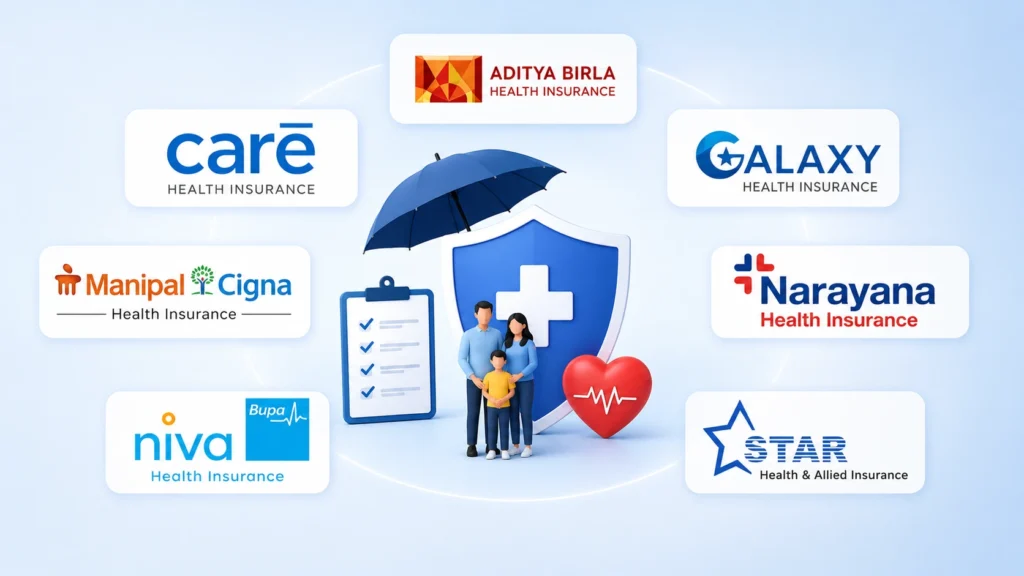
As verified in June 2026, the current IRDAI list contains seven standalone health insurance companies in India.
| Standalone health insurer | Company status | Main customer segments | Comparable historical data |
|---|---|---|---|
| Aditya Birla Health Insurance Co. Ltd. | Established insurer | Individuals, families and wellness-focused buyers | Available |
| Care Health Insurance Ltd. | Established insurer | Families, senior citizens and high sum insured buyers | Available |
| Galaxy Health Insurance Company Ltd. | Newer insurer | Individuals, families, senior citizens and group customers | Limited |
| ManipalCigna Health Insurance Company Ltd. | Established insurer | Individuals, families and buyers with specialised health needs | Available |
| Narayana Health Insurance Ltd. | Newer insurer | Buyers within its available product and healthcare network | Limited |
| Niva Bupa Health Insurance Co. Ltd. | Established insurer | Individuals, families and family-floater buyers | Available |
| Star Health & Allied Insurance Co. Ltd. | Established insurer | Families, senior citizens and buyers seeking specialised plans | Available |
Galaxy Health Insurance Company Limited was formerly known as Galaxy Health and Allied Insurance Company Limited.
Data verified: June 2026
Main data period: FY 2022–23 to FY 2024–25
Sources used: IRDAI records, insurer public disclosures and official hospital-network pages.
New insurers should not be ranked above or below established companies using one year of claim data. A small number of early claims can make a percentage appear unusually high or low.
Aditya Birla Health Insurance
Aditya Birla Health Insurance serves individuals and families through regular hospitalisation plans, chronic-care options, wellness-linked benefits and high-value covers.
Its claim settlement ratio remained consistent during the three financial years reviewed:
- FY 2022–23: 95.95%
- FY 2023–24: 95.61%
- FY 2024–25: 95.88%
Its three-year average CSR was 95.81%, while the FY 2024–25 incurred claim ratio was 71.50%. The company’s average complaint volume was 18.67 complaints per 10,000 claims.
Aditya Birla Health had access to more than 12,000 network hospitals when checked in June 2026. Its public disclosures show that claims may be managed through a combination of in-house settlement and TPAs, particularly across different types of business.
Important strengths
- Consistent claim settlement trend
- Relatively low complaint volume among standalone insurers
- Strong focus on wellness and chronic-condition management
- Large cashless hospital network
What buyers should check
Wellness rewards may look attractive, but they should not replace essential coverage. Check the base sum insured, restoration conditions, room eligibility, waiting periods and whether rewards affect only renewal benefits or actual claim coverage.
May suit: Buyers seeking comprehensive health insurance with wellness or chronic-care features.
Care Health Insurance
Care Health Insurance offers individual, family-floater, senior citizen, critical illness and high sum insured products. It is one of the larger standalone health insurers by health-insurance premium volume.
Its claim settlement ratio improved during the period reviewed:
- FY 2022–23: 90.03%
- FY 2023–24: 92.61%
- FY 2024–25: 96.74%
Its three-year average CSR was 93.13%. The FY 2024–25 ICR stood at 64.53%, while its average complaint volume was 42 complaints per 10,000 claims.
Care Health had more than 11,400 network hospitals when checked in June 2026. The insurer also operates an in-house claim-management team.
Important strengths
- Improving claim settlement trend
- Wide range of family and high sum insured plans
- Large national hospital network
- In-house claim-management process
What buyers should check
Its complaint volume is higher than some other established standalone insurers. Buyers should carefully examine room-rent conditions, co-payment, disease-wise limits, restoration rules and whether important benefits require paid add-ons.
May suit: Families and buyers seeking higher coverage options, provided the selected policy has manageable restrictions.
Galaxy Health Insurance
Galaxy Health Insurance is a newer entrant. IRDAI granted its registration in March 2024, which means it does not yet have a three-year performance record comparable with established insurers.
The company now offers products for individuals, families, senior citizens, personal accident needs, outpatient expenses and top-up coverage. Its official network locator displayed access to more than 9,000 network hospitals when checked in June 2026.
For FY 2024–25, its available CSR was 79.37%. However, this represents only an early operating period and should not be treated as a stable long-term indicator. Comparable three-year ICR and complaint data are not yet available.
Important strengths
- Expanding range of retail health products
- More than 9,000 listed network hospitals
- Individual, family, senior and top-up options
- Cashless and reimbursement claim facilities
What buyers should check
Verify whether the exact product is available in your location, whether your preferred hospital is active in the network and whether the insurer has sufficient service support in your city.
Do not select or reject Galaxy solely because of one year of early claim data.
May suit: Buyers comfortable evaluating a newer insurer and who find that its policy wording and local hospital access fit their needs.
ManipalCigna Health Insurance
ManipalCigna offers individual, family, senior citizen, critical illness and specialised health policies. It may be considered by buyers looking for varied coverage structures and disease-specific options.
Its claim settlement trend was:
- FY 2022–23: 90.16%
- FY 2023–24: 88.54%
- FY 2024–25: 93.70%
Its three-year average CSR was 90.80%, and its FY 2024–25 ICR was 74.81%. The company recorded an average of 23.50 complaints per 10,000 claims during the three-year period.
ManipalCigna had more than 8,500 network hospitals when checked in June 2026. Its disclosures show both in-house and TPA-supported claims arrangements.
Important strengths
- FY 2024–25 claim settlement improvement
- ICR within a reasonable operating range
- Moderate complaint volume compared with several standalone insurers
- Specialised health-policy options
What buyers should check
Its hospital network is smaller than that of some larger insurers. Confirm the availability of preferred hospitals and compare co-payment, room-rent eligibility, non-medical expenses and disease-specific restrictions.
May suit: Buyers who find a suitable specialised policy and have adequate ManipalCigna hospital access in their location.
Narayana Health Insurance
Narayana Health Insurance is another newer standalone insurer. Its product model has a closer connection with the Narayana Health ecosystem, although product coverage and hospital availability can differ by plan and location.
Only one year of CSR information is available, and the reported FY 2024–25 ratio was 100%. This should not be compared directly with established insurers because it was based on a small early claims volume.
A meaningful three-year ICR, complaint ratio and hospital-network total are not yet available.
The insurer currently lists retail products such as Narayana Aditi and Arya Health Insurance. Certain plans may have location-specific eligibility or different conditions for treatment outside the Narayana hospital network.
Important strengths
- Healthcare-provider-linked insurance model
- Cashless claim support
- Products that may combine hospitalisation with selected healthcare services
- Potentially useful for customers living near participating facilities
What buyers should check
Verify:
- Whether the policy is sold in your city
- Hospitals available under the specific plan
- Conditions for treatment outside the Narayana network
- Daily payments or restrictions at non-network facilities
- Medical-test and underwriting requirements
May suit: Buyers located within the insurer’s active service area who regularly use its participating healthcare network.
Niva Bupa Health Insurance
Niva Bupa focuses heavily on retail health insurance and offers individual, family-floater, senior citizen, top-up and specialised policies. Several of its plans emphasise restoration, increasing coverage and flexible benefit structures.
Its CSR improved during all three years reviewed:
- FY 2022–23: 90.53%
- FY 2023–24: 91.93%
- FY 2024–25: 92.39%
Its three-year average CSR was 91.62%, while the FY 2024–25 ICR stood at 61.22%. Its three-year average complaint volume was 42.85 complaints per 10,000 claims.
Niva Bupa had more than 10,000 network hospitals when checked in June 2026. Its March 2026 public disclosure stated that it uses both in-house and TPA claim arrangements.
Important strengths
- Consistently improving claim settlement trend
- Strong retail and family-floater focus
- Wide choice of restoration and coverage-enhancement features
- Large cashless network
What buyers should check
The complaint ratio is above 40 per 10,000 claims. Buyers should verify the current cashless status of their preferred hospitals and understand restoration triggers, waiting periods, room eligibility and conditions attached to unlimited or enhanced benefits.
May suit: Individuals and families looking for flexible retail health products with strong restoration features.
Star Health & Allied Insurance
Star Health is one of India’s largest and oldest standalone health insurers. It offers policies for individuals, families, senior citizens, maternity needs, diabetes, cardiac conditions and other specialised requirements.
Its CSR trend improved during the three financial years:
- FY 2022–23: 80.07%
- FY 2023–24: 86.49%
- FY 2024–25: 88.34%
However, its three-year average CSR of 84.97% remained lower than that of several standalone competitors. Its FY 2024–25 ICR was 70.30%, while its average complaint volume was 52.31 complaints per 10,000 claims.
Star Health had more than 14,000 network hospitals when checked in June 2026. Claims are handled through its in-house claim-settlement team rather than a TPA-only model.
Important strengths
- One of the largest hospital networks
- Extensive experience in retail health insurance
- In-house claim processing
- Wide selection of senior citizen and disease-specific plans
What buyers should check
Its complaint volume is relatively high, and its three-year CSR is lower than several peers. Carefully compare co-payment, room-rent restrictions, disease-wise limits, waiting periods and exclusions within the selected plan.
May suit: Buyers who need broad hospital access or a specialised policy that is not easily available from other insurers.
Comparison of Standalone Health Insurance Companies in India
| Company | Three-year CSR FY 2022–25 | Latest ICR FY 2024–25 | Complaints per 10,000 claims | Network hospitals | Claims model | Important watch-out |
|---|---|---|---|---|---|---|
| Aditya Birla Health | 95.81% | 71.50% | 18.67 | 12,000+ | In-house and TPAs | Check how wellness benefits affect actual coverage |
| Care Health | 93.13% | 64.53% | 42.00 | 11,400+ | In-house | Complaint volume and add-on-dependent benefits |
| Galaxy Health | NA; one-year CSR 79.37% | NA | NA | 9,000+ | Verify current disclosure | Short operating history |
| ManipalCigna | 90.80% | 74.81% | 23.50 | 8,500+ | In-house and TPAs | Smaller network than several major competitors |
| Narayana Health | NA; one-year CSR 100% on a small base | NA | NA | Not publicly stated | Verify current disclosure | Limited history and plan-specific reach |
| Niva Bupa | 91.62% | 61.22% | 42.85 | 10,000+ | In-house and TPAs | Complaint volume and changing hospital tie-ups |
| Star Health | 84.97% | 70.30% | 52.31 | 14,000+ | In-house | Higher complaints and lower three-year CSR |
Important: CSR, ICR and complaint figures should not be read separately.
A high CSR does not reveal whether every claim was paid in full. Similarly, a low complaint ratio does not confirm that a particular policy has better coverage.
Hospital-network counts also change regularly. Always use the insurer’s hospital locator before purchasing or renewing a policy.
Standalone Health Insurer vs General Insurer
| Factor | Standalone health insurer | General insurer |
|---|---|---|
| Main business | Primarily health and related insurance | Multiple non-life insurance categories |
| Product focus | Health, medical, accident and related covers | Health plus motor, travel, home and commercial insurance |
| Health operations | Dedicated health-insurance business | Depends on the size of the insurer’s health division |
| Product variety | Often includes more health-specific options | May also provide comprehensive health policies |
| Claims system | May be in-house, TPA-based or mixed | May be in-house, TPA-based or mixed |
| Hospital network | Varies by insurer and location | Varies by insurer and location |
| Risk concentration | Business is mainly concentrated in health insurance | Risk is spread across several non-life segments |
| Best choice | Depends on policy conditions and buyer needs | Depends on policy conditions and buyer needs |
A standalone health insurer is not automatically better than a general insurer. Compare the actual policy, claim service, underwriting rules and hospitals available near you.
Advantages and Limitations of Standalone Health Insurers
Potential advantages
- Dedicated focus on health insurance
- Wider selection of health-specific policies
- Disease-management and chronic-care options
- Wellness and preventive-health features
- Plans designed for senior citizens and families
- Dedicated health-claims operations in some companies
- Specialised coverage for maternity, diabetes, cardiac conditions or critical illnesses
Possible limitations
- Business risk is mainly concentrated in health claims
- Premiums can still be revised at renewal
- A large national network does not guarantee access to your preferred local hospital
- Claims remain subject to exclusions and policy conditions
- Attractive features may require additional premiums
- Some benefits may have separate limits or waiting periods
- New insurers have limited historical claim and complaint records
Claims should never be assumed to be faster merely because the insurer specialises in health insurance.
How to Compare Standalone Health Insurance Companies
1. Study the claim settlement trend
Do not select an insurer based on a single year’s claim settlement ratio. Compare at least three financial years wherever data is available.
CSR shows the proportion of available claims settled by number, but it does not tell you:
- Whether claims were paid fully or partially
- How much of the claimed amount was approved
- How long settlement took
- Why claims were rejected
- Whether customers faced repeated document queries
An improving or stable trend is usually more useful than one unusually high year.
2. Understand the incurred claim ratio
The incurred claim ratio compares claims incurred with the premium earned by the insurer.
A low ICR may indicate conservative claim payouts, a young portfolio, strong underwriting or a large share of recently issued policies. A very high ICR may reflect expensive claims, group-business losses or pricing pressure.
There is no universal “perfect” ICR. It must be evaluated with the insurer’s product mix, growth stage and premium volume.
3. Check complaints per 10,000 claims
Complaint volume helps you understand the level of customer friction relative to the number of claims handled.
Complaints may relate to:
- Claim delays
- Repeated documentation requests
- Partial deductions
- Policy servicing
- Renewal disputes
- Underwriting decisions
- Communication problems
Standalone health insurers can record more complaints than general insurers because health claims are frequent and involve complex hospital processes. Even so, a consistently high complaint ratio deserves closer examination.
4. Verify cashless hospitals in your city
Do not select a company only because it advertises 10,000 or 14,000 network hospitals nationwide.
Search for:
- Your preferred hospital
- The nearest emergency hospital
- A nearby multispeciality facility
- Hospitals with the specialist you may need
- Current cashless status
- Any excluded departments or branches
Hospital agreements may be added, suspended or removed. Verify the network again before planned hospitalisation.
5. Understand the claims-handling model
Health claims can be handled through:
- An in-house claim team
- A third-party administrator
- A combination of both
- A hospital’s insurance desk coordinating with the insurer or TPA
An in-house system may provide more direct control, while an experienced TPA may offer wider operational support. Neither model guarantees faster settlement.
The quality of processes, staff, digital tracking and communication matters more than the label alone.
6. Compare the policy conditions
Before looking at wellness rewards or discounts, examine the clauses that can directly affect a hospital bill.
Compare:
- Room-rent eligibility
- Co-payment
- Disease-wise sub-limits
- Pre-existing disease waiting period
- Specific illness waiting period
- Restoration conditions
- No-claim bonus
- Consumables coverage
- Non-medical expenses
- Maternity waiting period
- Modern treatment limits
- Home-care conditions
- Claim-related deductibles
A policy with a high sum insured can still leave you with a large bill if it has room restrictions, co-payment or treatment sub-limits.
7. Review renewal premium and underwriting
The lowest first-year premium may not remain affordable over the long term.
Check:
- Premium changes across age bands
- Zone-based pricing
- Medical loading
- Family-member addition rules
- Underwriting for existing illnesses
- Portability conditions
- Previous premium revisions
- Co-payment introduced at higher ages
- Disclosure requirements
Always disclose existing diseases, medicines, previous surgeries and medical investigations accurately. Incorrect disclosure can create serious problems during claims.
Which Standalone Health Insurer May Suit Different Buyers?
There is no single company that suits every customer. The right choice depends on the policy, not only the brand.
For young individuals
Prioritise:
- Affordable long-term premiums
- No room-rent restriction
- Strong restoration benefit
- Option to add a spouse or child later
- Good hospitals near home and work
- Limited disease-wise restrictions
Do not pay a significantly higher premium only for wellness rewards that you may not use.
For families
Compare:
- Family-floater structure
- Restoration after partial and complete exhaustion
- Child coverage
- Maternity benefits, if required
- Waiting periods
- Adequate sum insured for multiple claims
- Whether restoration can be used by the same member
A family floater should be large enough to handle more than one hospitalisation during the year.
For senior citizens
Give greater importance to:
- Mandatory co-payment
- Pre-existing disease waiting period
- Room-rent limits
- Medical underwriting
- Disease-wise sub-limits
- Home-care coverage
- Local claim support
- Nearby cashless hospitals
A lower waiting period may be more valuable than a small difference in premium.
For people with existing diseases
Compare:
- Whether the insurer accepts the medical condition
- Permanent exclusions
- Medical loading
- Pre-existing disease waiting period
- Disease-management options
- Co-payment
- Claim conditions for related complications
Do not cancel an existing policy before the new insurer formally accepts the proposal.
For buyers in smaller cities
The insurer’s total national hospital count is less important than the quality of its network in your district.
Check whether the insurer has:
- At least one dependable emergency hospital nearby
- A multispeciality hospital
- A cardiac or cancer facility, if relevant
- Active cashless arrangements
- Branch or service support in the region
Are Standalone Health Insurance Companies Better?

Standalone health insurers can be useful because health insurance is their primary business. They may offer more specialised products, wellness programmes, chronic-care benefits and policies for specific customer groups.
However, they are not automatically better than general insurers.
The better choice is the insurer and policy combination that provides:
- Suitable coverage
- Affordable long-term premiums
- Acceptable waiting periods
- Nearby cashless hospitals
- Fewer restrictive conditions
- Consistent claim performance
- Reasonable complaint levels
- Suitable underwriting for your medical history
A strong insurer cannot make a weak policy suitable. Similarly, a well-designed policy may not be useful if the insurer has poor hospital access in your city.
Conclusion
India currently has seven standalone health insurance companies. Five have enough operating history for a meaningful multi-year comparison, while Galaxy Health and Narayana Health are newer entrants with limited historical data.
Do not choose a company only because it has the highest claim settlement ratio, the largest hospital network or the lowest premium.
Compare CSR, ICR, complaints, hospital access and claims operations together. More importantly, read the room-rent rules, co-payment, sub-limits, waiting periods, restoration conditions and exclusions of the actual policy.
Your final choice should reflect your age, medical history, family size, city, preferred hospitals and long-term budget.
FAQs
How many standalone health insurance companies are currently registered in India?
The current IRDAI list contains seven standalone health insurers: Aditya Birla Health, Care Health, Galaxy Health, Narayana Health, ManipalCigna, Niva Bupa and Star Health.
Reliance Health may appear in older reports, but its health-insurance portfolio was transferred to Reliance General Insurance and it is not included in IRDAI’s current list of health insurers.
Is a standalone health insurer better than a general insurer?
Not necessarily. A standalone insurer specialises in health insurance, but a general insurer may offer an equally strong or better policy.
Compare the selected policy’s restrictions, claim performance, complaint levels, underwriting and nearby cashless hospitals instead of deciding only by insurer category.
Can I port my policy from a general insurer to a standalone health insurer?
Yes. An eligible individual or family health policy can generally be ported from a general insurer to a standalone health insurer at renewal, subject to the new insurer’s underwriting and acceptance.
Eligible continuity credits for completed waiting periods may be transferred, but the new insurer can evaluate your medical history, premium and requested coverage.
Do not allow the old policy to lapse until the portability request has been accepted and the new policy has been issued.
How should I compare a new standalone insurer with no three-year claim history?
Do not rank a new insurer using one early CSR figure.
Instead, examine:
- Its policy wording
- Promoters and capital position
- Solvency
- Product availability
- Medical underwriting
- Hospital network in your city
- Claims process
- Service reach
- Exclusions and sub-limits
Wait for several years of comparable claim and complaint information before drawing conclusions about consistency.
Does a larger hospital network guarantee cashless claim approval?
No. A network arrangement only means that the hospital can request cashless authorisation from the insurer.
Approval still depends on:
- Policy coverage
- Waiting periods
- Exclusions
- Medical necessity
- Available sum insured
- Required documentation
- Pre-authorisation
- Whether the hospital’s tie-up is active
Always confirm the hospital’s current network status and keep funds available for non-payable items or possible reimbursement.