Choosing a savings account only because a bank advertises a high interest rate can be an expensive mistake. The headline rate may apply only after your balance crosses a particular amount, while minimum-balance penalties and debit-card fees can reduce the additional interest you earn.
The bank that is best for a savings account depends on your usual balance and how you use the account. Someone maintaining ₹50,000 may get a different result from someone keeping ₹5 lakh as an emergency fund.
As of June 2026, IDFC FIRST Bank offers better interest potential for balances above ₹3 lakh, RBL Bank offers a relatively better rate on smaller balances among the banks compared, and SBI remains a practical choice for customers who prioritise extensive branch and ATM access.
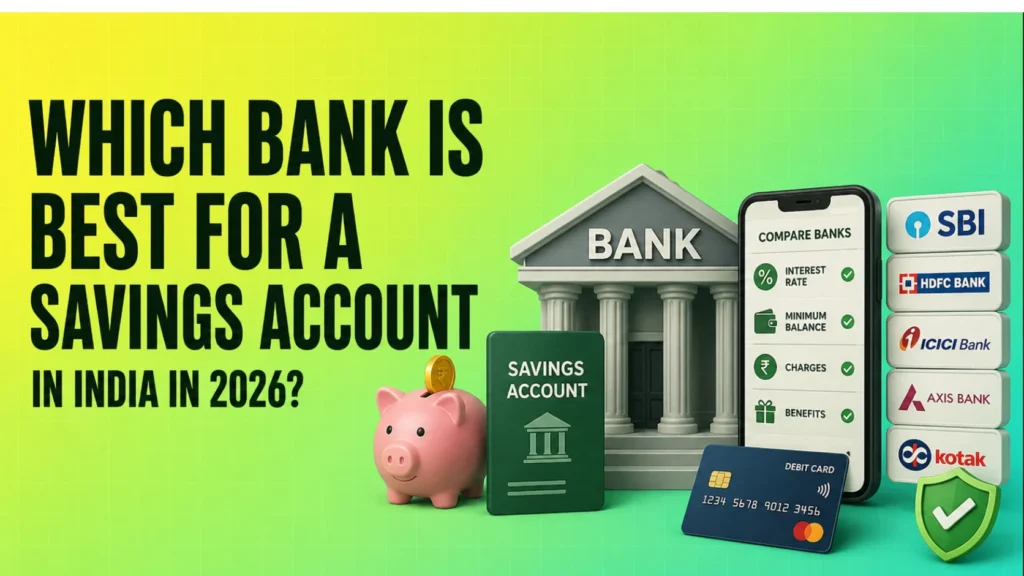
Which Bank Is Best for a Savings Account in India in 2026?
There is no single winner for every customer. Based on the current interest structure and common banking requirements, these are the most suitable options:
| Requirement | Suitable option | Why it stands out |
|---|---|---|
| Higher interest on balances above ₹3 lakh | IDFC FIRST Bank | Offers 6.50% on the portion above ₹3 lakh under its progressive structure |
| Better interest on balances up to ₹5 lakh | RBL Bank | Offers 3% on balances up to ₹5 lakh |
| Branch and ATM accessibility | SBI | Has an extensive physical banking network across India |
| Full-service private banking | HDFC Bank or ICICI Bank | Suitable for customers who want banking, cards, loans and investments in one relationship |
| Regular digital transactions | IDFC FIRST Bank or ICICI Bank | Strong digital account management and online service options |
| No minimum-balance requirement | A Basic Savings Bank Deposit Account | No mandatory minimum balance, although some service limitations may apply |
For an average salaried customer maintaining less than ₹3 lakh, choosing a bank only for interest may not make a major difference. Service quality, minimum-balance requirements and nearby branch access may matter more.
However, if you consistently maintain more than ₹3 lakh, IDFC FIRST Bank currently offers a stronger interest advantage than the large banks included in this comparison.
Savings Account Interest Rates Compared
The following table compares current rates advertised by selected Indian banks.
| Bank | Savings account interest rate | Interest structure | Interest credit |
|---|---|---|---|
| SBI | 2.50% | Same rate across balances | As per bank policy |
| HDFC Bank | 2.50% | Same rate across balances | Quarterly |
| ICICI Bank | 2.50% | Same rate across balances | As per bank policy |
| Axis Bank | 2.50% for normal retail balances | Same rate below ₹2,000 crore | Quarterly, depending on account |
| Kotak Mahindra Bank | 2.50% | Same rate across balances | As per bank policy |
| IDFC FIRST Bank | 2.50% to 6.50% | Progressive slabs | Monthly |
| RBL Bank | 3% to 6% for balances up to ₹7.5 crore | Progressive slabs | Monthly |
Rates are calculated on the daily closing balance. However, the higher slab rate may apply only to the portion of money falling within that slab.
For example, IDFC FIRST Bank does not pay 6.50% on the complete ₹5 lakh balance. The first ₹3 lakh earns 2.50%, while the remaining ₹2 lakh earns 6.50%.
This distinction is important because the maximum rate displayed in an advertisement may not be the effective rate earned on your complete balance.
Which Bank Should You Choose for Your Balance?
Balance below ₹1 lakh
Among the banks compared, RBL Bank offers 3%, while SBI, HDFC Bank, ICICI Bank, Axis Bank, Kotak Mahindra Bank and IDFC FIRST Bank offer 2.50% on this balance range.
On a constant ₹1 lakh balance, the difference between 3% and 2.50% is only around ₹500 a year before tax. Therefore, it may not be worth changing banks if the alternative account has:
- A higher minimum-balance requirement
- Debit-card or account-maintenance charges
- Limited branch access in your area
- Less convenient customer support
For a small balance, convenience and charges should receive more weight than a 0.50% rate difference.
Balance between ₹1 lakh and ₹3 lakh
RBL Bank remains ahead on interest at 3%, while most large banks continue to offer 2.50%.
However, the annual difference remains limited. On a ₹3 lakh balance, 3% produces approximately ₹9,000, compared with ₹7,500 at 2.50%. The difference is ₹1,500 before tax.
Choose RBL Bank only after checking the minimum balance and service charges for the specific account variant. Otherwise, SBI or an existing private bank relationship may remain more convenient.
Balance above ₹3 lakh
IDFC FIRST Bank becomes more competitive after the balance crosses ₹3 lakh. Its current progressive structure provides:
- 2.50% on the first ₹3 lakh
- 6.50% on the portion above ₹3 lakh and up to ₹25 crore
At a ₹5 lakh balance, the first ₹3 lakh earns approximately ₹7,500 annually, while the next ₹2 lakh earns approximately ₹13,000. The total estimated interest is ₹20,500 before tax.
This is significantly higher than the approximately ₹12,500 earned at a flat rate of 2.50%.
Therefore, IDFC FIRST Bank is currently one of the stronger choices for people who regularly maintain more than ₹3 lakh and are comfortable meeting the account’s average monthly balance requirement.
Balance above ₹10 lakh
IDFC FIRST Bank continues to provide a higher estimated return among the banks compared. RBL Bank also becomes more competitive because the portion between ₹5 lakh and ₹10 lakh earns 5%, while the portion above ₹10 lakh can earn 6%, subject to its current slabs.
However, keeping a very large amount in a savings account may not always be efficient. Money that is not needed immediately may earn better returns through an auto-sweep fixed deposit or another suitable low-risk option.
You can read this detailed comparison of FD or RD for idle money before moving surplus funds out of your savings account. A liquid mutual fund for short-term money parking may also be considered, but it is market-linked and does not offer the same certainty or deposit insurance as a bank account.
How Much Interest Can You Actually Earn?
The following estimates assume that the same balance is maintained throughout the year. They exclude tax and any account charges.
| Average balance | Banks offering a flat 2.50% | IDFC FIRST Bank | RBL Bank |
|---|---|---|---|
| ₹50,000 | ₹1,250 | ₹1,250 | ₹1,500 |
| ₹1 lakh | ₹2,500 | ₹2,500 | ₹3,000 |
| ₹3 lakh | ₹7,500 | ₹7,500 | ₹9,000 |
| ₹5 lakh | ₹12,500 | ₹20,500 | ₹15,000 |
| ₹10 lakh | ₹25,000 | ₹53,000 | ₹40,000 |
These figures show why a bank should be compared at your actual balance rather than by looking only at the highest advertised rate.
Monthly interest credit may provide slightly better compounding than quarterly credit. However, the applicable rate and balance slab have a much greater impact on your final return.
Best Bank for Salary and Everyday Transactions

A salary account should be selected based on transaction convenience rather than interest alone. Important factors include:
- Whether it remains zero balance while salary is credited
- What happens if salary credits stop
- ATM availability near your home and workplace
- UPI, IMPS and net-banking reliability
- Debit-card charges
- Customer support and complaint resolution
- Access to pre-approved banking products
A salary account is generally opened for personal transactions. Business owners and self-employed professionals should first understand the differences between a savings account and current account before selecting an account type.
SBI is a practical option for people who regularly use branches, deposit cash or live outside major cities.
HDFC Bank, ICICI Bank and Axis Bank may suit users who want their salary account, credit card, investments and loans within the same banking relationship. However, all three currently offer 2.50% on standard retail savings balances, so the selection should be based on charges and service experience.
IDFC FIRST Bank may suit salaried customers who want digital banking and expect their account balance to remain above ₹3 lakh.
Best Option for a Zero-Balance Account
Customers who cannot maintain a regular average balance should consider a Basic Savings Bank Deposit Account rather than paying non-maintenance penalties.
A BSBDA does not require a minimum balance and provides essential services such as deposits, withdrawals and electronic credits. However, additional services or transaction limits may vary.
Before opening a zero-balance account, check:
- Number of free withdrawals
- Debit-card issuance and annual charges
- Cheque-book availability
- Cash-deposit conditions
- Branch transaction limits
- Whether another regular savings account can be held with the same bank
A regular account may offer better features if you can comfortably maintain its required balance. A zero-balance account is useful only when the waived balance requirement saves more than the value of any lost benefits.
Charges That Can Cancel Your Extra Interest
A higher rate is valuable only when the additional interest is greater than the annual cost of maintaining the account.
Check the following before applying:
- Average monthly or quarterly balance requirement
- Non-maintenance penalty
- Debit-card annual fee
- ATM charges after the free transaction limit
- Cash-deposit charges
- SMS alert charges
- Cheque-book fees
- Replacement debit-card charges
- Account closure fee
- Charges for branch-based transactions
Suppose one bank gives you ₹1,500 more interest annually but charges ₹600 for a debit card and ₹500 for failing to maintain the required balance. Your real advantage falls to only ₹400.
Use this calculation:
Actual benefit = Interest earned − account-related charges
This gives a more realistic result than comparing interest rates alone.
Is It Safe to Keep More Than ₹5 Lakh in One Bank?
You can legally keep more than ₹5 lakh in a savings account. However, deposit insurance should be considered when storing a large emergency fund.
DICGC currently insures eligible deposits up to ₹5 lakh per depositor per bank, including principal and interest, when held in the same right and capacity.
Deposits covered under this limit can include:
- Savings account balances
- Current account balances
- Fixed deposits
- Recurring deposits
These deposits are generally combined when calculating insurance coverage at the same bank.
For example, if you hold ₹3 lakh in a savings account and ₹4 lakh in a fixed deposit at the same bank in the same capacity, the combined amount is ₹7 lakh. The applicable DICGC protection remains limited to ₹5 lakh.
People holding a large amount for emergencies may consider dividing deposits between insured banks. The bank’s stability, service quality and suitability should still be evaluated rather than selecting accounts only to increase deposit coverage.
Final Verdict
The best choice depends on the balance you normally maintain:
| Your requirement | Recommended option | Alternative |
|---|---|---|
| Balance below ₹1 lakh | Existing convenient bank or RBL Bank | SBI |
| Balance between ₹1 lakh and ₹3 lakh | RBL Bank for interest | SBI or an existing private bank |
| Balance above ₹3 lakh | IDFC FIRST Bank | RBL Bank |
| Extensive branch access | SBI | Bank of Baroda |
| Full-service private banking | HDFC Bank or ICICI Bank | Axis Bank |
| Zero-balance banking | BSBDA from an accessible bank | Eligible zero-balance digital account |
| Large emergency fund | Multiple suitable insured banks | Savings account with auto-sweep facility |
For most customers maintaining a modest balance, SBI, HDFC Bank, ICICI Bank, Axis Bank and Kotak Mahindra Bank offer similar interest. The better choice will depend on charges, nearby branches and digital service.
For balances above ₹3 lakh, IDFC FIRST Bank currently offers the strongest interest potential among the banks compared. RBL Bank can provide better interest on balances below ₹3 lakh, but the account’s balance requirements and charges must be checked before applying.
Avoid opening several accounts only for temporary offers. Unused accounts can eventually become inactive, so it is important to know how to prevent your bank account from becoming dormant.
Always verify the latest rate and schedule of charges on the bank’s official website. Savings account rates are variable and may change after the account is opened.
FAQs
Which bank gives the highest savings account interest rate in India in 2026?
Among the banks compared, IDFC FIRST Bank advertises interest of up to 6.50% under a progressive structure. The 6.50% rate applies only to the balance portion above ₹3 lakh and up to ₹25 crore. RBL Bank offers up to 6% on applicable higher balance slabs.
Which bank is best for a savings account below ₹1 lakh?
RBL Bank currently offers 3% on balances up to ₹1 lakh, compared with 2.50% at several large banks. However, the difference is approximately ₹500 annually on ₹1 lakh. Minimum-balance rules, charges and branch convenience may be more important than this rate difference.
Is SBI or HDFC Bank better for a savings account?
Both currently offer 2.50% on savings balances. SBI may be more suitable for customers who prioritise extensive branch and ATM access. HDFC Bank may suit customers who prefer a private banking relationship and use multiple banking products. Compare the applicable account charges before deciding.
Is IDFC FIRST Bank better than SBI for a savings account?
IDFC FIRST Bank can provide considerably higher interest when the balance exceeds ₹3 lakh. SBI may be more suitable for customers who need wider physical banking access or do not maintain a high balance. The better option depends on whether interest or branch convenience is your main priority.
Should I move my savings account for a 0.50% higher interest rate?
Not necessarily. A 0.50% difference adds only ₹500 annually on a ₹1 lakh balance. Switching may not provide meaningful value if the new account has higher balance requirements, debit-card charges or inconvenient customer support. Calculate the additional interest after deducting all likely fees.