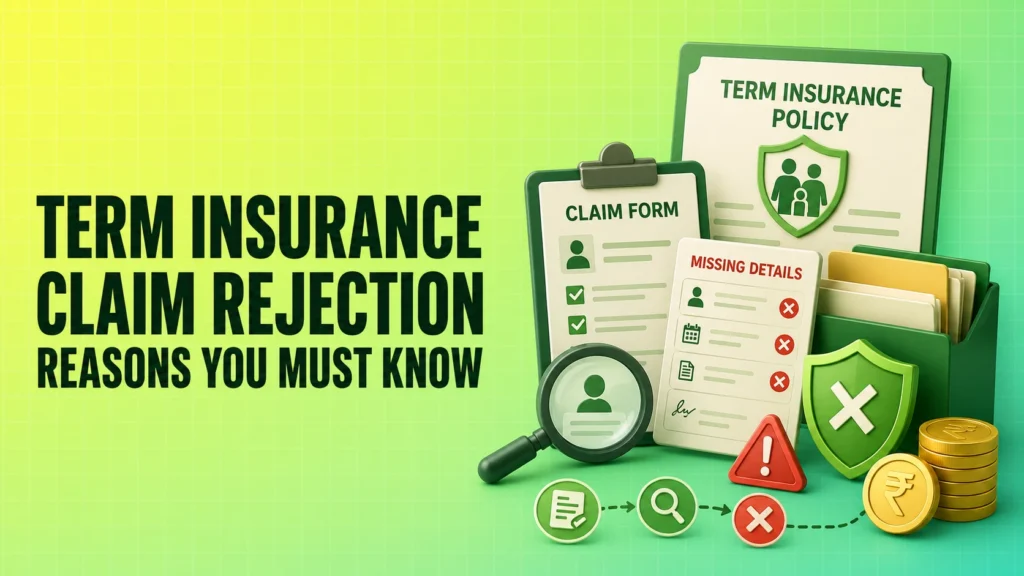
A term insurance plan is bought to protect the family financially after the policyholder’s death. But sometimes, the nominee does not receive the claim because the insurer rejects or delays it due to errors, missing documents, policy lapse, or wrong information in the policy application.
The most common term insurance claim rejection reasons include incorrect information, non-disclosure of medical history, unpaid premiums, incomplete claim documents, false lifestyle details, nominee mismatch, and policy exclusions. Bajaj Finserv also lists incorrect information, incomplete documentation, policy lapse, non-disclosure of medical history, and policy exclusions as common life insurance claim rejection reasons.
What Does Term Insurance Claim Rejection Mean?

Term insurance claim rejection means the insurer refuses to pay the death benefit to the nominee because the claim does not meet the policy terms or required conditions.
This can happen when:
- The policy was not active at the time of death
- The policyholder gave false or incomplete details
- The nominee submitted incomplete documents
- The death falls under policy exclusions
- There is fraud or material misrepresentation
In insurance reports, “rejected” and “repudiated” claims may have different meanings. IRDAI’s annual report notes that rejected claims are those that cannot be considered due to policy terms and conditions, while repudiated claims are connected with Section 45 of the Insurance Act, 1938.
1. Incorrect Information in the Application Form
One of the biggest term insurance claim rejection reasons is wrong information in the proposal form. When buying term insurance, the insurer asks for personal, financial, lifestyle, and health details.
Wrong details may include:
- Incorrect age
- Wrong income information
- False occupation details
- Incorrect smoking or drinking status
- Wrong address or identity details
- Hiding existing life insurance policies
Even a small mistake can create problems if it affects the insurer’s risk assessment. For example, if someone declares themselves as a non-smoker but later records show tobacco use, the insurer may investigate the claim.
2. Non-Disclosure of Medical History
Term insurance works on the principle of honest disclosure. If the policyholder hides health conditions while buying the policy, the claim may face rejection later.
Medical details that should be disclosed include:
- Diabetes
- High blood pressure
- Heart disease
- Kidney or liver disease
- Cancer history
- Past surgeries
- Long-term medication
- Hospitalisation history
- Mental health treatment, if asked in the proposal form
Many people hide medical history to get a lower premium or avoid medical tests. This is risky because insurers can verify hospital records, past treatment details, and medical reports during claim investigation.
3. Policy Lapse Due to Non-Payment of Premium
A term insurance policy remains active only when premiums are paid on time. If the premium is not paid even after the grace period, the policy may lapse.
A lapsed policy usually means:
- Life cover stops
- Nominee may not receive the death benefit
- Policy may need revival before coverage restarts
- Insurer may ask for health declaration or medical tests during revival
Bajaj Finserv also mentions policy lapse as a common reason for claim rejection because coverage ceases when the policy lapses.
To avoid this, use auto-debit, calendar reminders, or yearly premium payment if possible.
4. Incomplete Claim Documents
Even when the policy is valid, incomplete documents can delay or affect the claim process. The nominee must submit all required documents correctly.
Common documents required for a term insurance claim include:
- Claim form
- Death certificate
- Original or copy of policy document
- Nominee ID proof
- Nominee address proof
- Bank account details
- Medical records, if death happened due to illness
- Hospital discharge summary, if applicable
- FIR, post-mortem report, or police report in accidental death cases
If documents are missing, unclear, or mismatched, the insurer may ask for more proof. In some cases, the claim may be rejected if the nominee fails to provide valid documents.
5. Hiding Smoking, Alcohol, or Risky Lifestyle Habits
Smoking, tobacco use, alcohol consumption, and risky lifestyle habits affect term insurance premiums. If a person hides these details while buying the policy, it can become a serious issue at claim time.
For example:
- A smoker declares himself as a non-smoker
- A regular alcohol user hides drinking history
- A person with risky hobbies does not disclose them
- A person working in a hazardous job gives wrong occupation details
Term insurance companies calculate premium based on risk. If the risk was hidden, the insurer may question the claim.
6. Death Due to Policy Exclusions
Every term insurance plan has exclusions. If death happens due to an excluded condition, the claim may be rejected.
Common exclusions may include:
- Suicide within the initial policy period, depending on policy terms
- Death due to criminal activity
- Death due to participation in hazardous activities
- Death related to war or terrorism, if excluded
- Death due to false or hidden information
Bajaj Finserv also highlights suicide within the first policy year, hazardous activities, and war or terrorism as examples of common exclusions in life insurance policies.
Policy exclusions are different for different insurers, so the nominee and policyholder should read the policy wording carefully.
7. Wrong or Missing Nominee Details
Nominee details are very important in term insurance. If the nominee information is missing, outdated, or incorrect, the claim process can become complicated.
Common nominee-related issues include:
- No nominee added in the policy
- Wrong nominee name
- Nominee’s date of birth mismatch
- Nominee not aware of the policy
- Nominee does not have required documents
- Policyholder forgot to update nominee after marriage, divorce, or death of nominee
This may not always lead to direct rejection, but it can delay the claim and create legal complications.
8. False Income or Occupation Details
Term insurance coverage is usually linked with income and financial eligibility. If the policyholder gives false income details to get a higher cover, the insurer may investigate it later.
Occupation also matters because some jobs carry higher risk. For example, people working in mines, aviation, defence-related hazardous roles, or high-risk industrial jobs may need proper disclosure.
If occupation or income was wrongly declared, the insurer may treat it as misrepresentation.
9. Claim Filed During Contestability Period
In India, Section 45 of the Insurance Act, 1938 is important for life insurance claims. It says a life insurance policy cannot be called into question after three years from the later of policy issuance, commencement of risk, revival, or rider date. Within the first three years, the insurer can question the policy on grounds such as fraud or material misstatement, but it must communicate the reasons in writing.
This means early claims are often checked more carefully. If death happens soon after buying the policy, the insurer may investigate medical records, proposal details, income proof, and lifestyle declarations.
10. Fraud or Intentional Misrepresentation
Fraud is one of the most serious term insurance claim rejection reasons. It happens when the policyholder intentionally hides or changes important facts to get the policy issued.
Examples include:
- Fake medical reports
- False income documents
- Wrong identity documents
- Hiding major illness
- Giving false smoking status
- Buying policy after diagnosis but hiding it
- Fake death claim documents
If fraud is proven, the insurer can reject the claim. Section 45 also explains fraud and concealment of material facts in relation to life insurance policies.
Term Insurance Claim Rejection vs Claim Delay
Claim rejection and claim delay are not the same.
| Point | Claim Delay | Claim Rejection |
|---|---|---|
| Meaning | Claim is under process | Claim is refused |
| Common Cause | Missing documents or verification | Policy lapse, fraud, exclusion, non-disclosure |
| Can It Be Fixed? | Usually yes, by submitting documents | Possible only through appeal or grievance |
| Final Result | Claim may still be paid | Claim may not be paid unless dispute is resolved |
If the insurer asks for extra documents, it does not always mean the claim is rejected. The nominee should first understand whether the claim is pending, delayed, repudiated, or formally rejected.
How to Avoid Term Insurance Claim Rejection

Most term insurance claim rejection problems can be avoided if the policyholder is careful from the beginning.
Follow these steps:
- Fill the proposal form yourself or check it carefully before submission
- Disclose all medical conditions honestly
- Do not hide smoking, alcohol, or tobacco use
- Pay premiums on time
- Keep nominee details updated
- Inform family members about the policy
- Store policy documents safely
- Disclose existing life insurance policies
- Read exclusions before buying
- Choose adequate cover based on real income and family needs
The biggest mistake is buying term insurance only for low premium. A cheaper policy is not useful if the claim gets stuck later due to wrong information.
What to Do If Term Insurance Claim Is Rejected?
If the nominee receives a claim rejection letter, they should not panic. First, understand the exact reason.
Steps to follow:
- Read the rejection letter carefully
- Check the policy document and exclusion clause
- Collect missing documents or proof
- Contact the insurer’s claim department
- File a written complaint with the insurer’s grievance cell
- Keep copies of all emails, forms, and documents
- Escalate the complaint if the response is not satisfactory
Policyholders can also register complaints on IRDAI’s Bima Bharosa portal. IRDAI states that policyholders need to log in, create a profile, and register their complaint, after which details are passed to the concerned insurance company.
Conclusion
Term insurance claim rejection usually happens because of mistakes made during policy purchase or claim submission. Wrong information, hidden medical history, unpaid premiums, incomplete documents, nominee issues, and policy exclusions are the most common reasons.
The best way to protect your family’s claim is simple: be honest while buying the policy, pay premiums on time, update nominee details, and keep all documents ready. Term insurance is meant to give financial security to your family, so the policy should be clean, active, and properly documented.
FAQs Term Insurance Claim Rejection Reasons
Can a term insurance claim be rejected after 3 years?
Section 45 of the Insurance Act provides a three-year rule for questioning life insurance policies, counted from the later of policy issuance, commencement of risk, revival, or rider date. The exact claim situation depends on policy facts and applicable law.
Can non-disclosure of smoking cause claim rejection?
Yes, hiding smoking or tobacco use can create claim problems because it affects premium and risk assessment. Always disclose smoking habits correctly while buying term insurance.
What documents are required for a term insurance claim?
Common documents include claim form, death certificate, policy document, nominee ID proof, bank details, medical records, and FIR or post-mortem report in accidental death cases.
Does policy lapse always lead to claim rejection?
If the policy was lapsed at the time of death, the claim is usually not payable because the life cover was not active. However, the nominee should still check the policy status, grace period, and revival terms.
What should nominee do if the claim is rejected?
The nominee should read the rejection letter, collect supporting documents, contact the insurer’s grievance cell, and escalate the complaint through Bima Bharosa or the Insurance Ombudsman route if needed.