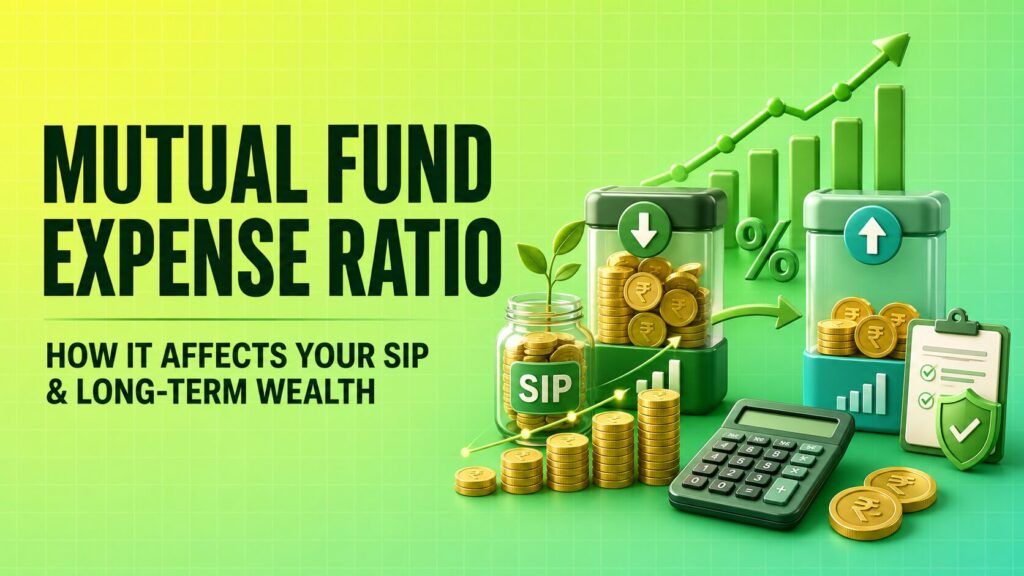
A small fee of 0.5% or 1% may not look like a big deal when you start a SIP. But over 10, 15, or 20 years, this small cost can silently reduce your final wealth by lakhs of rupees.
This cost is called Mutual Fund Expense Ratio. It is one of the most important charges every mutual fund investor should understand before investing. Many investors compare only past returns, ratings, and fund names, but they ignore expense ratio. That mistake can reduce long-term SIP returns.
What Is Mutual Fund Expense Ratio?
Mutual Fund Expense Ratio is the annual cost charged by a mutual fund house to manage and operate a mutual fund scheme.
It includes expenses such as fund management fee, administrative cost, registrar cost, custodian charges, audit cost, compliance cost, and distribution-related cost.
The important thing is that investors do not pay this charge separately. It is adjusted from the fund’s Net Asset Value, also called NAV. AMFI explains that TER is calculated as a percentage of the scheme’s average NAV, and the daily NAV is disclosed after deducting expenses.
The basic formula is:
Expense Ratio = Total Fund Expenses / Average Assets × 100
For example, if a mutual fund has an expense ratio of 1%, it means the fund charges around 1% annually from the fund’s assets to manage the scheme.
How Mutual Fund Expense Ratio Works

Suppose you invest ₹1,00,000 in a mutual fund with a 1% expense ratio.
This does not mean the AMC will directly ask you to pay ₹1,000 separately. Instead, this cost is adjusted inside the fund’s NAV.
So, if the fund earns returns, the published NAV already shows returns after deducting the expense ratio.
This is why many investors do not notice the cost. But even though it is not visible as a separate bill, it still affects your actual returns.
Why Mutual Fund Expense Ratio Matters More in SIP
SIP investors invest every month for many years. Because SIP is a long-term wealth-building method, even a small cost difference can become large due to compounding.
When the expense ratio is lower, more money remains invested in the fund. When the expense ratio is higher, a larger portion of the fund’s return goes toward cost.
For short-term investors, the difference may look small. But for long-term SIP investors, the impact becomes much bigger.
For example, if two similar funds generate the same gross return but one has a lower expense ratio, the low-cost fund may create a higher final corpus over time.
SIP Example: How Expense Ratio Impacts Long-Term Corpus
Let’s take an example.
Assume a mutual fund earns 12% annual return before expenses. Now compare two expense ratios: 0.5% and 1.5%.
| Monthly SIP | Gross Return Before Cost | Expense Ratio | Approx Net Return | Time | Approx Final Corpus |
|---|---|---|---|---|---|
| ₹5,000 | 12% | 0.5% | 11.5% | 20 years | ₹46.25 lakh |
| ₹5,000 | 12% | 1.5% | 10.5% | 20 years | ₹40.52 lakh |
| ₹10,000 | 12% | 0.5% | 11.5% | 20 years | ₹92.51 lakh |
| ₹10,000 | 12% | 1.5% | 10.5% | 20 years | ₹81.05 lakh |
In this example, a ₹5,000 monthly SIP can create a difference of around ₹5.73 lakh over 20 years.
For a ₹10,000 monthly SIP, the difference can be around ₹11.46 lakh.
These numbers are only for understanding. Mutual fund returns are market-linked and not guaranteed. But the example clearly shows how Mutual Fund Expense Ratio can affect long-term wealth.
Direct Plan vs Regular Plan Expense Ratio
Mutual funds usually have two plan options: direct plan and regular plan.
A direct plan is purchased directly from the AMC or investment platform without a distributor. A regular plan is purchased through a distributor or advisor.
AMFI states that direct plans have lower expense ratios than regular plans because there is no distributor or agent involved, and the saving in distribution cost is added back to the scheme’s returns. Direct plans also have separate NAVs, which are usually higher than regular plans.
| Point | Direct Mutual Fund | Regular Mutual Fund |
|---|---|---|
| Expense ratio | Lower | Higher |
| Distributor commission | Not included | Included |
| NAV | Usually higher | Usually lower |
| Returns | Usually higher than regular plan of same scheme | Usually lower than direct plan of same scheme |
| Suitable for | DIY investors | Investors who need advisor support |
If you understand mutual funds and can choose funds yourself, direct plans may help reduce cost. But if you need proper guidance, portfolio review, and behavioral support, a regular plan with a good advisor may still be useful.
How Expense Ratio Affects NAV
NAV is the price of one mutual fund unit. Expense ratio is adjusted before NAV is published.
That means the NAV you see is already after deducting fund expenses.
For example, if two funds have similar portfolios and similar gross returns, the fund with lower expense ratio may show better NAV growth over time.
This is why expense ratio should be checked before investing, especially when comparing two funds from the same category.
Is Lower Expense Ratio Always Better?
No, lower expense ratio is good, but it is not the only factor.
A fund with a low expense ratio is not automatically the best fund. Similarly, a fund with a slightly higher expense ratio is not always bad.
You should compare expense ratio with:
- Fund category
- Past consistency
- Benchmark performance
- Risk level
- Portfolio quality
- Fund manager track record
- Investment objective
- Your time horizon
For example, an index fund should usually have a low expense ratio because it simply tracks an index. But an actively managed small-cap fund may have a higher expense ratio because fund management requires more research and active decisions.
The right approach is to compare funds within the same category.
What Is a Good Mutual Fund Expense Ratio?
There is no single “good” expense ratio for all funds.
A good expense ratio depends on the type of mutual fund.
Index funds and ETFs usually have lower expense ratios because they are passively managed.
Actively managed equity funds usually have higher expense ratios because the fund manager actively selects stocks.
Debt funds should be checked more carefully because their return potential is generally lower than equity funds. A high expense ratio in debt funds can reduce net returns more visibly.
So, instead of asking “What is the lowest expense ratio?”, ask:
Is this expense ratio reasonable for this fund category and performance?
Expense Ratio in Equity Funds vs Debt Funds
In equity funds, the return potential is higher, so investors sometimes accept a slightly higher expense ratio if the fund consistently beats its benchmark.
But this does not mean high cost is always justified. If an equity fund charges high expenses but fails to beat its benchmark over time, investors should review it carefully.
In debt funds, expense ratio matters even more because returns are usually lower. If a debt fund earns 6% to 7% and charges a high expense ratio, the net return can reduce meaningfully.
For conservative investors, debt fund costs should be checked before investing.
Components of Mutual Fund Expense Ratio
Mutual Fund Expense Ratio may include different operating and management costs.
Common components are:
| Component | Meaning |
|---|---|
| Fund management fee | Paid for managing the fund portfolio |
| Administrative cost | Day-to-day operational expenses |
| Registrar cost | Investor record and transaction management |
| Custodian cost | Safekeeping of securities |
| Audit and compliance cost | Legal, audit, and regulatory expenses |
| Distribution cost | Cost related to regular plans and distributors |
These costs together form the total expense ratio of the fund.
How to Check Mutual Fund Expense Ratio Before Investing
You should always check the expense ratio before starting a SIP.
You can check it through:
- Mutual fund factsheet
- AMC website
- AMFI TER disclosure page
- Investment platform fund details
- Scheme information document
AMFI also provides a TER disclosure section where investors can check the Total Expense Ratio of mutual fund schemes.
Before investing, compare:
- Direct plan expense ratio
- Regular plan expense ratio
- Same category funds
- Index fund vs active fund cost
- Current expense ratio and recent changes
Do not compare a small-cap fund’s expense ratio with a liquid fund. Always compare within the same category.
Common Mistakes Investors Make
Many investors ignore expense ratio because it looks small. But in long-term SIP investing, this can be a costly mistake.
Common mistakes include:
- Choosing a fund only because expense ratio is low
- Ignoring direct plan vs regular plan difference
- Comparing funds from different categories
- Looking only at past returns
- Ignoring benchmark performance
- Not checking debt fund expense ratio
- Forgetting exit load and taxation
- Assuming high expense ratio means better fund management
A smart investor looks at cost, return, risk, and consistency together.
When Should You Avoid a High Expense Ratio Fund?
You should be careful with a high expense ratio fund when:
- The fund is underperforming its benchmark
- Similar funds are available at lower cost
- The fund’s risk is high but returns are weak
- The fund is a debt fund with low return potential
- The regular plan cost is reducing SIP returns
- The fund is not giving enough extra return to justify the cost
A high expense ratio can be acceptable only when the fund consistently delivers value after costs.
Simple Rule for SIP Investors

For SIP investors, the best rule is simple.
Choose a mutual fund where:
- Expense ratio is reasonable
- Fund performance is consistent
- Risk matches your goal
- Fund category matches your time horizon
- Portfolio quality is strong
- Fund is not selected only because of past returns
- Direct plan is considered if you can invest without advisor support
Mutual Fund Expense Ratio should not be the only decision factor, but it should never be ignored.
Final Thoughts
Mutual Fund Expense Ratio may look like a small percentage, but it can have a big impact on your SIP and long-term wealth.
A lower expense ratio helps more of your money stay invested. Over many years, this can improve your final corpus. But the cheapest fund is not always the best fund.
The right way is to compare expense ratio with performance, risk, benchmark, fund category, and your financial goal.
For long-term SIP investors, even a small cost saving can become a big wealth difference.