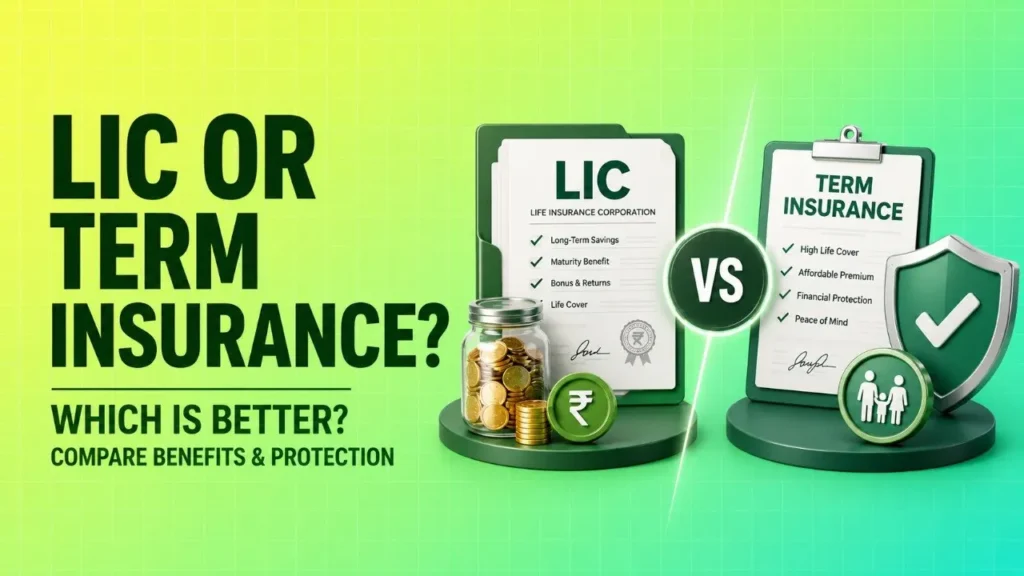
Many Indian buyers get stuck on the same question: lic or term insurance which is better? The confusion is understandable because both are sold under the broad label of life insurance, but they serve very different purposes. One is mainly about pure protection; the other often mixes insurance with savings.
If your main goal is to protect your family from financial stress after your death, term insurance is usually the cleaner option. If you want a plan that may give money back on maturity and you are comfortable with lower life cover for a higher premium, traditional LIC plans such as endowment or money-back policies may feel more familiar. The better choice depends on what you want your money to do.
Before comparing products, one important principle should be clear: insurance is a risk-mitigation tool, not a wealth-creation tool. The more clearly you separate protection from investing, the easier it becomes to judge value.
The Core Difference: Pure Protection vs. Investment-Linked Insurance
The simplest way to understand the difference is this: term insurance is protection-only, while many traditional LIC plans combine protection with a built-in savings element. That means the way your premium is used is different in both products.
In a term plan, most of what you pay goes toward covering the risk of death during the policy term. If the insured person dies during the policy period, the nominee receives the sum assured. If the policyholder survives the term, there is usually no maturity payout unless the plan has a return-of-premium feature.
In an endowment or money-back plan, part of the premium goes toward insurance cover and part goes toward building a maturity value. This is why these plans often feel like a bundle: they provide some protection and some savings, but usually neither component is as strong as a standalone product.
Think of it as protection vs. bundle. A term plan focuses on giving the highest possible cover for the least cost. A traditional LIC plan tries to combine a small insurance cover with forced savings. The trade-off is lower cover and lower flexibility.
Term Insurance: Why It Is Generally Recommended
Term insurance is generally recommended because it gives a very high sum assured at a relatively low premium. For most families, that combination is the main purpose of life cover: replacing income if the earning member is no longer around.
For example, a healthy young adult may be able to buy ₹1 crore or more of term cover at a premium that is far lower than the premium for a traditional savings-linked plan. The exact premium depends on age, health, smoking status, policy term, sum assured, and insurer underwriting rules.
This low-cost structure exists because term insurance does not try to do too much. There is usually no maturity benefit, no savings pool, and no market-linked return promise. That may sound like a disadvantage at first, but it is the reason the cost of protection is so efficient.
For someone with dependents, this efficiency matters. If you have a spouse, children, ageing parents, or a home loan, your life cover should ideally be large enough to help the family repay liabilities and replace lost income. Term insurance is designed for that purpose.
Another useful way to look at it is through opportunity cost. If you lock a large premium into a traditional plan for a modest cover, you may lose the chance to invest the difference elsewhere, such as in a diversified mutual fund SIP or other suitable long-term investment options. Of course, any investment should be chosen based on your risk profile and goals.
The main limitation of term insurance is simple: if you survive the policy term, you do not usually get the premium back. But that is not a flaw; it is the design that makes the cover affordable.
LIC Traditional Plans (Endowment/Money-Back): What Are They?
Traditional LIC plans such as endowment and money-back policies are life insurance products that promise a payout either on death during the policy term or on maturity if you survive the term. In money-back plans, a portion of the benefit may be paid during the policy term in instalments, while the balance is paid at maturity.
These plans are often chosen by people who like the idea of a disciplined, long-term savings habit. The premium is usually fixed, and the policy creates a sense of commitment. For some households, that psychological structure is useful.
However, the key trade-off is coverage. For the same premium, the life cover in a traditional plan is usually much lower than in a term plan. That means if your real priority is family protection, you may not be getting enough cover.
Traditional LIC plans also tend to offer modest returns compared with what many people expect from long-term market-based investments. The final amount may include bonus additions, but these are not the same as market-linked growth and should not be treated like a high-return investment product.
Another point to remember is liquidity. These policies may have surrender values after a certain period, but surrendering early can reduce the benefit significantly. Under current IRDAI-linked product rules, surrender value treatment is an important feature to read carefully in the policy document, because the exact amount and conditions can vary by product and policy year.
LIC vs. Term Insurance
The comparison below shows the core difference more clearly. The figures are illustrative, because actual premium and cover depend on age, health, policy term, plan type, and insurer rules.
| Factor | Term Insurance | LIC Endowment Plan |
|---|---|---|
| Cost (Premium) | Low | High |
| Sum Assured | Very high | Low to moderate |
| Maturity Benefit | None in most plans | Guaranteed sum plus possible bonus, depending on policy |
| Primary Goal | Family protection | Forced savings with limited cover |
| Liquidity | Low | Moderate, subject to surrender rules and loan conditions |
| Return Pattern | No maturity return unless return-of-premium option is chosen | Usually modest and not market-linked |
To make the difference more concrete, here is an illustrative comparison box.
| Illustrative Annual Premium | Term Insurance Cover | Endowment / Traditional LIC Cover |
|---|---|---|
| ₹15,000 | About ₹1 crore for a healthy 30-year-old in some cases | Often much lower, such as ₹5 lakh to ₹10 lakh, depending on plan and age |
Illustrative figures only. Actual premiums vary based on age, health, smoking habits, policy term, sum assured, and policy terms. Always check the insurer’s benefit illustration and official documents.
Evaluating Your Needs: Which One Is For You?
The right answer depends on your life stage, responsibilities, and budget. A product that looks attractive in isolation may not be suitable if it does not solve your actual problem.
If you have dependents and liabilities, term insurance should usually be your first priority. This includes situations such as:
- You have a spouse, children, or dependent parents.
- You have a home loan, education loan, or other major debts.
- Your family depends on your income for monthly expenses.
- You want maximum cover at the lowest possible premium.
If you are looking for a long-term, low-risk savings habit and are comfortable with modest returns, a traditional LIC endowment plan may be worth evaluating. This can suit people who prefer a built-in discipline mechanism and are not looking for high growth.
Still, it is important to be honest about the trade-off. If the same budget can buy much larger protection through term insurance, you should ask whether the savings element is worth the lower cover. In many cases, the answer is no.
Why Keeping Insurance and Investment Separate is Usually Better
One of the smartest personal finance ideas is unbundling. This means you do not force one product to do two very different jobs. Insurance should cover risk. Investments should build wealth.
When you separate them, the purpose of each rupee becomes clearer. A term plan gives you high protection. A mutual fund SIP or other suitable investment can potentially grow wealth over time, subject to market risk. The two are different tools for different jobs.
This approach also improves transparency. With a traditional insurance-cum-savings plan, it can be hard to see how much is going toward pure protection, how much is going toward charges, and how much is actually building value. In a standalone term plan, the cost of protection is easier to understand.
That does not mean every bundled plan is bad. It simply means you should compare it honestly with the alternative: term insurance plus separate investing. For many households, that combination offers better cover and better long-term flexibility.
Important Factors to Check Before Buying
Regardless of whether you choose term insurance or a traditional LIC plan, do not buy based only on brand familiarity. Read the policy documents carefully and check the details that actually affect claims and benefits.
- Claim settlement ratio: Look at the insurer’s recent claim settlement record, but also read the claim process and documentation requirements.
- Exclusions: Check what the policy does not cover, such as certain pre-existing conditions, early waiting periods, suicide exclusion rules, or death due to listed exclusions.
- Medical underwriting: Premium and approval depend on age, health, lifestyle, and disclosures. Be accurate in the application.
- Benefit illustration: Study this document to understand premium, bonuses if any, maturity value, and assumptions used in the policy projection.
- Surrender and loan rules: If the plan allows surrender or policy loans, understand the timing, charges, and possible reduction in benefits.
It is also worth checking whether the policy wording matches your expectation. In insurance, small wording differences matter. A plan can look attractive in a brochure and still perform very differently in the actual policy document.
Remember that insurance claims depend on policy terms, exclusions, waiting periods, and insurer rules. Always verify the latest information from the insurer’s website and official IRDAI-related disclosures where relevant.
Helpful Interactive Tool: Premium vs. Coverage Visual
The visual below shows why many people choose term insurance when they compare pure protection with traditional LIC-style savings plans. It is not a quote, but a simple way to understand the coverage gap.
| For ₹15,000 per year | Typical Outcome |
|---|---|
| Term Insurance | Can provide very high cover, such as around ₹1 crore for a healthy young adult in some cases |
| Endowment / Traditional LIC Plan | Usually offers far lower cover, often in the ₹5 lakh to ₹10 lakh range, depending on the policy |
Illustrative figures only. Actual premiums and coverage vary by age, health, policy term, plan type, and insurer rules. Always read the benefit illustration and policy wording before buying.
For most beginners, this is the “aha” moment. The same budget can buy dramatically different levels of protection. If the goal is to protect a family from financial shock, that difference is hard to ignore.
Final Takeaway Before You Decide
If your question is strictly about protection value, term insurance is usually better. It gives high life cover at low cost, which makes it ideal for income replacement and family security.
If your preference is for a combined savings-and-insurance structure, traditional LIC plans can still have a place, especially for people who value discipline and are clear about the lower cover and lower flexibility. But they should not be mistaken for a high-return investment product.
The cleanest way to decide is to ask three questions: What is my family’s protection need? What liabilities do I have? Do I want insurance and investment in one product, or do I want each product to do one job well?
Tax note: Life insurance premiums may qualify for tax benefits under Section 80C, and maturity proceeds may be tax-exempt under Section 10(10D) if conditions are met. Tax rules can change, so verify the latest provisions from the Income Tax Department or a qualified tax professional.
Disclosure: Insurance is a subject matter of solicitation. Please read all policy terms, exclusions, and benefit illustrations carefully before purchase.
FAQ
Is term insurance a waste of money if I survive?
No. Term insurance is bought for protection, not for savings. If you survive, it means the risk did not occur during the policy term, which is exactly what you hoped for. The value comes from financial security for your family during the risk period.
Can I have both term insurance and LIC plans?
Yes, you can hold both if your budget allows. A common approach is to prioritise term insurance for strong protection and then add an LIC traditional plan only if you still want a savings-linked policy.
Do I get tax benefits on both?
In many cases, life insurance premium payments may qualify for deductions under Section 80C, and maturity proceeds may be exempt under Section 10(10D) if the policy meets the applicable conditions. Tax rules can change, so check the latest law before relying on the benefit.
Which one is better for a young earner?
For most young earners, term insurance is the better first choice because premiums are usually lower at a younger age and the cover amount can be much higher. After that, investing separately may give better flexibility.
Does LIC offer term insurance?
Yes. LIC also offers term insurance products, which are different from traditional endowment or money-back plans. If you want pure protection, look at LIC’s term products rather than only the savings-linked plans.