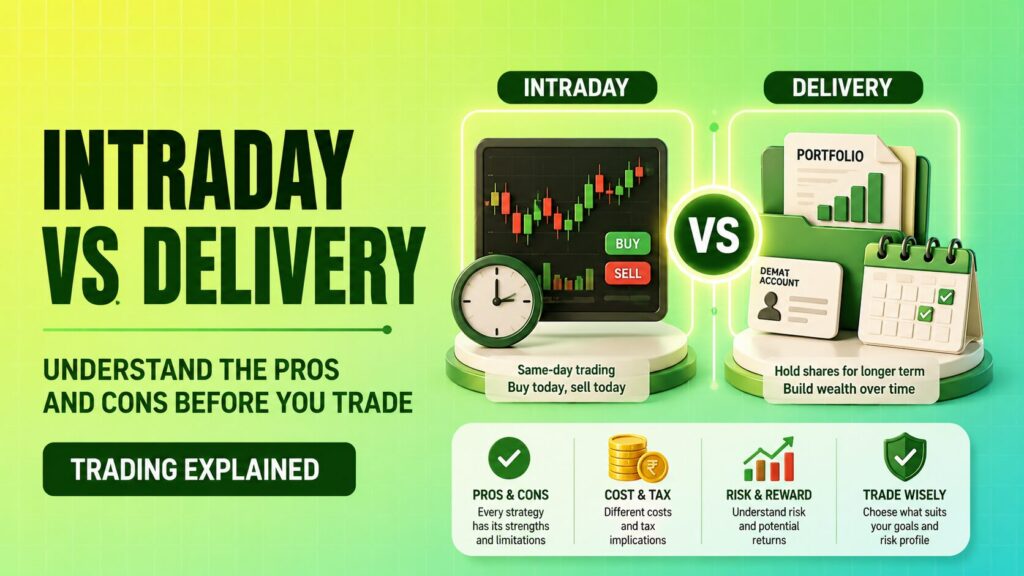
When people talk about buying stocks, they usually mean one of two very different actions: making a quick trade for a small price move, or buying a business and holding it for the long run. That is the real practical difference in Intraday vs Delivery. One is a high-risk trading style that needs discipline and fast decisions. The other is a calmer investment approach built around patience and ownership.
If you are new to the stock market, it helps to understand this difference before placing your first order. Intraday trading can look exciting because money moves quickly, but it also exposes you to sharp losses. Delivery buying is slower, but it gives you actual ownership of shares and is often better suited for beginners who want to build wealth over time.
Important: Both intraday and delivery involve market risk. Stock prices can rise or fall, and no approach guarantees profit. If you are unsure, review the latest rules from SEBI, NSE, BSE, and the Income Tax Department before you trade or invest.
What is Intraday Trading?
Intraday trading means buying and selling a stock on the same trading day. The goal is to profit from short-term price movement, not from long-term ownership. Since the trade is closed before the market ends, the shares do not get credited to your Demat account as a regular holding.
In simple words, you are not buying the company to keep it. You are trying to take advantage of small price changes during market hours. If the position is not squared off by the broker or trader before the closing time, it may be auto-squared off based on broker rules and risk controls.
Intraday trading often uses margin or leverage, which means you may control a larger position with a smaller amount of money. That can increase gains, but it can also increase losses very quickly. For that reason, intraday should never be treated like a shortcut to easy money.
What is Delivery Trading?
Delivery trading means buying shares and taking actual ownership of them. Once the trade settles, the shares are credited to your Demat account and you can hold them for as long as you want, subject to market risk and your financial goals.
You can keep delivery shares for a few days, months, or even years. This is the method most investors use when they want to build wealth patiently through good businesses, compounding, and long-term market growth. Delivery is generally more suitable for beginners because it does not require constant monitoring or the pressure of same-day price movement.
For many Indian investors, delivery is the cleaner and more understandable way to start in the stock market. You know what you own, why you own it, and you are not forced to exit the same day.
Intraday vs Delivery Comparison Table
| Feature | Intraday | Delivery |
|---|---|---|
| Holding period | Same trading day only | Can be held for days, months, or years |
| Ownership | No delivery of shares to Demat for holding | Shares are credited to your Demat account |
| Risk | Higher risk due to price swings and leverage | Market risk exists, but no same-day square-off pressure |
| Capital required | Lower upfront amount may be enough because of margin | Full share value is usually needed for purchase |
| Margin funding | Commonly available, subject to broker and SEBI rules | Generally not used for standard delivery buying |
| Taxation | Usually treated as speculative business income | Usually taxed as capital gains, depending on holding period |
Note: Tax rules are subject to change under the Income Tax Act. Consult a CA or tax professional for personal tax advice.
Key Differences Between Intraday and Delivery
The biggest difference is ownership. In intraday, you are trading price movement. In delivery, you are buying the shares themselves. That one difference changes almost everything else: risk, time commitment, margin use, and taxation.
- Time: Intraday needs active monitoring. Delivery needs patience.
- Risk: Intraday is more volatile and can move against you fast. Delivery still has market risk, but you are not forced to exit the same day.
- Capital: Intraday may allow smaller upfront exposure through margin. Delivery usually needs full payment.
- Mindset: Intraday demands speed and discipline. Delivery rewards long-term thinking and research.
- Goal: Intraday is for short-term price moves. Delivery is for ownership and compounding.
For beginners, this difference matters more than most people realize. Many new traders enter intraday with a “get rich quick” mindset. That approach often leads to overtrading, poor decisions, and unnecessary losses. Delivery is not exciting in the same way, but it is usually easier to understand and manage.
Risk and Return: Setting Realistic Expectations
Intraday trading is considered high risk because prices can change sharply within minutes. A small move in the wrong direction can cause a loss, especially if leverage is used. Since you are trading on short time frames, there is less room to wait for the market to recover.
Delivery investing has a different risk profile. The value of your shares can still go up or down with the market, but you are not forced to exit quickly. Over long periods, quality businesses may create value through earnings growth, dividends, and compounding. Still, that is not guaranteed. Even delivery investing can lead to losses if you buy weak businesses or panic sell at the wrong time.
It is also important to understand that leverage changes the game. Margin can make intraday look attractive because it allows larger trades with less cash, but it also magnifies mistakes. SEBI and broker risk frameworks are designed to limit unsafe exposure, but the core risk still remains with the trader.
If your financial goal is steady wealth creation, delivery generally fits better. If your goal is active speculation and you have the time, skill, and emotional control to handle fast decisions, intraday may be suitable for a small part of your capital. For most beginners, that is a big “if.”
Tax Implications for Indian Traders
Tax treatment is one of the clearest differences between intraday and delivery in India. Intraday trades are usually treated as speculative business income. Delivery trades are usually treated as capital gains, and the tax rate depends on how long you hold the shares and the applicable tax rules at that time.
For delivery investing, short-term capital gains and long-term capital gains are taxed differently based on the holding period and current law. The exact tax treatment can change with budget updates, so you should always verify the latest rules from the Income Tax Department or a qualified tax professional.
For intraday, your profits and losses are generally handled as business income for tax purposes. This may affect how you report income, set off losses, and maintain records. It can also make tax filing more detailed than many beginners expect.
Because tax rules can change and personal situations vary, do not rely on generic online advice alone. If you trade regularly, a chartered accountant can help you understand reporting, set-off rules, and documentation requirements.
Which One Is Right for You?
The right choice depends on your mindset, time, and risk tolerance. Use the checklist below to self-select honestly.
Choose Intraday if:
- You can watch the market during trading hours.
- You understand that losses can happen quickly.
- You are disciplined enough to follow rules and exit plans.
- You are comfortable with a speculative style of trading.
- You can treat intraday as a risky activity, not as guaranteed income.
Choose Delivery if:
- You want to own shares and hold them for the long term.
- You prefer lower stress and less screen time.
- You are building wealth through patience and compounding.
- You are new to the stock market and want a simpler starting point.
- You want to focus on businesses, not just daily price movement.
If you are a beginner, delivery is usually the better starting point. It gives you time to learn how markets behave without the pressure of same-day trading. Intraday can be learned later, if at all, once you fully understand risk management and your own emotional limits.
Common Mistakes Beginners Make
Many first-time traders and investors lose money not because the market is unfair, but because they repeat avoidable mistakes. Here are the most common ones.
- Using too much leverage: Borrowed exposure can magnify losses very quickly in intraday trading.
- Ignoring a stop-loss: Without a planned exit, a small loss can become a large one.
- Panic selling: Emotional decisions often lead to buying high and selling low.
- Mixing trading and investing: A delivery investment should not be treated like an intraday bet.
- Chasing tips: Unverified stock tips can be expensive, especially for beginners.
A better habit is to define your purpose before placing any order. Ask yourself: am I speculating on a same-day move, or am I investing in a business I want to hold? That one question can save you from many poor decisions.
It also helps to stay updated with the latest settlement and trading rules. In India, equity delivery now follows the T+1 settlement cycle for most stocks, which means the trade is settled one business day after execution. Settlement rules, margin rules, and broker-specific features can change, so always confirm details with your broker and official exchange notices from NSE or BSE.
Frequently Asked Questions
Can I convert an intraday trade to delivery?
Yes, many brokers allow intraday positions to be converted to delivery if you have enough funds or margin to pay for the shares. The broker must support this feature, and the position must meet the required funds and risk checks.
Is intraday trading considered gambling?
Intraday trading is not the same as gambling when it is done with a clear plan, risk control, and discipline. But for beginners who trade on tips or luck, it can behave very much like speculation. The difference is in process, not just in outcome.
Do I get dividends if I buy intraday?
No. Since intraday positions are squared off the same day, you do not hold the shares in your Demat account at the end of the day, so you do not qualify for dividends as a shareholder.
Which one is better for beginners?
Delivery is usually better for beginners because it is simpler, less stressful, and more aligned with long-term wealth creation. Intraday requires more skill, time, and emotional control.
Are there different brokerage charges for intraday and delivery?
Yes, brokerage and related charges can differ. Some brokers may offer zero brokerage on delivery trades, while intraday usually attracts separate fees or margin-related charges. Always check the broker’s latest fee schedule before placing trades.