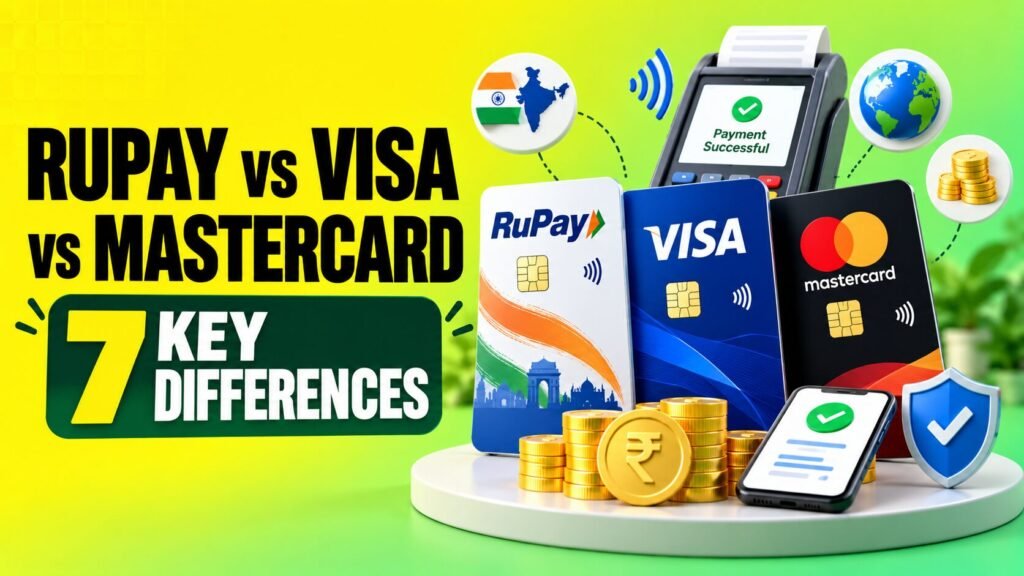
Quick Answer: RuPay vs Visa vs Mastercard
|
Factor |
RuPay |
Visa |
Mastercard |
|---|---|---|---|
|
Origin |
India (NPCI) |
USA |
USA |
|
Domestic Acceptance |
99%+ in India |
95%+ in India |
95%+ in India |
|
International Acceptance |
10+ countries (growing) |
250+ countries |
250+ countries |
|
UPI Credit Card Link |
✅ Yes (eligible cards) |
❌ No |
❌ No |
|
Data Processing |
Stays in India |
Goes overseas |
Goes overseas |
|
Domestic Transaction Fee |
~0.60% (lower) |
~1.50% |
~1.50% |
|
Forex Markup |
2–3% |
3.50% |
3.50% |
|
Market Share (New Cards) |
50% |
~30% |
~20% |
|
Best For |
UPI payments, domestic use |
International travel |
International travel |
⚡ 2026 Update: RuPay now captures 28% of all credit card transactions and 50% of new card issuance in India — up from just 10% last year. UPI credit card transactions via RuPay crossed ₹638 billion in the first 7 months of FY 2025.
What Is RuPay?
RuPay is India’s domestic card payment network, developed and operated by the National Payments Corporation of India (NPCI). Launched in 2012, it was designed to reduce India’s dependence on international payment networks and keep transaction data within the country.
Key Features of RuPay
- Domestic Network: All transaction processing happens within India
- UPI Integration: Eligible RuPay credit cards can be linked to UPI for QR code payments
- Lower Fees: Domestic transaction fees are significantly lower than Visa/Mastercard
- Government Push: Mandatory for government benefit disbursements (PMJDY accounts)
- Growing International Presence: RuPay Global cards work in 10+ countries through partnerships
RuPay’s Explosive Growth in 2026
RuPay is no longer the “newcomer” — it is now a dominant force in Indian payments:
|
Metric |
2024 |
2026 |
Growth |
|---|---|---|---|
|
Credit Card Transaction Share |
~10% |
28% |
+180% |
|
New Card Issuance Share |
~20% |
50% |
+150% |
|
UPI Credit Card Volume |
₹300B |
₹638B (7 months) |
+113% |
|
Merchant Acceptance |
High |
99%+ |
Stable |
What Are Visa and Mastercard?
Visa and Mastercard are American multinational payment networks that dominate global card transactions. They don’t issue cards themselves — banks and financial institutions issue cards that run on these networks. If you are new to credit cards, first understand how a credit card works, including billing, limits, interest and repayment.
Key Features of Visa
- Global Acceptance: 150+ million merchants across 250+ countries and territories
- Premium Benefits: Extensive lounge access, travel insurance, concierge services
- Contactless Technology: Visa payWave for tap-and-pay transactions
- Strong Online Presence: Preferred by most international e-commerce platforms
Key Features of Mastercard
- Global Acceptance: 150+ million acceptance locations across 250+ countries
- Priceless Program: Exclusive experiences, dining, and entertainment offers
- Mastercard ID Theft Protection: Advanced fraud monitoring
- Strong Digital Wallet Integration: Apple Pay, Google Pay, Samsung Pay
Visa vs Mastercard: Is There a Real Difference?
For most users in India, Visa and Mastercard are nearly identical. Both offer:
- Similar domestic and international acceptance
- Comparable forex markup fees (3.50%)
- Similar reward structures (decided by issuer, not network)
- Same contactless payment limits
The real difference lies in specific card benefits (decided by your bank), not the network itself.
RuPay vs Visa vs Mastercard: Detailed Comparison
1. Domestic Acceptance in India
|
Network |
ATM Acceptance |
POS Acceptance |
Online Acceptance |
|---|---|---|---|
|
RuPay |
99%+ |
99%+ |
95%+ |
|
Visa |
99%+ |
98%+ |
98%+ |
|
Mastercard |
99%+ |
98%+ |
98%+ |
Verdict: All three networks have excellent domestic acceptance. For everyday use in India, you won’t notice a difference.
2. International Acceptance
|
Network |
Countries |
Merchants |
Best For |
|---|---|---|---|
|
RuPay |
10+ (growing) |
Limited |
Occasional travel to partner countries |
|
Visa |
250+ |
150M+ |
Frequent international travel |
|
Mastercard |
250+ |
150M+ |
Frequent international travel |
RuPay International Presence (2026):
- Singapore, Bhutan, Maldives, UAE, Saudi Arabia
- Bahrain, Myanmar, South Korea, Nepal, France, Singapore, Bhutan, Maldives, Saudi Arabia, UAE, Bahrain, Myanmar, South Korea, Nepal, and France now accept RuPay cards
Verdict: For international travel, Visa or Mastercard is still the safer choice. RuPay is expanding but acceptance is limited compared to global networks.
3. UPI Credit Card Integration (RuPay’s Killer Feature)
This is where RuPay has a clear, exclusive advantage.
How RuPay Credit Card on UPI Works
- Link your eligible RuPay credit card to a UPI app (PhonePe, Google Pay, Paytm, etc.)
- Scan any UPI QR code at a merchant
- Select your RuPay credit card as the payment source
- Payment is processed — no physical card needed!
What You CAN Do
✅ Pay at local kirana stores via UPI QR
✅ Pay at restaurants, petrol pumps, salons
✅ Online payments through UPI
✅ Earn credit card rewards on UPI transactions
What You CANNOT Do
❌ Person-to-person transfers (P2P)
❌ Cash withdrawals via UPI
❌ Card-to-card transfers
UPI Transaction Fee Structure (2026)
|
Transaction Amount |
Merchant Fee |
Who Pays |
|---|---|---|
|
Up to ₹2,000 |
₹0 (Zero) |
No one — FREE |
|
Above ₹2,000 |
~0.60% |
Merchant |
Key Advantage: For small transactions under ₹2,000, RuPay UPI credit card payments are completely free for merchants — unlike Visa/Mastercard which charge fees on all transactions. This makes RuPay popular with small businesses.
Verdict: If you want to use your credit card for UPI payments, RuPay is your only option.
For a detailed breakdown of when fees may apply and who pays them, see our guide to UPI charges.
4. Transaction Fees & Costs
|
Fee Type |
RuPay |
Visa |
Mastercard |
|---|---|---|---|
|
Domestic Transaction (Merchant) |
~0.60% |
~1.50% |
~1.50% |
|
International Transaction |
~1.50% |
~2.50% |
~2.50% |
|
Forex Markup |
2–3% |
3.50% |
3.50% |
|
ATM Withdrawal (Own Bank) |
Free |
Free |
Free |
|
ATM Withdrawal (Other Bank) |
₹20–₹50 |
₹20–₹50 |
₹20–₹50 |
|
Annual Fee (Basic Card) |
₹0–₹499 |
₹0–₹999 |
₹0–₹999 |
|
Annual Fee (Premium Card) |
₹1,999–₹5,000 |
₹2,500–₹10,000 |
₹2,500–₹10,000 |
Note: These are indicative ranges. Actual fees depend on your bank and specific card variant.
Verdict: RuPay is cheaper for domestic transactions. For international use, all three have similar forex markup, but Visa/Mastercard may have better exchange rates due to volume.
5. Data Processing & Security
|
Factor |
RuPay |
Visa |
Mastercard |
|---|---|---|---|
|
Data Storage |
India only |
USA + global |
USA + global |
|
Regulator |
RBI |
US Federal Reserve |
US Federal Reserve |
|
Data Protection Law |
DPDP Act 2023 |
US laws |
US laws |
|
Fraud Monitoring |
NPCI systems |
Visa Advanced Authorization |
Mastercard Identity Check |
|
Dispute Resolution |
Indian banking ombudsman |
International process |
International process |
Why This Matters:
- RuPay: Your transaction data never leaves India. Protected under Indian law (DPDP Act 2023). Faster dispute resolution through Indian channels.
- Visa/Mastercard: Data is processed overseas (primarily USA). Subject to US laws. Dispute resolution may involve international processes.
Verdict: For data privacy-conscious users, RuPay offers better protection as data stays within India’s jurisdiction.
6. Rewards & Benefits
Important: Rewards are primarily determined by your bank and card variant, not the network. However, networks do offer some exclusive benefits.
RuPay Benefits
- RuPay Select: Lounge access, dining discounts, golf privileges
- RuPay Platinum: Enhanced rewards on fuel, groceries, utility bills
- UPI Credit Card Rewards: Earn points on UPI transactions (unique to RuPay)
- Government Schemes: Special benefits on PMJDY, Jan Dhan accounts
Visa Benefits
- Visa Classic/Basic: Standard rewards
- Visa Signature: Lounge access, travel insurance, concierge
- Visa Infinite: Premium lounge access, luxury hotel benefits, air accident cover
- Visa Offers: Exclusive discounts on dining, shopping, travel
Mastercard Benefits
- Mastercard Standard: Basic rewards
- Mastercard World: Lounge access, golf, dining
- Mastercard World Elite: Premium benefits, Priceless experiences
- Mastercard ID Theft Protection: Advanced fraud monitoring
Verdict: For premium benefits, Visa and Mastercard have more mature programs. But RuPay is rapidly catching up, especially for domestic-focused users.
7. Card Availability & Eligibility
|
Factor |
RuPay |
Visa |
Mastercard |
|---|---|---|---|
|
Debit Card Availability |
Universal (all banks) |
Universal |
Universal |
|
Credit Card Availability |
Growing (major banks) |
Universal |
Universal |
|
Minimum Income (Basic) |
₹10,000–₹15,000/month |
₹15,000–₹20,000/month |
₹15,000–₹20,000/month |
|
Credit Score Required |
600+ (flexible) |
650+ |
650+ |
|
Co-branded Cards |
Limited (growing) |
Extensive |
Extensive |
RBI’s Network Choice Rule (2024):
RBI has directed banks to offer customers a choice of card network at the time of issuance. However, this applies mainly to new credit cards and certain issuers are exempt. Card-network choice is only one of several regulatory changes cardholders should know about. You can also check the latest credit card rule changes in India.
RuPay vs Visa vs Mastercard: Which Should You Choose?
Choose RuPay If:
✅ You want to use your credit card for UPI payments (unique feature)
✅ You primarily spend within India
✅ You want lower domestic transaction fees
✅ You are privacy-conscious (data stays in India)
✅ You want a lower annual fee card
✅ You have a low or new credit score (easier approval)
✅ You want to support India’s domestic payment ecosystem
Choose Visa If:
✅ You travel internationally frequently
✅ You shop on international websites (Amazon US, etc.)
✅ You want premium travel benefits (lounge, insurance)
✅ You want the widest global acceptance
✅ You prefer mature reward programs with extensive partnerships
Choose Mastercard If:
✅ You travel internationally frequently
✅ You want exclusive experiences (Priceless program)
✅ You prefer advanced fraud protection
✅ You want strong digital wallet integration
✅ You value global brand recognition
Scenario-Based Decision Matrix
|
Your Situation |
Best Network |
Why |
|---|---|---|
|
Mostly UPI + local shopping |
RuPay |
UPI credit card linking, lower fees |
|
Frequent international travel |
Visa/Mastercard |
Global acceptance, forex benefits |
|
First credit card, low CIBIL |
RuPay |
Easier approval, lower fees |
|
Premium travel + lounge access |
Visa Signature/Infinite or Mastercard World |
Better lounge networks |
|
Online shopping (India only) |
Any |
All work equally well |
|
Government employee / PMJDY |
RuPay |
Mandatory for government schemes |
|
Small business owner |
RuPay |
Lower merchant fees on UPI |
|
Student / Young professional |
RuPay |
Lower annual fee, UPI integration |
|
NRI / Frequent flyer |
Visa/Mastercard |
International acceptance |
|
Data privacy priority |
RuPay |
Data stays in India |
How to Link Your RuPay Credit Card to UPI (Step-by-Step)
Since this is RuPay’s exclusive advantage, here’s how to set it up:
Step 1: Check Eligibility
- Your RuPay credit card must be enabled for UPI (check with your bank)
- Most major banks (SBI, HDFC, ICICI, Axis) support this
Step 2: Open Your UPI App
- Use PhonePe, Google Pay, Paytm, or BHIM
- Ensure the app is updated to the latest version
Step 3: Add Credit Card
- Go to “Profile” or “Payment Methods”
- Tap “Add Credit Card”
- Enter your RuPay credit card details
- Verify via OTP sent to your registered mobile
Step 4: Set UPI PIN
- Create a UPI PIN for your credit card
- This is separate from your card PIN
Step 5: Start Paying
- Scan any UPI QR code at a merchant
- Select your RuPay credit card as the payment source
- Enter UPI PIN to complete the payment
- Earn credit card rewards on UPI transactions!
💡 Pro Tip: You can also pay at merchants who don’t have card machines — just scan their UPI QR code. This works at kirana stores, auto-rickshaws, small restaurants, and more.
Popular RuPay, Visa & Mastercard Cards in India (2026)
If you want to compare actual cards instead of only payment networks, see our guide to the best credit cards in India based on fees, rewards and common use cases.
Best RuPay Credit Cards
|
Card |
Issuer |
Annual Fee |
Key Benefit |
|---|---|---|---|
|
RuPay SBI Card Prime |
SBI |
₹2,999 |
5X rewards on dining, groceries |
|
RuPay HDFC Regalia |
HDFC |
₹2,500 |
Lounge access, 4 reward points/₹150 |
|
RuPay ICICI Coral |
ICICI |
₹500 |
Movie tickets, dining discounts |
|
RuPay Axis Bank ACE |
Axis |
₹499 |
5% cashback on bill payments |
|
RuPay BoB Easy |
Bank of Baroda |
₹0 (lifetime free) |
Basic rewards, no annual fee |
Best Visa Credit Cards
|
Card |
Issuer |
Annual Fee |
Key Benefit |
|---|---|---|---|
|
SBI Card Elite |
SBI |
₹4,999 |
Premium lounge, travel insurance |
|
HDFC Infinia |
HDFC |
₹10,000 |
Unlimited lounge, 5X rewards |
|
ICICI Amazon Pay |
ICICI |
₹0 (lifetime free) |
5% cashback on Amazon |
|
Axis Magnus |
Axis |
₹12,500 |
Luxury benefits, concierge |
Best Mastercard Credit Cards
|
Card |
Issuer |
Annual Fee |
Key Benefit |
|---|---|---|---|
|
SBI Card Prime |
SBI |
₹2,999 |
5X rewards, lounge access |
|
HDFC Diners Club |
HDFC |
₹1,000 |
10X rewards on SmartBuy |
|
ICICI Manchester United |
ICICI |
₹499 |
Football merchandise discounts |
|
Axis Flipkart |
Axis |
₹500 |
5% cashback on Flipkart |
The RuPay vs Visa vs Mastercard debate is not about which network is “best” — it’s about which network fits your specific needs.
Frequently Asked Questions (FAQs)
Q1. Is RuPay better than Visa and Mastercard?
Answer: It depends on your usage. RuPay is better for domestic UPI payments and has lower fees. Visa and Mastercard are better for international travel due to wider global acceptance. For everyday domestic debit card use, all three work equally well.
Q2. Can I use RuPay card internationally?
Answer: Only RuPay Global cards work internationally, and that too in 10+ partner countries (Singapore, UAE, Bhutan, Nepal, etc.). For extensive international travel, Visa or Mastercard is still recommended. Always check if your specific card is internationally enabled before traveling.
Q3. Can Visa or Mastercard credit cards be linked to UPI?
Answer: No. As of October 2026, only RuPay credit cards can be linked to UPI for merchant payments. Visa and Mastercard credit cards do not support UPI linking. However, their debit cards can be used for normal bank account-based UPI transactions.
Q4. Does RuPay have lower annual fees than Visa or Mastercard?
Answer: Not necessarily. Annual fees depend on your bank and card variant, not the network. You can find:
- Lifetime free RuPay cards (Bank of Baroda Easy)
- Lifetime free Visa cards (ICICI Amazon Pay)
- Premium RuPay cards with ₹5,000+ annual fee (RuPay HDFC Regalia)
- Premium Visa cards with ₹10,000+ annual fee (HDFC Infinia)
Always compare the specific card’s fee structure, not just the network logo.
Q5. Which network is safest for online transactions?
Answer: All three networks use 256-bit encryption and two-factor authentication for online transactions. However:
- RuPay: Data stays in India, protected under DPDP Act 2023
- Visa/Mastercard: Data processed overseas, subject to international fraud monitoring systems
For data privacy, RuPay has an edge. For fraud detection technology, Visa and Mastercard have more mature systems due to their global scale.
Q6. Can I choose my card network when applying for a credit card?
Answer: Sometimes. RBI has directed banks to offer a choice of network at the time of issuance for eligible customers. However:
- Not all banks comply yet
- Some card variants are only available on one network
- Existing cardholders may get the option at renewal
Ask your bank specifically if they offer the same card on multiple networks.