What is Simple Interest?
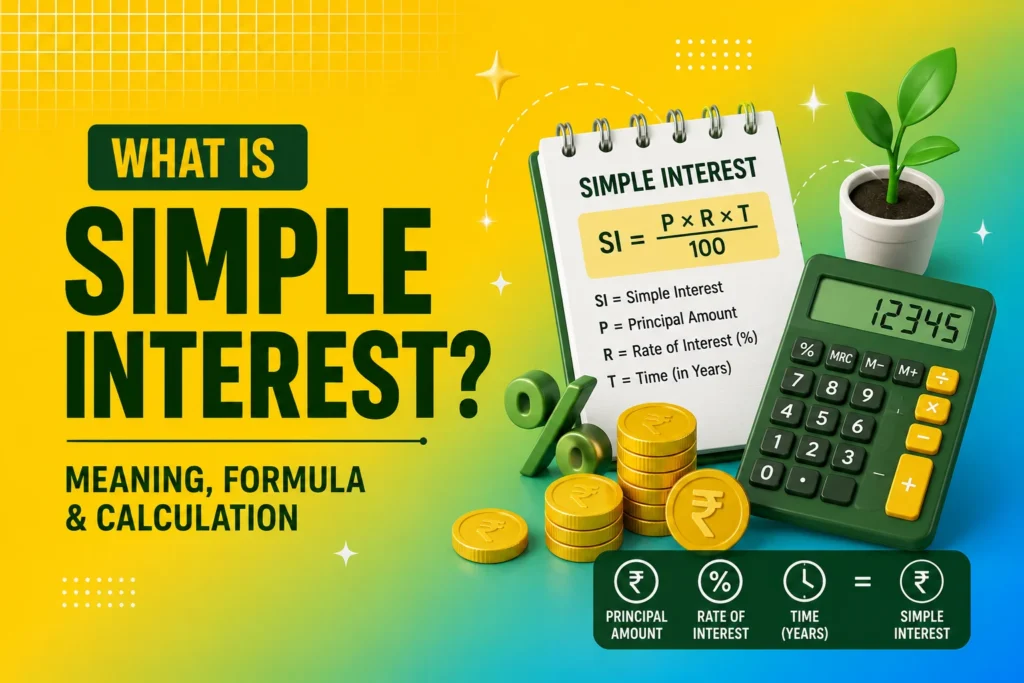
In simple terms, what is Simple Interest is a fixed cost or yield charged or earned on an initial principal amount that is borrowed or invested.
The primary characteristic of simple interest is that it is calculated solely on the original principal. No additional interest is accrued on the interest that accrues over time. This straightforward nature is precisely why it is termed “Simple.”
Real-Life Example:
Imagine that you borrow $10,000 from a friend at an annual interest rate of 5% and promise to repay it after two years. Here, you only need to pay $500 in interest annually. After two years, you will repay a total of $11,000 ($10,000 principal + $1,000 interest).
Core Components of Simple Interest
To calculate simple interest accurately, one must understand its four core components:
- Principal (P): The initial sum of money borrowed or deposited in a bank or investment scheme.
- Rate of Interest (R): The percentage (%) at which interest is charged or earned annually.
- Time Period (T): The duration (in years) for which money is lent, borrowed, or invested.
- Total Amount (A): The total sum to be repaid at the end of the tenure, including both the principal and accrued interest ($A = P + \text{SI}$).
Read Also: Compounding Interest
Simple Interest Formula
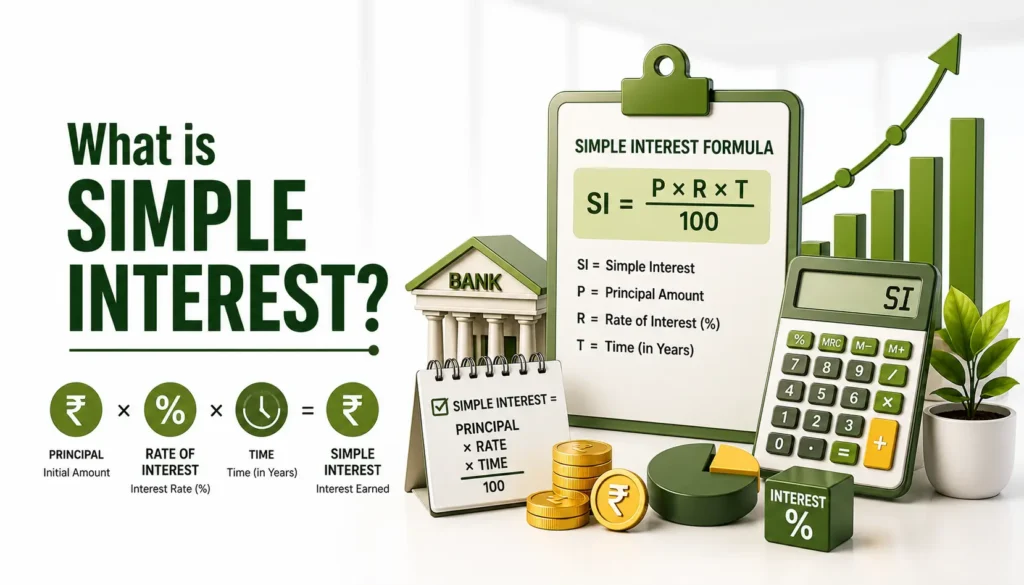
The standard mathematical formula used to calculate simple interest is as follows:
$$\text{Simple Interest (SI)} = \frac{P \times R \times T}{100}$$
Where:
- $P$ = Principal
- $R$ = Rate of Interest per annum (%)
- $T$ = Time in years
Essential Formula Cheat Sheet
If you already know the total Simple Interest ($\text{SI}$) and need to derive the other components, use these converted formulas:
- To find Principal ($P$): $P = \frac{\text{SI} \times 100}{R \times T}$
- To find Rate of Interest ($R$): $R = \frac{\text{SI} \times 100}{P \times T}$
- To find Time Period ($T$): $T = \frac{\text{SI} \times 100}{P \times R}$
- To find Total Amount ($A$): $A = P \times \left(1 + \frac{R \times T}{100}\right)$
How to Calculate Simple Interest for Months and Days?

Loans or investments often have tenures specified in months or days rather than in complete years. In such cases, slight adjustments are made to the formula as follows:
A. When Time is Given in Months:
To convert months into years, divide the number of months by 12.
$$\text{SI} = \frac{P \times R \times \text{Months}}{100 \times 12}$$
B. When Time is Given in Days:
To convert days into years, the number of days is divided by 365.
$$\text{SI} = \frac{P \times R \times \text{Days}}{100 \times 365}$$
Step-by-Step Practical Examples
Example 1: Annual Calculation (Personal Loan Scenario)
Question: Amit takes a personal loan of $100,000 at an annual simple interest rate of 10% for a tenure of three years. How much total interest will he pay, and what will the total repayment amount be?
Solution:
- $P = \$100,000$
- $R = 10\%$
- $T = 3 \text{ years}$
$$\text{SI} = \frac{100000 \times 10 \times 3}{100} = \$30,000$$
- Total Repayment Amount ($A$): $\$100,000 + \$30,000 =$ $130,000
Example 2: Monthly Calculation (Short-Term Scenario)
Question: What will be the simple interest on an amount of $50,000 at an annual rate of 8% over 6 months?
Solution:
- $P = \$50,000$
- $R = 8\%$
- $\text{Months} = 6$
$$\text{SI} = \frac{50000 \times 8 \times 6}{100 \times 12} = \$2,000$$
Simple Interest vs. Compound Interest
When making financial decisions, it is crucial to understand how simple interest differs from compound interest.
| Feature / Comparison | Simple Interest | Compound Interest |
| Calculation Basis | It is calculated strictly on the initial principal amount. | Calculated on the principal + accumulated past interest. |
| Interest Amount | It remains constant throughout every period. | It grows progressively over time. |
| Cost / Yield Effect | Less expensive for borrowers: | This is more lucrative for investors. |
| Typical Application | Auto loans, short-term personal loans, and some student loans. | Fixed deposits (FDs), mutual funds, and credit card balances. |
Where is Simple Interest Used in Real Life?
In practical banking and finance, simple interest models are utilized across various financial products.
- Auto and Vehicle Loans: Many vehicle loans follow a simple interest calculation model, keeping monthly interest payouts straightforward.
- Short-Term Business Loans: Working capital loans extended to small businesses are often issued based on simple-interest terms.
- Student Loans: In several education loan structures, the interest charged during the study period (grace period) is computed using simple interest.
Read Also: Business Loans