What is TDS on Fixed Deposits?
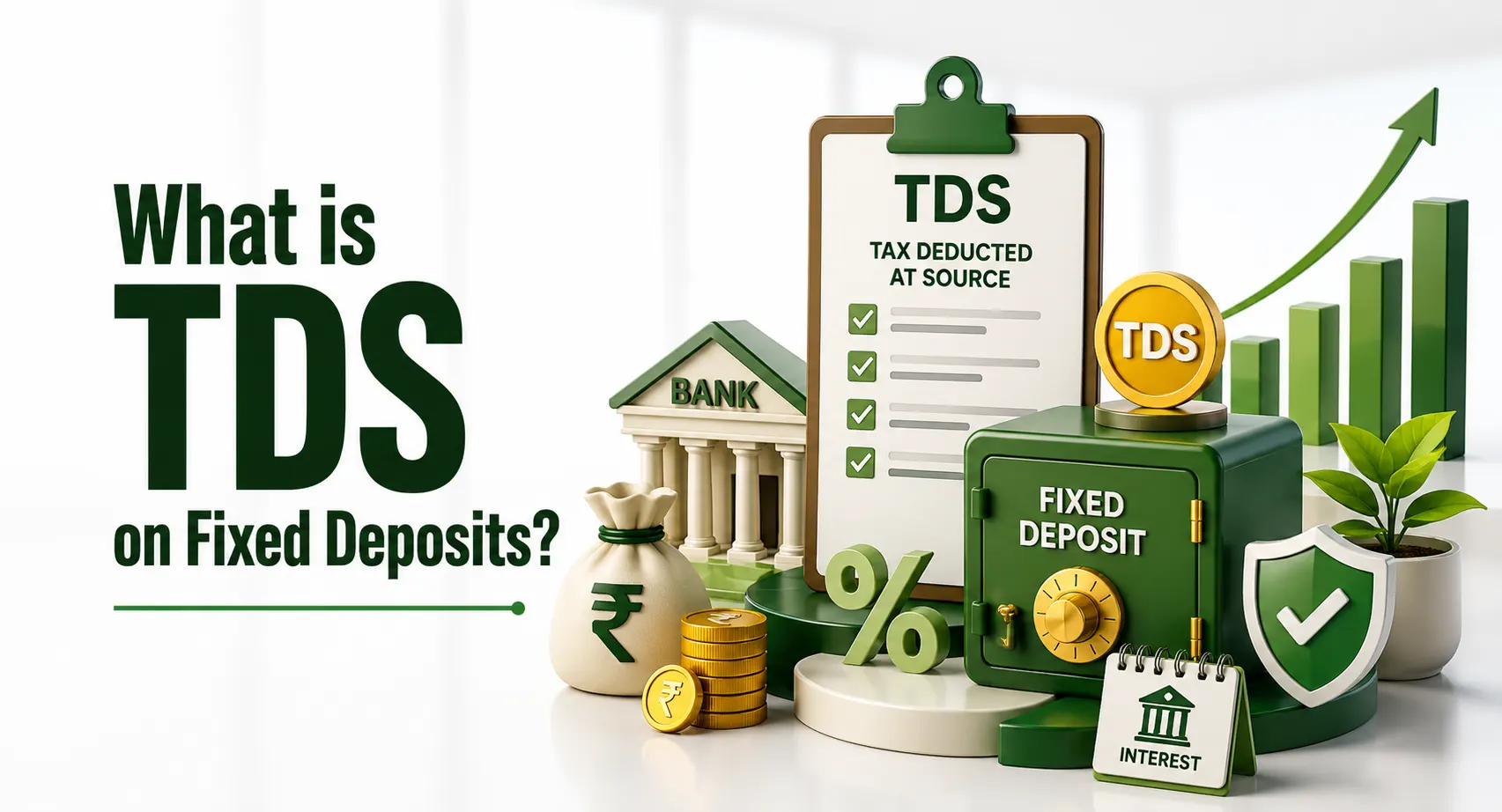
TDS on fixed deposits is the tax that banks, co-operative banks, and post offices deduct on the interest earned on fixed deposits (FDs) and recurring deposits (RDs). The deduction occurs under the provisions that earlier fell under Section 194A of the Income Tax Act, 1961, and are now covered under Section 393(1) of the Income Tax Act, 2025.
It is important to note that TDS is only a method of collecting tax in advance. The interest itself is always taxable under the head “Income from Other Sources.” Even if no TDS is deducted, you must still declare the full interest income in your Income Tax Return.
TDS Rate on Fixed Deposit Interest
| Situation | TDS Rate |
|---|---|
| PAN provided and linked | 10% |
| PAN not provided or not linked | 20% |
No surcharge or cess is added at the time of TDS deduction. The higher 20% rate applies under Section 206AA when a valid PAN is not provided.
TDS Limit / Threshold on Fixed Deposit (FY 2025-26 onwards)
Banks, cooperative banks, and post offices deduct TDS only when the interest credited or paid during the financial year exceeds the prescribed threshold. The limit is calculated on the aggregate interest from all branches of the same bank under one PAN (i.e., a core banking system).
| Category of Depositor | Threshold Limit (per bank per year) |
|---|---|
| Individuals below 60 years | ₹50,000 |
| Senior citizens (60 years and above) | ₹1,00,000 |
For deposits with companies, NBFCs, or other non-banking entities, the threshold is lower at ₹10,000.
Key clarification: The higher limit for senior citizens applies only to interest received from banks, cooperative banks, and post offices. Interest from other sources continues to have a lower threshold.
How is TDS on Fixed Deposits Calculated?
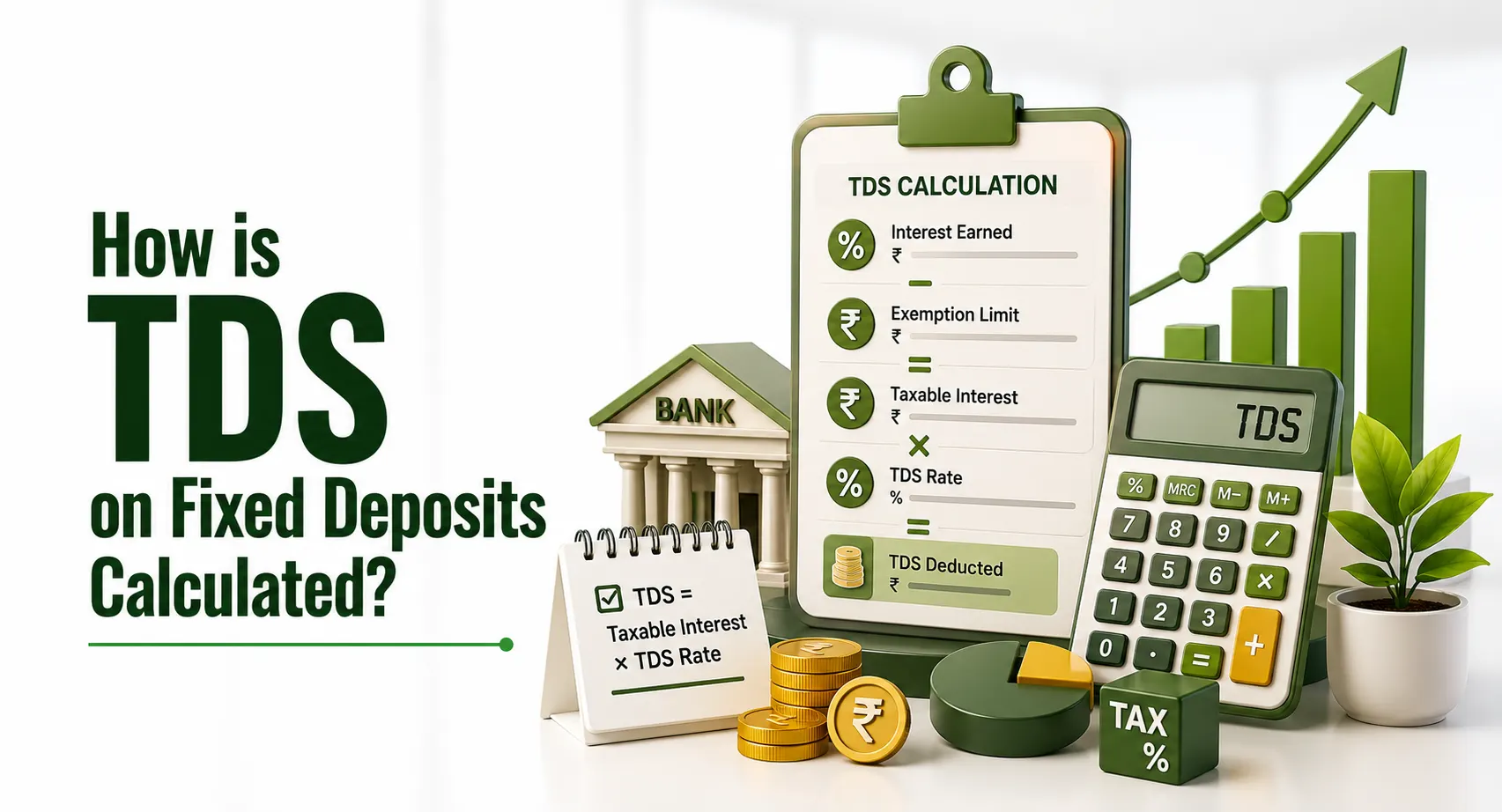
TDS is calculated on the interest amount that exceeds the threshold in a given financial year.
Simple example (Individual below 60 years)
- Interest earned from one bank in the financial year: ₹72,000
- Threshold: ₹50,000
- Interest subject to TDS: ₹72,000 – ₹50,000 = ₹22,000
- TDS deducted (with PAN): 10% of ₹22,000 = ₹2,200
Example for senior citizen
- Interest earned from one bank: ₹1,25,000
- Threshold: ₹1,00,000
- Interest subject to TDS: ₹25,000
- TDS deducted (with PAN): 10% of ₹25,000 = ₹2,500
The bank issues Form 16A as a TDS certificate. You can also check the deducted amount in Form 26AS or the Annual Information Statement (AIS) on the income-tax portal.
How to Save Tax / Avoid TDS on Fixed Deposit
Read Also: Best Tax Saving Investments
The legitimate methods available are as follows:
- 1. Submit the self-declaration form (Form 121) From 1 April 2026, Form 121 has replaced the earlier Form 15G and Form 15H. You can submit Form 121 to the bank if your estimated total tax liability for the year is zero.
- It must be submitted at the beginning of the financial year (preferably, in April) or before the first interest credit.
- A fresh form is required every financial year.
- Valid PAN is mandatory.
- Non-residents cannot submit these forms.
- 2. Keep interest below the threshold in each bank Since the limit is calculated per bank, you can open fixed deposits in different banks so that interest from any single bank stays below ₹50,000 (or ₹1,00,000 for senior citizens).
- 3. Claim available deductions
- Senior citizens can claim a deduction of up to ₹50,000 under Section 80TTB on interest from deposits with banks, co-operative banks, and post offices.
- This reduces the taxable income, even if TDS has already been deducted.
- 4. Ensure PAN is correctly linked Always provide and link a valid PAN to your bank account. This maintains the TDS rate at 10% instead of 20%.
- 5. Claim refund while filing ITR If TDS has already been deducted and your final tax liability is lower (or nil), you can claim the excess amount as a refund by filing your Income Tax Return on time.
Important Points to Remember
- Interest on fixed deposits is fully taxable. The absence of TDS does not mean that the income is tax-free.
- The threshold applies to the aggregate interest of the entire bank under one PAN, not per branch or deposit.
- Savings account interest is generally not subject to TDS under these rules, although it remains taxable (subject to Section 80TTA for non-seniors).
- PPF and certain other notified schemes continue to enjoy exemptions from both tax and TDS.
- Always verify the deducted amount in Form 26AS / AIS before filing your return.