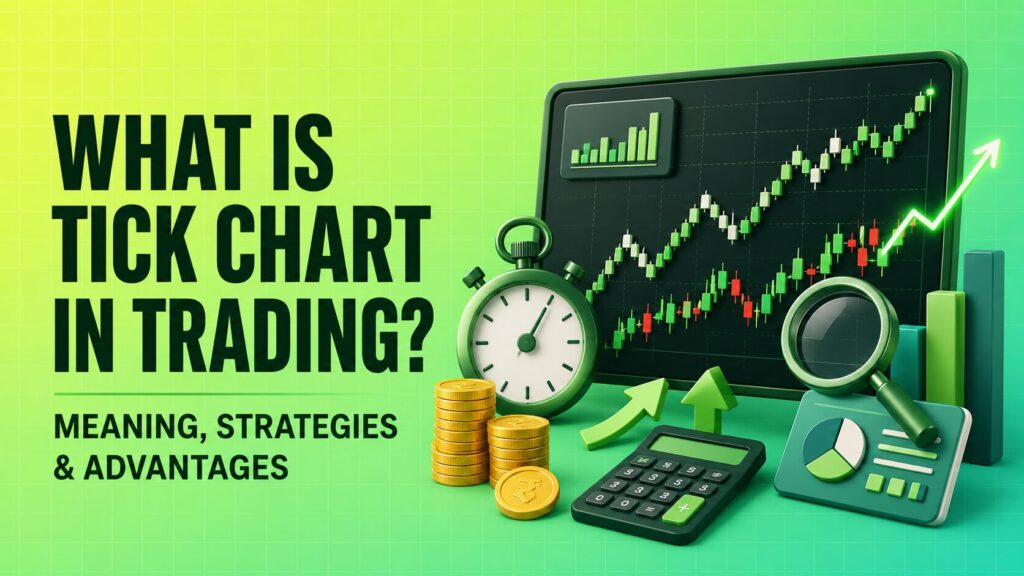
Most beginners watch a 5-minute or 15-minute chart and think the market is moving clearly. But here is the problem: time-based charts keep forming candles even when very little trading is happening. This can create noise, slow signals, and sometimes confusing price action.
A tick chart solves this problem differently. Instead of creating a candle after a fixed time, a tick chart creates a new candle after a fixed number of trades. That means it focuses on market activity, not just time.
For active traders, scalpers, and intraday traders, a tick chart can give a cleaner view of price movement, volatility, and trading momentum. But it is not a magic tool. To use it properly, you need to understand how it works, which tick setting to use, and what risks to avoid.
In this guide, you will learn the meaning of tick chart, how it works, tick chart strategies, advantages, disadvantages, and beginner-friendly tips.
What is a Tick Chart in Trading?

A tick chart is a trading chart where a new candle or bar is created after a fixed number of trades or transactions. Unlike a time chart, it does not depend on minutes or hours.
For example, if you are using a 100-tick chart, one candle will form after every 100 trades. If you are using a 500-tick chart, one candle will form after every 500 trades.
TradingView explains tick-based charts as charts that form bars based on the number of transactions instead of fixed time periods. This helps traders see market activity more clearly, especially during fast-moving sessions.
In simple words:
Tick chart = chart based on number of trades, not time.
How Does a Tick Chart Work?
A tick chart works by counting trades.
Let’s understand with an example:
If you select a 200-tick chart, the platform will create one candle after 200 trades are completed.
If the market is very active, 200 trades may happen quickly, so candles will form faster. If the market is slow, the same 200 trades may take more time, so candles will form slowly.
This is the main difference between a tick chart and a normal time chart.
Thinkorswim also describes tick charts as charts where price is plotted based on the number of trades, and a new bar forms whenever the selected number of trades is completed.
Simple Example
| Tick Chart Setting | New Candle Forms After | Speed |
|---|---|---|
| 100-tick chart | 100 trades | Very fast |
| 500-tick chart | 500 trades | Medium |
| 1000-tick chart | 1000 trades | Slower and cleaner |
So, a smaller tick chart gives more candles and faster signals, while a larger tick chart gives fewer candles and cleaner structure.
Tick Chart Example for Beginners
Suppose you are watching a stock or index future.
On a normal 5-minute chart, one candle will form every 5 minutes, even if very few trades happen during that period.
But on a tick chart, candles form only when the selected number of trades is completed.
For example:
- On a 100-tick chart, one candle forms after 100 trades.
- On a 500-tick chart, one candle forms after 500 trades.
- On a 1000-tick chart, one candle forms after 1000 trades.
During high-volume market hours, tick chart candles may form very quickly. During slow market hours, candles may take longer to form.
This makes the tick chart useful for traders who want to focus on actual market participation.
Tick Chart vs Time Chart
Most traders start with time charts such as 1-minute, 5-minute, 15-minute, or daily charts. A tick chart is different because it removes fixed time dependency.
| Point | Tick Chart | Time Chart |
|---|---|---|
| Based on | Number of trades | Fixed time interval |
| Candle formation | After selected trades complete | After selected time ends |
| Best for | Scalping and intraday activity | General technical analysis |
| Market activity view | Stronger | Limited |
| Slow market behavior | Fewer candles | Candles still form |
| Beginner difficulty | Medium | Easy |
| Noise control | Can reduce time-based noise | May show candles even in low activity |
Investopedia notes that data-based charts such as tick, volume, and range charts are different from time-based charts because they print bars based on data intervals instead of fixed time periods.
Tick Chart vs Volume Chart vs Range Chart
Many beginners confuse tick chart, volume chart, and range chart. They are not the same.
| Chart Type | Based On | Best Use |
|---|---|---|
| Tick chart | Number of trades | Market activity and scalping |
| Volume chart | Quantity traded | Volume-based analysis |
| Range chart | Price movement | Trend clarity and noise reduction |
| Time chart | Time interval | General analysis |
Tick Chart
A tick chart counts transactions. Every trade counts as one tick, whether the trade size is small or large.
Volume Chart
A volume chart is based on the total quantity traded. It focuses on how much volume has changed hands.
Range Chart
A range chart forms a new bar when price moves by a fixed range. It ignores time and focuses on price movement.
For intraday traders, tick charts and volume charts can both be useful, but they show different information.
Advantages of Tick Chart
A tick chart can be helpful for active traders because it focuses on real trading activity.
1. Shows Real Market Activity
A tick chart shows when trading activity is high or low. When many trades are happening, candles form quickly. When activity is low, candles form slowly.
This gives traders a better idea of market participation.
2. Useful for Intraday Trading
Intraday traders need quick and clear price action. A tick chart can help them see momentum shifts faster than some time-based charts.
This is why tick charts are often used by scalpers and short-term traders.
3. Helps Reduce Time-Based Noise
A time chart keeps printing candles even when the market is inactive. This can sometimes create unnecessary signals.
A tick chart reduces this issue because candles form only when trades happen.
4. Better During High Volatility
During volatile market periods, tick charts can show price action in more detail. This helps traders identify breakouts, reversals, and pullbacks more clearly.
TradingView also mentions that tick charts can be useful during volatile periods because they provide a more granular view of market activity.
5. Helps in Scalping
Scalpers look for small price moves. Since tick charts react to market activity, they can help scalpers find short-term entries and exits.
However, scalping also carries high risk, so proper stop-loss and discipline are important.
Disadvantages of Tick Chart
A tick chart is powerful, but it is not perfect. Beginners should understand its limitations before using it.
1. Not Ideal for Complete Beginners
If you are new to trading, a tick chart may feel fast and confusing. You should first understand candlestick charts, support and resistance, trendlines, and risk management.
2. Data May Vary by Platform
Tick chart data can depend on the broker or charting platform. If your platform has poor-quality data, your chart may not be reliable.
3. Can Lead to Overtrading
Small tick settings create many candles. This may tempt traders to enter too many trades.
More signals do not always mean better trades.
4. Requires Fast Decision-Making
Tick charts move quickly during high-volume periods. Traders need a clear plan before entering a trade.
Without discipline, fast charts can increase losses.
5. Not Best for Long-Term Investors
A tick chart is mainly useful for short-term trading. Long-term investors usually do not need tick charts because they focus on broader trends, fundamentals, and longer timeframes.
Best Tick Chart Settings for Trading
There is no single best tick chart setting for every trader. The right setting depends on your market, instrument, liquidity, and trading style.
| Tick Chart Setting | Best For | Risk Level |
|---|---|---|
| 100-tick chart | Very fast scalping | High |
| 233-tick chart | Quick intraday entries | High |
| 500-tick chart | Balanced short-term trading | Medium |
| 1000-tick chart | Cleaner intraday structure | Medium |
| 2000-tick chart | Slower price-action view | Lower than small tick charts |
Some traders use Fibonacci-style intervals such as 144, 233, and 610 ticks. Investopedia also mentions popular tick chart intervals based on Fibonacci numbers such as 144, 233, and 610 ticks.
Beginner Tip
If you are new, avoid very small tick settings. Start with a medium setting and compare it with a 5-minute or 15-minute chart.
This will help you understand how price action looks on both chart types.
Tick Chart Strategies for Traders
 A tick chart can be used with many trading strategies. But you should not use any strategy blindly. Always test it first and use proper risk management.
Strategy 1: Breakout Trading with Tick Chart
A breakout happens when price moves above resistance or below support.
How to use it:
- Mark support and resistance on a higher timeframe.
- Open a tick chart for entry timing.
- Wait for price to break the level with strong activity.
- Avoid weak breakouts with low participation.
- Use stop-loss below/above the breakout level.
This strategy works better when the breakout happens with strong market activity.
Strategy 2: Pullback Entry Strategy
A pullback is a temporary price correction within a trend.
How to use it:
- Identify the main trend.
- Wait for price to pull back near support, resistance, or moving average.
- Use the tick chart to watch entry confirmation.
- Enter only when price starts moving back in trend direction.
- Keep a fixed stop-loss.
This strategy helps traders avoid entering too late.
Strategy 3: Tick Chart with VWAP
VWAP is often used by intraday traders to understand average traded price.
A simple approach:
- If price is above VWAP, traders may look for bullish setups.
- If price is below VWAP, traders may look for weak or bearish setups.
- Tick chart can help with entry timing near VWAP pullbacks.
This does not guarantee profit, but it can help traders filter trades better.
Strategy 4: Tick Chart Scalping Strategy
Scalping means taking small trades for quick price moves.
Basic scalping rules:
- Use liquid stocks, futures, or instruments.
- Avoid low-volume periods.
- Use small stop-loss.
- Do not chase every candle.
- Exit quickly if the setup fails.
Tick charts can help scalpers because they show activity-based movement, but scalping is risky and needs experience.
Who Should Use Tick Charts?
A tick chart may be useful for:
- Intraday traders
- Scalpers
- Active traders
- Futures traders
- Options traders
- Price-action traders
- Traders who want activity-based candles
If you trade fast-moving markets and need better entry timing, tick chart analysis can be useful.
Who Should Avoid Tick Charts?
A tick chart may not be suitable for:
- Complete beginners
- Long-term investors
- Traders without stop-loss discipline
- Traders who overtrade easily
- Traders using poor internet or delayed data
- Traders who do not understand price action
If you are still learning basic chart reading, start with time charts first. Then slowly test tick charts.
Common Mistakes While Using Tick Charts
Many traders use tick charts incorrectly. Avoid these common mistakes.
1. Using Very Small Tick Settings
A 50-tick or 100-tick chart can move very fast. Beginners may get confused and take unnecessary trades.
2. Trading Every Signal
A tick chart gives many signals, but not all signals are worth trading.
Quality matters more than quantity.
3. Ignoring Higher Timeframe Trend
Do not use a tick chart alone. Always check the bigger trend on a higher timeframe.
4. Not Using Stop-Loss
Tick charts move fast. Without stop-loss, one wrong trade can become a big loss.
5. Ignoring Market Liquidity
Tick charts work better in liquid markets. In low-liquidity stocks, signals may be unreliable.
Tick Chart Trading Tips for Beginners
If you want to use a tick chart, follow these simple tips:
- Start with paper trading or demo trading.
- Compare tick chart with 5-minute and 15-minute charts.
- Use only one or two indicators.
- Avoid very small tick settings.
- Trade only during active market hours.
- Do not overtrade.
- Use fixed risk per trade.
- Keep a trading journal.
A tick chart should support your trading plan, not replace your trading discipline.
Is Tick Chart Better Than Time Chart?
A tick chart is not always better than a time chart. It depends on your trading style.
If you are an intraday trader or scalper, a tick chart may give a better view of market activity.
If you are a beginner, swing trader, or long-term investor, a time chart may be easier and more useful.
The best approach is to combine both.
For example:
- Use a 15-minute chart to understand trend.
- Use a tick chart to time entries.
- Use risk management for every trade.
This balanced approach is better than depending on only one chart type.
Final Thoughts
A tick chart is a powerful trading tool that shows price movement based on the number of trades instead of time. It can help traders understand market activity, reduce time-based noise, and improve short-term entry timing.
However, tick charts are not suitable for everyone. They move fast, require good data, and can lead to overtrading if used without discipline.
For beginners, the best way is to first understand normal candlestick charts, then slowly test tick charts with demo trading or backtesting. A tick chart can improve your analysis only when it is combined with proper strategy, risk management, and patience.