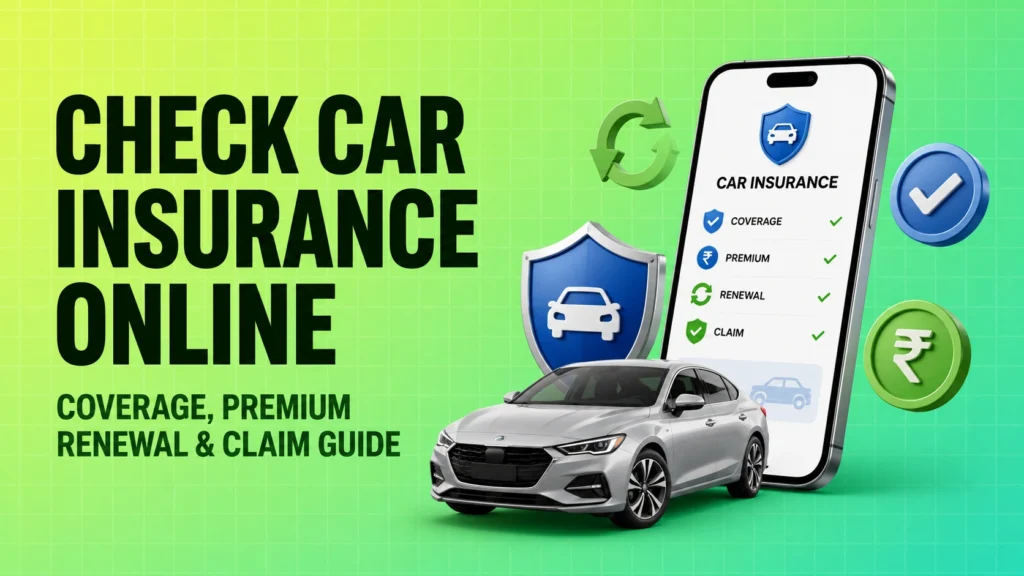
Keeping your car insurance active is not just about compliance. It also protects you from financial loss if your vehicle is damaged, stolen, or involved in an accident. When people search to check car insurance online, they usually want one of two things: to verify whether the policy is active, or to review the policy details before renewal or a claim.
This guide covers both. You will learn how to check car insurance status online, how to understand the policy document, how to renew digitally, and what to do if you cannot find your policy copy. The steps below reflect common industry practices in India and are meant to help you verify details with the insurer’s official records or the government vehicle database.
 How to Check Your Car Insurance Status Online
 How to Check Your Car Insurance Status Online
There are two common ways to check car insurance status online in India. First, you can use the insurer’s official website or mobile app if you know your policy number, vehicle registration number, or registered mobile number. Second, you can use the government’s VAHAN / mParivahan system to verify whether a vehicle record shows an active insurance entry.
These two methods serve slightly different purposes. The insurer portal is the best place to see your exact policy schedule, coverage, add-ons, and renewal date. VAHAN is useful for checking vehicle details in the national database and confirming whether insurance information is available there.
Using the Insurer’s Official Website or App
Most insurers provide a “policy lookup,” “quick renew,” or “renew existing policy” option on their official website or app. You can usually search by vehicle registration number, policy number, or mobile number linked to the policy.
A typical workflow looks like this:
- Go to the insurer’s official website or app.
- Select the option for policy status, renewal, or existing policy lookup.
- Enter your vehicle registration number, policy number, or registered mobile number.
- Complete OTP verification if required.
- View the policy status, expiry date, and available renewal options.
- Download the policy copy or renewal receipt if the details are available.
If you only want to check car insurance quickly, the vehicle registration number is often the easiest starting point. Many insurers can fetch policy details from that number, especially for renewal and policy download requests.
Always use the insurer’s official domain or official app. Avoid third-party links that ask for your vehicle details, OTP, or policy information unless you have independently confirmed that the page belongs to the insurer. Insurance fraud and phishing attempts often look similar to genuine renewal pages.
Using the VAHAN / mParivahan Portal
The VAHAN database is a government vehicle registry used across India. It is useful when you want to verify whether vehicle insurance details are reflected in the official system. The mParivahan app and VAHAN-related portals are commonly used for this purpose. If you are unsure where to begin, check the latest official government vehicle services portal for the current access route, since government interfaces may change over time.
A simple verification process usually includes these steps:
- Open the official VAHAN or mParivahan service.
- Choose the option to search vehicle details.
- Enter your vehicle registration number.
- Complete any captcha or verification step.
- Review the vehicle record, including insurance-related information if shown.
This is helpful when you want to know whether the vehicle appears active in the government system. However, the VAHAN view may not always show the full policy schedule, add-ons, or claim history. For detailed coverage information, the insurer’s own portal remains more reliable.
If the portal shows no result or incomplete data, that does not always mean the policy is invalid. Sometimes the data sync is delayed, or the vehicle record has not been updated. In that case, confirm directly with the insurer.
Understanding Your Car Insurance Policy Document
Once you access the policy copy, do not stop at the expiry date. A proper review should include the coverage type, insured value, and bonus status. These details affect both your premium and the amount you may receive in a claim.
The most important items to check are IDV, NCB, policy expiry date, and whether the policy is third-party only or comprehensive. If you are renewing online, these terms usually appear on the policy schedule or renewal page.
| Term | What it means | Why it matters | What to check |
|---|---|---|---|
| IDV (Insured Declared Value) | The approximate current value of the vehicle as declared by the insurer for total loss or theft claims. | It influences the premium and the maximum claim amount in total loss cases. | Check whether the IDV is close to the car’s current market value. |
| NCB (No Claim Bonus) | A discount earned for claim-free policy years, as per insurer rules. | It can reduce renewal premium if you have not raised eligible claims. | Confirm the NCB percentage shown on the renewal quote. |
| Policy Expiry Date | The date on which the policy cover ends. | If you miss renewal, the car can remain uninsured. | Renew before the expiry date to avoid a break in cover. |
| Coverage Type | Whether the policy is third-party only or comprehensive. | It decides what risks are covered. | Check the type of cover and read the inclusions and exclusions. |
| Add-ons | Extra covers such as zero depreciation, return to invoice, engine protection, or roadside assistance. | These can improve protection but may increase the premium. | See which add-ons are active and whether you still need them. |
IDV is especially important for older vehicles. If it is set too low, your premium may look cheaper, but the payout in a total loss or theft claim may also be lower. If it is set too high, you may pay more premium than needed. The right IDV depends on vehicle age, depreciation, and insurer rules.
NCB is another key item to verify. In Indian motor insurance practice, NCB belongs to the policyholder, not the vehicle, and it can generally carry forward when you renew within the allowed time window, subject to the insurer’s conditions. If you changed insurers, the new insurer may ask for proof of your NCB eligibility.
Coverage type is also important. A third-party policy is mandatory under law for vehicle use on public roads, but it does not cover damage to your own car. A comprehensive policy generally includes third-party liability plus own-damage cover, subject to the policy wording. If your car is new or financed, a comprehensive policy is usually easier to manage because it offers broader protection, though exact suitability depends on your situation and budget.
 How to Renew Your Car Insurance Online
 How to Renew Your Car Insurance Online
Renewing car insurance online is usually straightforward if you have the policy number or vehicle registration number. Most insurers and insurance marketplaces show the renewal quote after basic vehicle and policy details are entered.
Here is a practical 5-step process:
- Select the policy by entering the vehicle registration number or existing policy details.
- Declare past claims accurately, because claim history can affect the premium and NCB eligibility.
- Choose add-ons only if they are relevant to the car’s age and your usage pattern. Common options include zero depreciation, roadside assistance, engine protection, and return to invoice.
- Review the premium and verify the coverage, IDV, and deductibles before paying.
- Make payment and download the policy once the transaction is successful. Keep the digital copy and renewal receipt safely.
When you renew online, do not rush through the declaration section. Incorrect claim declarations can create problems later. Also, do not assume every add-on is useful. A new car owner may value zero depreciation more than an older vehicle owner, while a car used mainly in flood-prone areas may need different protection considerations.
Crucial Checks Before Making a Payment
Before paying the premium, verify the following items carefully:
- Insurer identity: Make sure you are paying on the official insurer website or app. Check the domain name and secure payment page.
- Final premium amount: Confirm taxes, add-ons, and deductibles so there are no surprises after payment.
- Policy wording: Read the key exclusions, claim conditions, and waiting periods where applicable.
- Vehicle details: Recheck the registration number, chassis number, engine number, and make/model details.
- Policy dates: Confirm the new start date and expiry date, especially if you are switching insurers or renewing after a gap.
IRDAI regulates the insurance market in India, but the actual policy terms, claim handling, and servicing are managed by the insurer as per the product rules. So, even if a policy is similar across insurers, you should still read the exact schedule and wording before payment. Insurance is a subject matter of solicitation, and final benefits always depend on the policy document and insurer rules.
Car Insurance Coverage Checklist
Use this checklist to quickly review whether your current policy looks reasonably balanced for basic protection. This is for educational purposes only. Always consult your policy document or insurance agent for exact coverage details.
- Third-party liability cover is included.
- Own damage cover is included, not just third-party cover.
- Policy expiry date is known and renewal is due before lapse.
- IDV is reasonably aligned with the car’s current value.
- NCB is correctly reflected if there were no eligible claims.
- Important add-ons are active only if needed.
- Voluntary or compulsory deductibles are understood.
- Chassis and engine details match the RC book and policy copy.
- Policyholder name, address, and mobile number are correct.
- You know how to download the policy copy for future claim use.
If most of the items above are checked, the policy is usually in better shape for a basic review. If several items are missing, it may be worth revisiting the renewal quote rather than choosing the lowest premium blindly.
What to Do If You Can’t Find Your Policy Details
Losing the policy copy is common. The good news is that you can usually recover car insurance details through a few simple routes.
Start with these steps:
- Check your registered email: Most insurers send the policy schedule, renewal reminders, and receipts to the email ID used at purchase or renewal.
- Search SMS and WhatsApp logs: If the insurer or agent sent confirmation messages, the policy number may still be there.
- Contact the insurer’s toll-free number or customer care: Keep the vehicle registration number, engine number, chassis number, and registered mobile number ready for verification.
- Ask the dealer or agent: If the policy was bought through a dealer, broker, or agent, they may be able to share the policy number or copy.
- Use the insurer portal: Many official portals allow you to fetch policy details using the registration number alone.
If you still cannot locate the policy, ask the insurer to confirm whether the policy is active, expired, or pending renewal. This is especially helpful if the policy was bought long ago or the contact details have changed.
Be careful with fake “policy recovery” pages. Do not upload your Aadhaar, PAN, or vehicle documents on unverified websites just because they promise instant policy retrieval. Use only the insurer’s official support channels or trusted government portals.
Common Mistakes to Avoid When Checking or Renewing
A few small errors can create bigger problems later, especially at claim time. These are the most common mistakes to avoid when you check car insurance online or renew it digitally:
- Under-insuring the vehicle: Choosing a very low IDV can reduce premium but may also reduce claim value in a total loss situation.
- Ignoring add-ons entirely: Some add-ons are unnecessary, but skipping all of them without review can leave gaps in protection.
- Entering wrong vehicle details: Mistakes in registration number, chassis number, or model can delay policy issuance or claims.
- Letting the policy lapse: Even a short break in cover can create inconvenience during renewal and may affect NCB treatment as per insurer rules.
- Trusting unofficial websites: Never enter OTPs, card details, or vehicle documents on suspicious pages.
- Not checking exclusions: A policy may look comprehensive, but exclusions still apply. Always read the wording.
- Assuming VAHAN shows the complete policy: Government records help with verification, but they are not always a full substitute for the insurer’s policy document.
A simple rule works well here: use the insurer portal for exact policy details, use VAHAN or mParivahan for government-level verification, and always keep the downloaded policy copy for reference. That approach is usually enough for most routine checks, renewals, and claim preparation.
FAQs
Can I check my car insurance status without the policy number?
Yes. In many cases, you can check car insurance status using the vehicle registration number on the insurer’s website or app. You may also use the VAHAN or mParivahan portal for government database verification.
Is a printout of my car insurance policy mandatory?
No, a printout is usually not mandatory if you have a valid digital copy. However, you should keep an accessible PDF or digital version on your phone and email. Authorities may accept digital documents in many situations, but always verify the latest local requirements if needed.
How does the IDV affect my insurance premium?
IDV affects the premium because it reflects the insured value of the car. A higher IDV usually means a higher premium, while a lower IDV may reduce premium but can also reduce the claim payout in total loss or theft cases.
What happens if my car insurance expires for a few days?
If the policy expires, the vehicle is uninsured during that gap. You may lose continuous cover benefits, and renewal can become more difficult depending on insurer inspection rules and the length of the lapse. Claims for incidents during the lapse are generally not covered.
Can I change my insurance provider during renewal?
Yes. You can usually switch insurers at renewal time, subject to the new insurer’s underwriting and policy conditions. Keep your previous policy details, claims history, and NCB proof ready so the new insurer can process the renewal correctly.
What is the difference between Third-Party and Comprehensive insurance?
Third-party insurance covers your legal liability for damage or injury to other people or their property. Comprehensive insurance usually includes third-party liability plus own-damage cover for your car, subject to the policy terms, exclusions, and chosen add-ons.