Car insurance is one of those things many people buy only because it is required during renewal, police checking, or vehicle registration.
But the type of policy you choose decides what happens when your car meets with an accident, gets stolen, catches fire, or gets damaged in a flood.
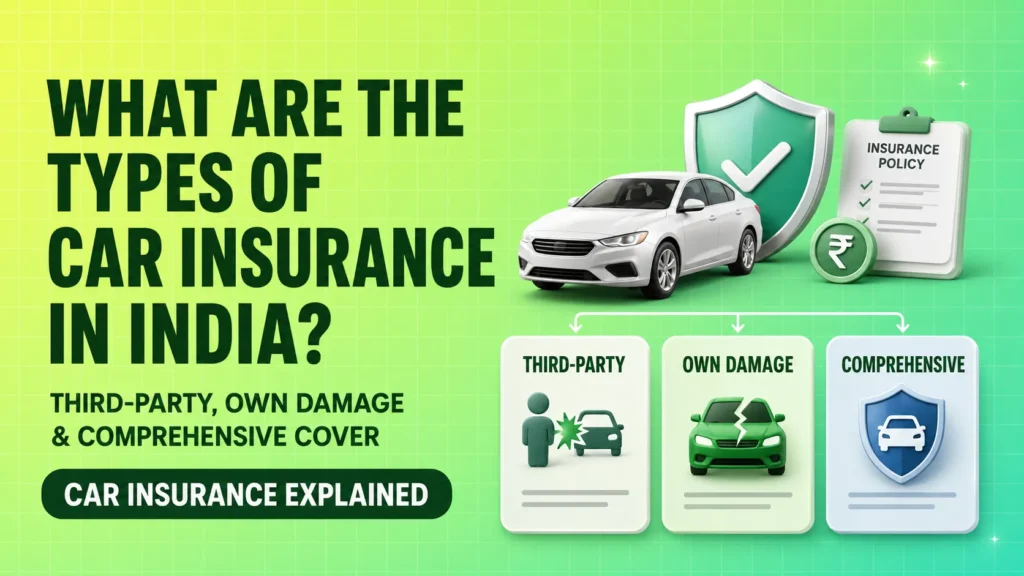
Quick answer: The main types of car insurance in India are third-party car insurance, standalone own damage car insurance, and comprehensive car insurance. Third-party insurance is legally mandatory. Own damage and comprehensive insurance protect your own car against covered risks like accident, theft, fire, flood, and natural calamities.
What is car insurance?
Car insurance is a contract between the car owner and the insurance company.
You pay a premium. In return, the insurer covers specific financial losses as per the policy terms.
A car insurance policy can cover damage caused to another person, another vehicle, another property, or your own car. The exact coverage depends on the type of policy you buy.
For example, third-party insurance protects you from legal liability toward others. Comprehensive insurance can cover both third-party liability and damage to your own car.
Why car insurance is mandatory in India
In India, third-party motor insurance is mandatory for vehicles used in public places.
This rule exists because accidents can injure other people or damage their vehicles and property. Third-party insurance gives financial protection to accident victims and protects the vehicle owner from large legal liability.
If you drive without valid third-party insurance, you may face a fine, imprisonment, or both as per the Motor Vehicles Act.
Own damage cover is not legally mandatory for all cars. But it is useful because third-party insurance does not pay for your own car repair.
Main types of car insurance in India
There are 3 main types of car insurance policies in India.
1. Third-party car insurance
Third-party car insurance is the basic legal insurance cover for a car.
It covers liability caused to another person, vehicle, or property because of your insured car.
It can cover:
- death of a third party
- injury to a third party
- damage to another person’s vehicle
- damage to third-party property
Third-party insurance does not cover damage to your own car.
Example: You accidentally hit another car. Third-party insurance can cover the damage caused to the other car, subject to policy terms and claim process. But it will not pay for repair of your own car.
What third-party insurance does not cover
- your own car accident damage
- theft of your car
- fire damage to your car
- flood damage to your car
- damage due to normal wear and tear
- damage when driving without a valid licence
Third-party insurance is cheaper than comprehensive insurance because the coverage is limited.
2. Standalone own damage car insurance
Standalone own damage insurance covers damage to your own car.
This policy is useful when you already have a valid third-party insurance policy and want separate protection for your car.
Own damage insurance can cover:
- accident damage
- theft
- fire
- explosion
- flood
- earthquake
- cyclone
- riot
- vandalism
- damage during transit, if covered
Standalone own damage insurance does not replace third-party insurance. You still need valid third-party cover to drive legally.
Example: Your car is parked outside and gets damaged due to heavy rain and flooding. A standalone own damage policy may cover the repair cost, subject to policy terms and exclusions.
3. Comprehensive car insurance
Comprehensive car insurance includes third-party liability cover and own damage cover in one policy.
It is usually the better choice for new cars, financed cars, and regularly used cars.
Comprehensive insurance can cover:
- third-party injury or death
- third-party property damage
- damage to your own car
- theft of your car
- fire damage
- flood damage
- natural calamities
- some man-made risks, as per policy wording
You can also add useful add-ons to comprehensive insurance, such as zero depreciation, engine protection, roadside assistance, and return to invoice cover.
Third-party vs own damage vs comprehensive car insurance
| Point | Third-party insurance | Standalone own damage | Comprehensive insurance |
|---|---|---|---|
| Mandatory? | Yes | No | No, but it includes third-party cover |
| Covers third-party injury or death | Yes | No | Yes |
| Covers third-party property damage | Yes | No | Yes |
| Covers your own car damage | No | Yes | Yes |
| Covers theft | No | Yes | Yes |
| Covers fire and flood | No | Yes | Yes |
| Premium | Usually lower | Depends on car and IDV | Higher than third-party cover |
| Best for | Legal compliance | Cars with existing third-party cover | New and regular-use cars |
Personal accident cover in car insurance
Personal accident cover is different from car damage cover.
It gives financial protection to the owner-driver in case of accidental death or disability, as per policy terms.
This cover is linked to the person driving the insured vehicle as owner-driver. It is not the same as repair coverage for the car.
Before buying or renewing car insurance, check whether you already have a valid personal accident cover. Some buyers end up paying for the same type of cover more than once because they do not check the existing policy.
Common car insurance add-ons in India
Add-ons are extra covers that you can buy with own damage or comprehensive car insurance.
They increase the premium, so choose only the ones that match your car, location, and usage.
Zero depreciation cover
Zero depreciation cover reduces the depreciation deduction during a claim.
This add-on is useful for new cars because plastic, rubber, fibre, and metal parts can attract depreciation during claim settlement.
Example: If your bumper is damaged, the insurer may deduct depreciation from the claim amount under a normal policy. With zero depreciation cover, the deduction may be lower, subject to policy terms.
Engine protection cover
Engine protection cover is useful in cities where waterlogging and floods are common.
A normal policy may not cover certain types of engine damage, especially if the damage happens due to water entering the engine and the driver tries to start the car again.
Engine protection cover can reduce this risk, subject to policy wording.
Return to invoice cover
Return to invoice cover is useful for new cars.
If the car is stolen or declared a total loss, this add-on can help you get an amount closer to the original invoice value, subject to policy terms.
Without this add-on, claim amount is usually based on IDV.
Roadside assistance cover
Roadside assistance can support you during breakdowns.
It may include towing, flat tyre support, battery jump-start, fuel assistance, and minor on-road help, depending on the insurer.
Consumables cover
Consumables cover can pay for small items used during repairs.
These may include nuts, bolts, screws, engine oil, coolant, grease, clips, washers, and similar items.
Without this add-on, such costs may be paid by the policyholder.
NCB protection cover
NCB means No Claim Bonus.
If you do not make a claim during the policy year, you may get a discount on own damage premium at renewal.
NCB protection cover can help protect your bonus after an eligible claim, subject to policy terms and claim limits.
Key replacement cover
Modern car keys can be costly.
Key replacement cover can pay for lost or damaged car key replacement, lockset replacement, or reprogramming cost, depending on the policy.
What is covered under car insurance?
Coverage depends on the policy type.
A comprehensive car insurance policy may cover:
- third-party injury or death
- third-party property damage
- damage to your own car due to accident
- theft of the car
- fire
- explosion
- lightning
- flood
- earthquake
- cyclone
- riot
- strike
- malicious damage
- damage during transit, if covered
Always check the policy wording. The same add-on name can have different conditions across insurers.
What is not covered under car insurance?
Car insurance does not cover every loss.
Common exclusions include:
- driving without a valid licence
- drunk driving
- driving under the influence of drugs
- using a private car for commercial purpose
- normal wear and tear
- mechanical or electrical breakdown
- damage after policy expiry
- intentional damage
- damage outside policy terms
- tyre damage alone, unless covered
- consequential loss, unless covered by add-on
Example: If your car is damaged in an accident while you are driving without a valid licence, the insurer may reject the claim.
Which type of car insurance should you buy?
The right policy depends on car age, car value, usage, city, parking safety, and budget.
For a new car
Comprehensive insurance is usually a better choice for a new car.
New cars have higher repair costs. Parts, sensors, headlights, bumpers, and electronic systems can be expensive.
Useful add-ons for a new car may include:
- zero depreciation cover
- engine protection cover
- return to invoice cover
- roadside assistance
- consumables cover
For an old car
For an old car, compare the car value, premium, and likely repair cost.
If the car value is very low and repair cost is manageable, some owners choose only third-party insurance. If the car is still used daily, comprehensive insurance can still make sense.
Do not buy add-ons blindly for an old car. Some add-ons may not be available after a certain car age.
For a financed car
If the car is bought on loan, comprehensive insurance is usually preferred.
The lender may also require proper insurance coverage because the vehicle is linked to the loan.
Check the lender’s insurance requirements before choosing the policy.
For city driving
City driving increases the chance of small dents, bumper damage, scratches, and traffic accidents.
Comprehensive cover with zero depreciation can be useful for a car used daily in busy traffic.
For a low-usage car
If you drive the car rarely, third-party insurance is still mandatory.
Own damage cover depends on the car’s value and parking risk. If the car is parked in an open area, flood, theft, and fire risk should be considered.
How car insurance premium is calculated
Car insurance premium depends on many factors.
Third-party premium is regulated. Own damage premium can vary across insurers.
Common premium factors include:
- type of policy
- car model
- engine capacity
- fuel type
- age of the car
- registration city or RTO
- IDV
- claim history
- No Claim Bonus
- add-ons selected
- voluntary deductible
- anti-theft device discount, if applicable
A cheaper premium is not always better. Low premium may come with lower IDV, higher deductible, fewer add-ons, or weaker claim support.
Important terms to know before buying car insurance
IDV
IDV means Insured Declared Value.
It is the maximum amount the insurer may pay if your car is stolen or declared a total loss, subject to policy terms.
Higher IDV can increase premium. Lower IDV can reduce premium but may reduce claim amount in total loss or theft cases.
NCB
NCB means No Claim Bonus.
If you do not make a claim in a policy year, you may get a discount on own damage premium at renewal.
NCB belongs to the policyholder, not the car. It can often be transferred when you replace your car, subject to insurer rules.
Deductible
Deductible is the amount you pay from your pocket during a claim.
There can be compulsory deductible and voluntary deductible.
A higher voluntary deductible may reduce premium, but it increases your share during claim.
Premium
Premium is the amount you pay to keep the policy active.
If you do not renew on time, the policy can expire. Claim will not be paid for damage after policy expiry.
Claim settlement
Claim settlement is the process where the insurer checks the damage, verifies documents, and pays the approved claim amount.
The process can be cashless or reimbursement-based.
How to choose the right car insurance policy
Use this checklist before buying or renewing car insurance.
- Check whether third-party cover is active.
- Compare comprehensive and standalone own damage cover.
- Check IDV carefully.
- Compare coverage, not only premium.
- Check cashless garage network near your city.
- Read exclusions.
- Choose useful add-ons only.
- Check claim process and customer support.
- Do not hide car modifications.
- Renew before expiry.
If your car is new, do not reduce IDV only to make the premium cheaper.
If your car is old, compare the value of add-ons with the likely claim benefit.
Common mistakes while buying car insurance
Buying only the cheapest policy
A cheap policy may have low IDV, weak coverage, limited add-ons, or higher out-of-pocket cost during claim.
Compare the full policy, not just the premium.
Ignoring IDV
IDV matters most in theft and total loss claims.
Reducing IDV too much can hurt you later.
Skipping useful add-ons for a new car
New cars have expensive parts.
Zero depreciation, engine protection, and return to invoice cover can be useful, depending on car model and city.
Buying too many add-ons for an old car
Every add-on increases the premium.
For an old car, choose add-ons only after checking car value and usage.
Forgetting policy expiry date
If your policy expires, you lose active coverage.
A break in insurance can also require vehicle inspection during renewal.
Assuming third-party insurance covers own car damage
Third-party insurance does not cover your own car repair.
You need own damage or comprehensive insurance for that.
Not reading exclusions
Every policy has exclusions.
Read the policy wording before filing a claim or expecting coverage.
Conclusion
The main types of car insurance in India are third-party insurance, standalone own damage insurance, and comprehensive insurance.
Third-party insurance is mandatory by law. It covers liability toward others but does not cover your own car damage.
Standalone own damage insurance covers your own car when you already have third-party cover. Comprehensive insurance covers both third-party liability and own damage in one policy.
For most new and regularly used cars, comprehensive insurance with selected add-ons is a practical choice. For old or low-value cars, compare the premium with the car’s value and repair cost.
Before buying, check IDV, exclusions, claim process, cashless garages, deductibles, and add-ons. A policy with clear coverage is better than a policy chosen only for the lowest premium.
Disclaimer: This article is for educational purposes only. Insurance coverage, premium, add-ons, limits, and claim rules can vary by insurer and policy wording. Please read the policy document carefully before buying or renewing car insurance.
FAQs
What are the main types of car insurance in India?
The main types of car insurance in India are third-party car insurance, standalone own damage insurance, and comprehensive car insurance. Third-party insurance is mandatory. Own damage and comprehensive insurance protect your own car against covered risks.
Which car insurance is mandatory in India?
Third-party car insurance is mandatory in India. It covers liability for injury, death, or property damage caused to a third party by the insured vehicle.
Is comprehensive car insurance mandatory?
Comprehensive car insurance is not mandatory for all cars. But it is useful because it includes third-party cover and own damage cover in one policy.
What is third-party car insurance?
Third-party car insurance covers legal liability caused to another person, vehicle, or property. It does not cover damage to your own car.
What is own damage car insurance?
Own damage car insurance covers damage to your own car due to covered risks such as accident, theft, fire, flood, natural calamity, and some man-made events.
What is the difference between third-party and comprehensive car insurance?
Third-party insurance covers damage or injury caused to others. Comprehensive insurance covers third-party liability and damage to your own car, subject to policy terms.
Which car insurance is best for a new car?
Comprehensive car insurance is usually better for a new car. Add-ons like zero depreciation, engine protection, and return to invoice cover can also be useful for new cars.