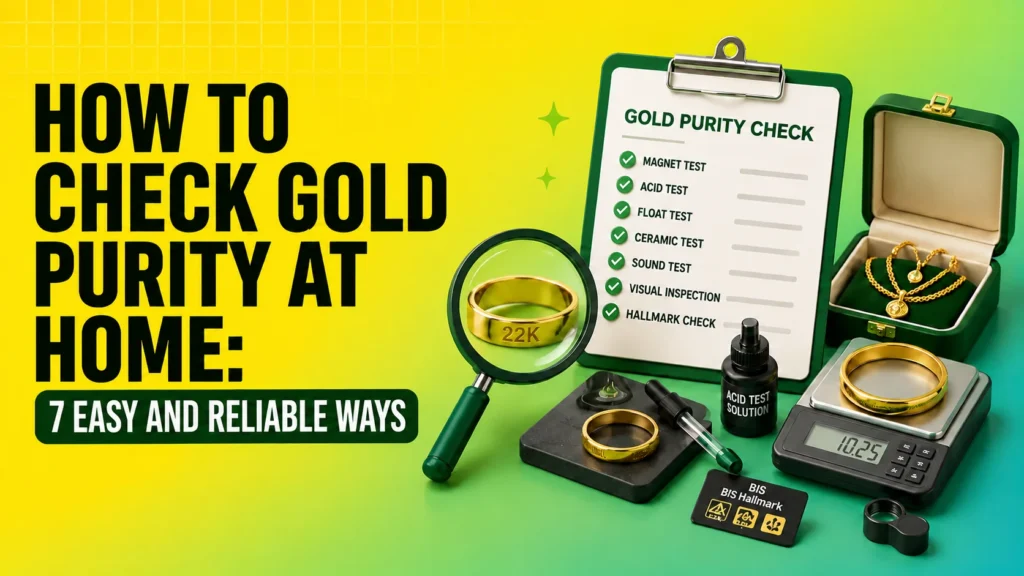
Why Checking Gold Purity Matters

Gold purity directly affects three factors:
- The price you pay at the shop
- The amount you get when you sell later
- The value you receive against a gold loan
In India, most jewellery is made of 22 K gold (91.6% pure). 24 K gold (99.9% pure) is mainly used for coins, biscuits, and investment bars. Pure 24 K gold is soft; therefore, jewellers mix other metals to make jewellery stronger for daily wear.
Also Read: Gold Loan vs Personal Loan
Understanding Gold Purity: Karat and Fineness
| Karat | Fineness | Pure Gold % | Common Use |
|---|---|---|---|
| 24K | 999 | 99.9% | Coins, bars, investment |
| 22K | 916 | 91.6% | Most jewellery |
| 18K | 750 | 75% | Designer jewellery |
| 14K | 585 | 58.5% | Everyday wear pieces |
When you see “916” stamped on jewellery, it means 22 K gold.
7 Easy Ways to Check Gold Purity
1. BIS Hallmark and HUID Check (Most Reliable Method)
This is currently the strongest and most trusted method in India.
Look carefully for these marks on the jewellery (usually inside rings, near clasps, or on the back of pendants):
- BIS logo (triangle shape)
- Purity mark (example: 22K916 or 18K750)
- 6-character HUID number
- Jeweller’s mark
Also read: Difference Between 22K and 24K Gold
How to verify using the BIS Care App:
- Download the free BIS Care app from the Play Store or App Store.
- Open the app and tap “Verify HUID.”
- Enter the 6-character code written on the jewellery.
- The app will show the purity, jeweller name, assaying centre, and hallmarking date.
If the details match, the gold is genuine as per BIS records. This method works best for jewellery hallmarked after 2021.
2. Magnet Test
Gold is a non-magnetic metal.
Take a strong magnet and hold it close to the piece. If the jewellery is attracted to the magnet, it contains iron, nickel, or other magnetic metals. Real gold does not stick.
Limitation: Many fake pieces use non-magnetic metals such as brass or copper. This test only detects the most obvious fakes.
3. Float or Water Test
Pure gold is very dense (approximately 19.3 grams per cubic centimetre).
The item was then dropped into a glass of clean water. Genuine solid gold sinks quickly to the bottom of the pan. Gold-plated or hollow pieces often float or sink slowly in the water.
This test is more effective for coins and solid bars than for hollow jewellery.
4. Vinegar or Lemon Juice Test
A few drops of white vinegar or lemon juice were placed on the surface of the gold.
Real gold does not react or change colour. Fake or low-purity gold often darkens or shows visible marks within a minute or two.
This is a quick chemical check but does not determine the exact karat.
5. Ceramic Scratch Test
Use an unglazed ceramic tile or the rough bottom of a ceramic plate.
Gently rub the gold piece across the surface. Real gold leaves a clear golden streak. Fake gold usually leaves a black, grey, or green mark.
Be careful while performing this test because it can leave a small scratch on jewellery.
6. Acid Test (Touchstone Method)
This is a common method used by many jewellers.
Gold is rubbed on a black touchstone to leave a streak. Different concentrations of nitric acid were then applied to the streak. The reaction shows approximate purity.
This method is moderately accurate but slightly damages the surface. It also requires experience and proper acids, so it is better performed by a trained person.
7. Professional Testing (XRF and Electronic Tester)
For higher accuracy, the following methods are preferred:
- Electronic Gold Tester: Measures the electrical conductivity and provides a karat reading quickly. It does not damage the piece but requires regular calibration.
- XRF (X-ray Fluorescence): This is the most accurate non-destructive method available at good jewellers and assay centres. It shows the exact metal composition with an accuracy of approximately ±0.1%.
Fire assay is the most precise laboratory method, but it destroys a small sample of gold.
Comparison of Testing Methods
| Method | Accuracy | Damages Item? | Best For | Approximate Cost |
|---|---|---|---|---|
| BIS HUID + App | Highest | No | Hallmarked jewellery | Free |
| Magnet Test | Low | No | Quick first check | Free |
| Float Test | Low to Moderate | No | Coins and solid pieces | Free |
| Vinegar Test | Low | No | Basic screening | Free |
| Ceramic Test | Moderate | Slight | Home check | Free |
| Acid Test | Moderate | Mild | Jewellers | Low |
| XRF Testing | Very High | No | High-value purchases | ₹200–500 |
Common Mistakes People Make
- Trusting only the stamp without verifying the HUID on the BIS Care app
- Relying only on magnet or float test
- Buying without checking the bill and hallmark together
- Ignoring older jewellery that may not have a HUID number
- Assuming that gold-plated items will fail every home test
Read Also; Gold SIP vs Gold ETF
What You Should Check Before Buying Gold
- Always ask for BIS hallmark and the HUID number
- Verify the HUID on the BIS Care app while you are still at the shop
- Match the purity written on the bill with the hallmark
- Prefer jewellers who offer XRF testing on the spot
- Keep the original invoice safely for future resale or gold loan
Conclusion
Today, the most reliable way to check gold purity in India is the BIS Hallmark combined with HUID verification on the BIS Care app. Home tests, such as those using magnets, floats, vinegar, and ceramics, are useful as initial checks but are insufficient on their own.
For any expensive purchase, combine the hallmark check with an XRF test at a trusted jeweller. This simple habit helps you avoid paying for impure or fake gold.
FAQs