Table of Contents
When you take a personal loan, repaying your monthly EMI on time is just as important as choosing the right lender. Missing an EMI can result in late payment charges, additional penalties, and a negative impact on your credit history. To make monthly repayments easier, banks and financial institutions offer automatic payment facilities such as UPI AutoPay and eNACH.
Both payment methods allow lenders to collect your loan instalments automatically from your bank account. However, their registration process, payment systems, and mandate management features are different.
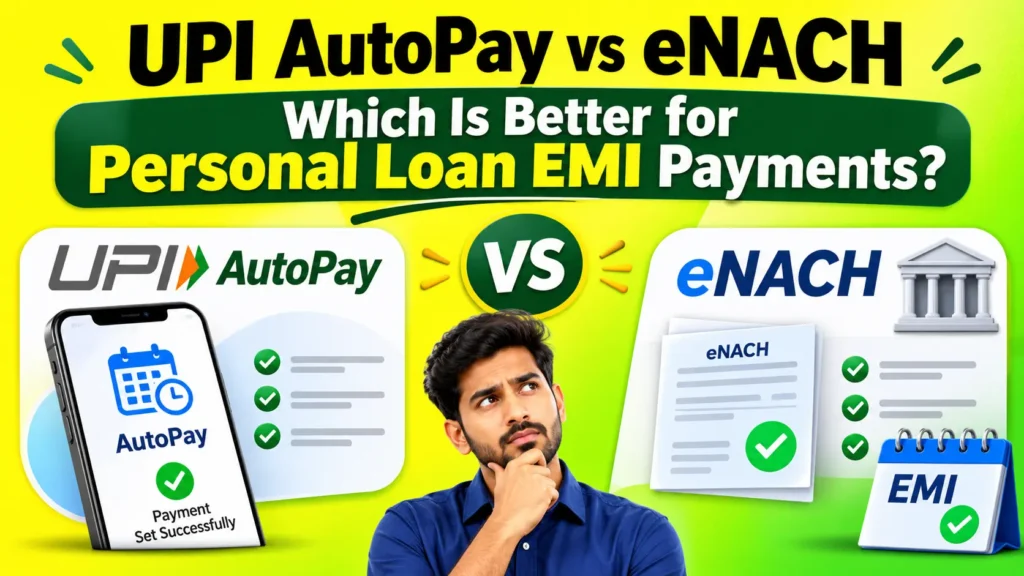
So, when comparing UPI AutoPay vs eNACH, which option is better for personal loan EMI payments?
In this guide, you will understand how both payment methods work, their benefits, key differences, and which option you should choose for convenient loan repayments.
What Is UPI AutoPay?
UPI AutoPay is a recurring payment facility that allows users to schedule automatic payments through the Unified Payments Interface (UPI). It helps people manage regular expenses without manually transferring money every month.
With UPI AutoPay, you can create a payment mandate through a supported UPI application and authorise your lender to collect your personal loan EMI on the scheduled date.
For example, suppose your monthly personal loan EMI is ₹6,000. Instead of making a manual payment every month, you can approve a UPI AutoPay mandate for the agreed amount and payment frequency. Once activated, the payment can be automatically deducted according to the mandate conditions.
Key Features of UPI AutoPay
Easy registration: Create and approve recurring payment mandates through supported UPI applications.
Automatic deductions: Your EMI can be collected according to the authorised payment schedule.
Payment notifications: Receive updates about mandate creation and payment transactions.
Mandate management: View and manage supported mandates through your UPI application.
Less manual effort: Avoid initiating a separate payment every month.
UPI AutoPay is useful for borrowers who regularly use digital payment applications and prefer managing recurring transactions through their smartphones.
What Is eNACH?
eNACH refers to an electronic mandate facility under the National Automated Clearing House (NACH) system. NACH is operated by the National Payments Corporation of India (NPCI) and supports recurring electronic payments between bank accounts.
Banks, NBFCs, and other financial institutions use NACH to collect loan EMIs, insurance premiums, and other scheduled payments.
When you select eNACH for your personal loan, you authorise your lender to debit the agreed EMI amount from your registered bank account on the specified date.
For example, if your monthly personal loan EMI is ₹8,000, you can register an eNACH mandate that allows the lender to collect the instalment automatically every month.
To understand the NACH mandate process and how it works, borrowers should know that the mandate gives the lender permission to initiate authorised recurring deductions.
Key Features of eNACH
Direct bank deductions: EMIs are collected from your registered bank account.
Electronic registration: Mandates can be registered through supported digital authentication methods.
Regular repayments: Supports scheduled payments throughout the loan tenure.
Less manual work: Reduces the need to transfer EMI amounts manually.
Banking support: Commonly used by banks and NBFCs for recurring collections.
eNACH is a practical option for borrowers who prefer automatic bank-account-based repayments.
UPI AutoPay vs eNACH: Key Differences
Both payment facilities help borrowers automate monthly loan repayments. However, they use different payment networks and mandate registration processes.
Here is a comparison to understand the difference between UPI AutoPay and eNACH.
| Comparison | UPI AutoPay | eNACH |
|---|---|---|
| Payment system | UPI network | NACH system |
| Registration | Through supported UPI apps | Through supported bank or lender processes |
| Authentication | UPI-based authorisation | Net banking, debit card, Aadhaar-based or other supported methods |
| Payment source | Linked bank account through UPI | Registered bank account |
| Payment frequency | Recurring schedules | Recurring schedules |
| Management | Supported UPI applications | Bank or lender mandate process |
| Common usage | EMIs, bills and subscriptions | Loan EMIs, insurance and recurring payments |
| Main advantage | Convenient app-based setup | Bank-based automatic collections |
The exact registration methods, mandate limits, and management facilities may vary depending on your bank, UPI application, and lender.
Benefits of UPI AutoPay for Personal Loan EMI Payments
UPI AutoPay offers several advantages to borrowers who prefer digital payment facilities.
1. Easy Mandate Registration
You can approve a recurring payment mandate through a supported UPI application. This makes the process convenient and reduces the need for physical paperwork.
2. Automatic EMI Payments
Once the mandate is active, your EMI can be deducted automatically on the scheduled date. You do not have to remember to initiate a payment every month.
3. Convenient Payment Tracking
UPI applications and banks may send notifications about mandate creation and payment transactions. These updates help you monitor your recurring payments.
4. Digital Mandate Management
Supported UPI applications allow users to view and manage active mandates. Depending on the available features, you may also be able to pause or revoke a mandate.
Benefits of eNACH for Personal Loan EMI Payments
eNACH is another useful option for borrowers who want to automate their loan repayments through their bank accounts.
1. Direct Bank Account Deduction
Your lender can collect the authorised EMI directly from your registered bank account without requiring a separate monthly transfer.
2. Suitable for Long-Term Repayments
Personal loans may have repayment periods of several months or years. eNACH helps automate these recurring payments throughout the authorised period.
3. Reduced Manual Effort
You do not need to remember to make a bank transfer every month. Once the mandate is registered successfully, payments follow the agreed schedule.
4. Convenient for Different Financial Payments
Apart from loan EMIs, NACH is also used for recurring payments such as insurance premiums and investment contributions.
Which Is Better for Personal Loan EMI Payments?
The better option depends on your banking preferences, lender support, and repayment requirements. Both UPI AutoPay and eNACH can make personal loan repayments easier.
Choose UPI AutoPay if:
You regularly use UPI applications.
You prefer digital mandate registration.
You want to manage recurring payment instructions through your smartphone.
Your lender supports UPI AutoPay for personal loan EMIs.
Choose eNACH if:
You prefer automatic deductions through your bank account.
Your lender offers eNACH as a repayment option.
You want a bank-based mandate for regular loan repayments.
You are comfortable with the bank’s mandate registration process.
For most borrowers, both options can be suitable. UPI AutoPay offers app-based convenience, while eNACH provides a bank-based repayment arrangement.
Before choosing either option, check the mandate conditions, debit date, applicable limits, and payment failure charges with your lender.
What Happens If Your EMI Payment Fails?
An automatic EMI payment can sometimes fail even when your mandate is registered. This may happen with either UPI AutoPay or eNACH.
Some common reasons include:
Insufficient balance in your bank account.
Temporary technical issues with the bank or payment network.
An inactive, expired, or revoked mandate.
Incorrect bank or mandate details.
Restrictions on your bank account.
If your EMI deduction fails, immediately check your loan account and contact your lender. You may need to pay the instalment through another approved payment method.
A failed debit does not cancel your repayment obligation. Delayed repayment may result in applicable bounce charges, late payment fees, and other consequences under your loan agreement.
Repeated repayment delays may also affect your credit history. Understanding DPD in your CIBIL report can help you learn how overdue payments are reflected in your repayment history.
Important Things to Check Before Setting Up an EMI Mandate
Before selecting UPI AutoPay or eNACH, consider these important points:
Check your EMI amount: Verify that the authorised mandate matches your loan repayment requirements.
Confirm the debit date: Know when your EMI will be collected every month.
Maintain sufficient balance: Keep enough funds in your account before the scheduled deduction.
Check mandate validity: Make sure your mandate remains active throughout the required repayment period.
Understand applicable charges: Ask your lender about failed payment charges and other fees.
Plan your monthly budget: Use a personal loan EMI calculator to understand your monthly repayment obligation before committing to a loan.
Keep payment records: Save transaction notifications, bank statements, and repayment receipts.
These steps can help you avoid unnecessary payment problems and manage your personal loan repayments more effectively.
Conclusion
Choosing between UPI AutoPay and eNACH depends on your convenience, banking habits, and the repayment options offered by your lender. Both payment facilities help automate monthly personal loan EMIs and reduce the effort of making manual transactions.
If you prefer managing recurring payments through UPI applications, UPI AutoPay can be a convenient option. However, if you prefer automatic deductions through your registered bank account, eNACH is also a practical choice.
Before selecting either facility, understand the mandate conditions, payment schedule, and applicable charges. Most importantly, maintain sufficient funds in your bank account and monitor your EMI transactions regularly.
Timely repayments can help you avoid unnecessary penalties and maintain a healthy credit history.
Frequently Asked Questions
Q1. What is the main difference between UPI AutoPay and eNACH?
UPI AutoPay uses the UPI network to automate recurring payments through supported UPI applications, whereas eNACH uses the NACH system to collect authorised recurring payments directly from registered bank accounts.
Q2. Is UPI AutoPay safe for personal loan EMI payments?
Yes. UPI AutoPay uses digital authentication and authorised payment mandates. However, always verify the lender’s details and approve only genuine payment requests.
Q3. Can I switch from eNACH to UPI AutoPay for my personal loan?
It depends on your lender. If UPI AutoPay is supported, you may register a new mandate and discontinue your existing eNACH mandate by following the lender’s process. Do not cancel your existing mandate before confirming the replacement.
Q4. What happens if my EMI is not deducted through UPI AutoPay or eNACH?
If an automatic EMI payment fails, you remain responsible for paying the instalment. Contact your lender, check the reason for failure, and make the payment through an approved alternative method to avoid repayment delays.
Q5. Which is better for long-term personal loan EMI payments?
Both UPI AutoPay and eNACH can be suitable for long-term repayments. UPI AutoPay offers app-based convenience, while eNACH provides a bank-account-based payment facility. Choose according to your lender’s support and personal preferences.