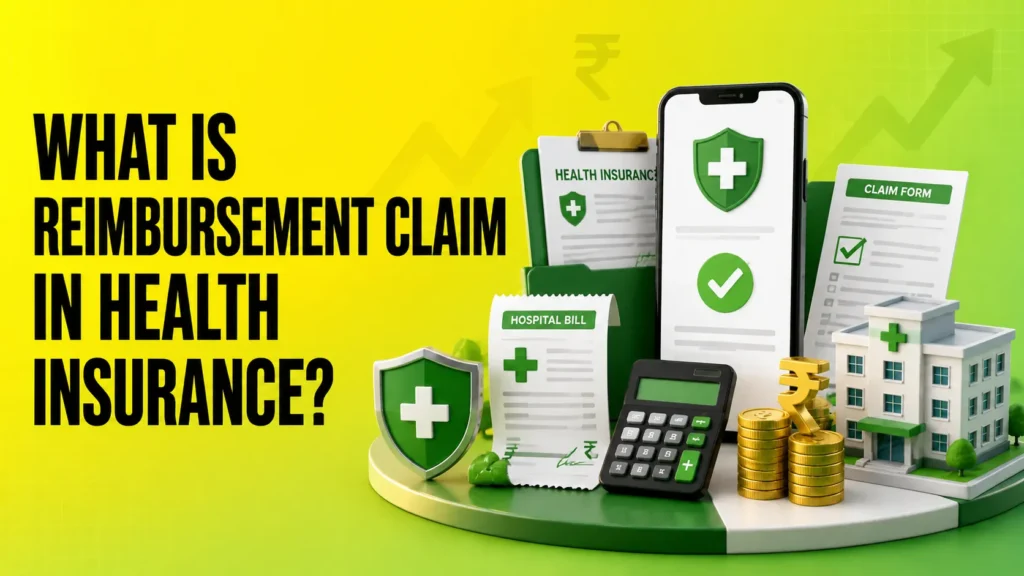
A reimbursement claim in health insurance means you pay your medical expenses first and later submit the bills and documents to your insurer to receive the eligible amount covered under your policy.
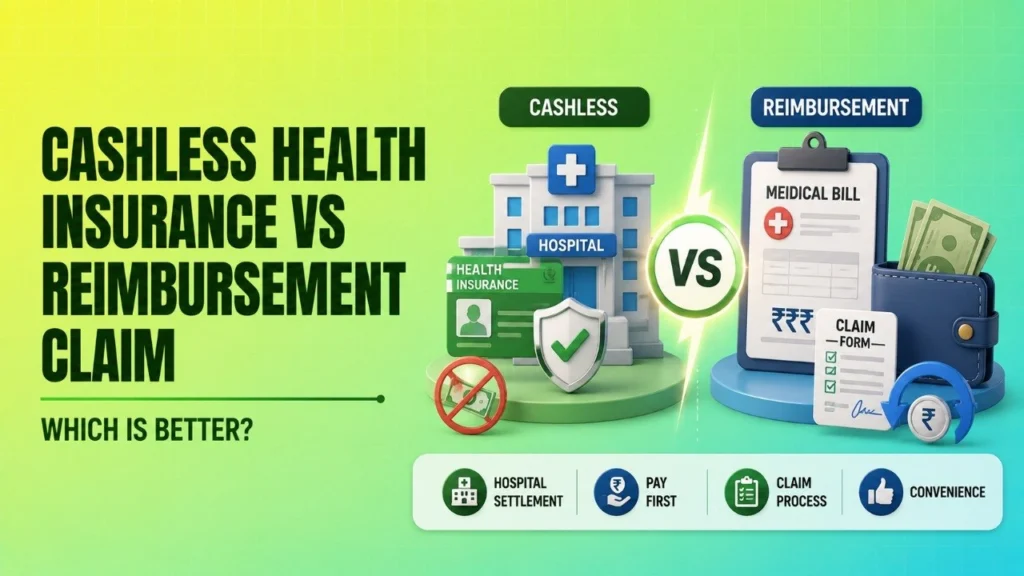
Unlike a cashless claim, where the insurer settles the approved amount directly with the hospital, a reimbursement claim requires you to pay the hospital bill yourself and claim the amount afterward.
Many policyholders assume that submitting a hospital bill means they will receive the entire amount back. However, insurers review the treatment details, policy coverage, exclusions, limits, and documents before approving the claim amount.
For example, if your hospital bill is ₹2 lakh, the approved reimbursement may be lower if some expenses are not covered under your policy.
A reimbursement claim is mainly useful when:
- Cashless treatment is unavailable.
- You receive treatment at a non-network hospital.
- You pay medical expenses during an emergency and claim later.
What Does a Reimbursement Claim Mean in Health Insurance?
A reimbursement claim allows you to recover eligible medical expenses after paying them yourself.
The payment process is different from a cashless claim:
Cashless claim:
Insurer → Hospital payment
Reimbursement claim:
You → Hospital payment → Insurer → Approved reimbursement to you
The insurer does not reimburse every expense automatically. Only those expenses that meet your policy terms are considered for payment.
Who Can File a Reimbursement Claim in Health Insurance?
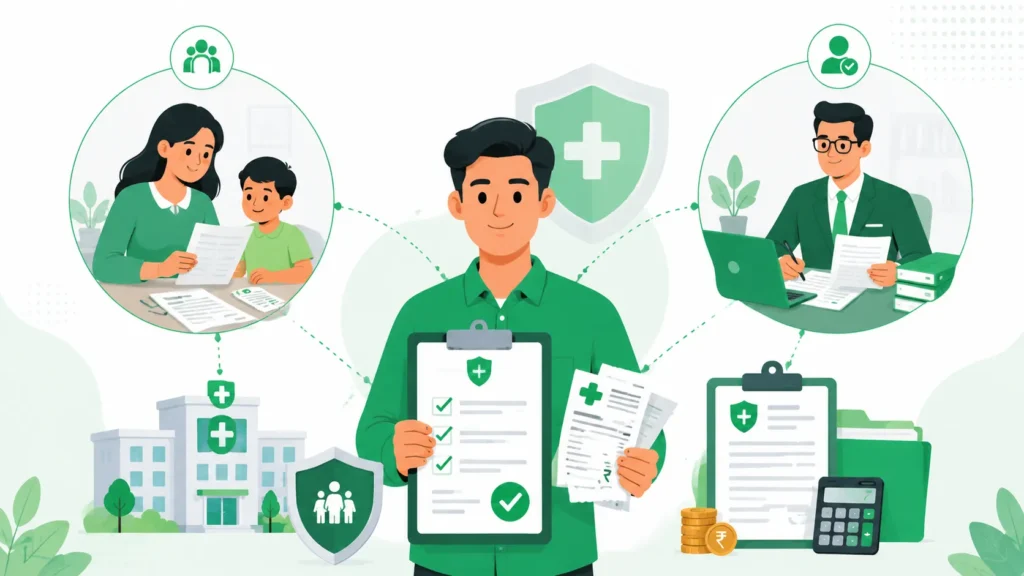
Usually, the insured person or policyholder can file a reimbursement claim. However, some policies may allow a dependent family member or an authorised person to submit the claim on behalf of the patient.
The claim can generally be filed by:
- Policyholder or insured person: The person covered under the health insurance policy.
- Dependent family member: A spouse, child, or other covered member if allowed by the policy.
- Authorised representative: A person filing the claim with proper authorisation.
The exact rules depend on your policy terms. Check your insurer’s guidelines before submitting a claim to avoid delays.
How Does a Reimbursement Claim Work?
The reimbursement claim process involves these simple steps:
1. Pay for your treatment
You first pay the hospital bill from your own pocket.
This usually happens when:
- The hospital does not offer cashless treatment.
- The hospital is outside your insurer’s network.
- You choose to pay first and claim later.
Keep all bills and medical records safely.
2. Collect required documents
Collect documents that help the insurer verify your treatment and expenses.
Common documents include:
- Hospital bills and payment receipts
- Discharge summary
- Doctor’s prescriptions
- Medical reports
- Claim form
- Policy and bank details
3. Submit your claim
Fill out the claim form and submit it with all required documents.
Before submission, check that:
- Bills are attached.
- Details are correct.
- Medical reports are included.
- Copies of documents are saved.
4. Insurer reviews and settles the claim
The insurer checks:
- Policy coverage
- Treatment details
- Exclusions
- Waiting periods
- Eligible expenses
After approval, the insurer pays the eligible reimbursement amount.
The final payment may be lower than your total bill because of policy limits, exclusions, deductibles, or co-payment clauses.
When Do You Need a Reimbursement Claim?
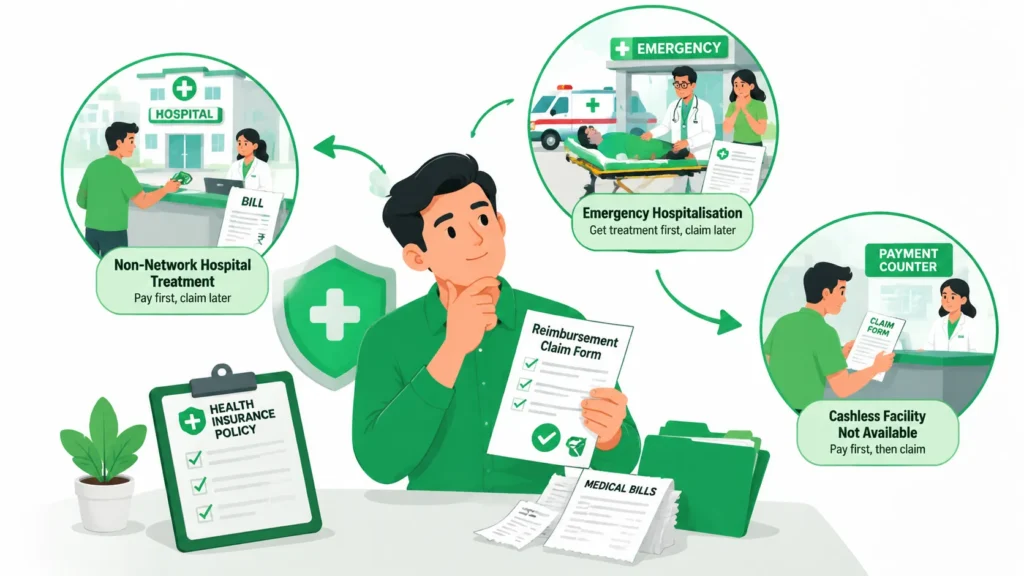
A reimbursement claim is used when you pay medical expenses first and later claim the eligible amount from your insurer.
1. Treatment at a Non-Network Hospital
If you receive treatment at a hospital that is not part of your insurer’s cashless network, you may need to pay the bill yourself and file a reimbursement claim later, depending on your policy terms.
Example:
After an accident, you are admitted to the nearest hospital that does not provide cashless treatment. You pay the hospital expenses and claim reimbursement afterward.
2. Emergency Hospitalisation
During emergencies, immediate treatment is the priority. If cashless approval is not possible, you can pay the expenses first and claim reimbursement later.
3. Cashless Facility Is Not Available
Sometimes cashless settlement may not be possible due to practical issues. In such cases, reimbursement allows you to recover eligible medical expenses after paying the hospital bill.
Reimbursement Claim vs Cashless Claim: What Is the Difference?
Both options help you use your health insurance, but the payment process is different.
| Feature | Reimbursement Claim | Cashless Claim |
|---|---|---|
| Payment process | You pay the hospital first and claim later | Insurer settles the approved amount with the hospital |
| Initial payment | Paid by the policyholder | Managed through insurer-hospital coordination |
| Hospital requirement | Depends on policy terms | Usually available at network hospitals |
| Documents | Requires bills, receipts, and medical records | Hospital usually coordinates claim documents |
| Payment timing | Received after claim approval | Settlement happens during treatment after approval |
A cashless claim reduces upfront payment, while reimbursement claims provide flexibility when you need to pay first.
Documents Required for a Reimbursement Claim
A reimbursement claim requires documents that help the insurer verify your treatment and expenses.
| Document | Purpose |
|---|---|
| Hospital bills and payment receipts | Proof of medical expenses paid by you |
| Discharge summary | Details of hospitalisation and treatment received |
| Doctor’s prescriptions and medical reports | Shows diagnosis and treatment details |
| Health insurance policy details | Helps verify coverage and benefits |
| Claim form and identity proof | Required for claim processing |
| Authorisation documents | Needed if someone else files the claim |
Keeping documents complete and organised can help prevent delays during claim processing.
Does Health Insurance Reimbursement Cover the Entire Hospital Bill?
No. A reimbursement claim does not always mean you will receive the full hospital bill amount.
The insurer pays only eligible expenses covered under your policy.
The final reimbursement amount may be affected by:
| Factor | How It Affects Your Claim |
|---|---|
| Policy exclusions | Expenses not covered under the policy are not reimbursed |
| Co-payment | You may need to pay a percentage of approved expenses |
| Deductibles | A fixed amount may need to be paid before coverage applies |
| Sub-limits | Certain treatments or expenses may have maximum payout limits |
Always check your policy coverage, exclusions, and limits before filing a claim.
What Factors Affect Reimbursement Claim Approval?
Several factors influence whether your claim gets approved.
Policy coverage
The treatment must be covered under your health insurance plan.
Waiting periods
Some treatments or conditions may have waiting periods before coverage starts.
Medical records
Complete medical documents help the insurer verify the claim.
Policy limits
Your sum insured and policy restrictions affect the payable amount.
Claim documentation
Incomplete or incorrect documents can delay processing.
Common Reasons Reimbursement Claims Get Rejected
A claim can be rejected even when treatment was genuine.
Common reasons include:
Missing documents
Incomplete bills, reports, or receipts can create problems.
Treatment not covered under the policy
Some expenses may fall outside your policy coverage.
Waiting period not completed
Certain treatments may not be covered if the waiting period is active.
Incorrect information
Mismatch between claim forms and medical records can delay or affect approval.
Expenses outside policy limits
Some charges may not qualify for reimbursement.
Common Mistakes to Avoid While Filing a Reimbursement Claim
Avoid these common mistakes:
Assuming every expense is covered
Check your policy before expecting reimbursement for every medical expense.
Losing original documents
Bills and medical records are important proof for your claim.
Submitting incomplete paperwork
Missing documents can delay approval.
Ignoring policy exclusions
Understand what your insurance does not cover.
Delaying claim submission
Follow your insurer’s claim filing requirements.
How to Make Your Reimbursement Claim Process Easier?
A few simple steps can make the process smoother:
- Keep digital copies of all medical documents.
- Inform your insurer about hospitalisation when required.
- Maintain a separate folder for claim-related papers.
- Review your policy exclusions before making a claim.
- Submit complete documents in the first attempt.
Good documentation reduces unnecessary back-and-forth during claim processing.
What Should You Check in Your Health Insurance Policy Before Filing a Claim?
Before you need to make a claim, check these sections:
Coverage details
Understand which medical expenses are included.
Exclusions
Know which treatments or expenses are not covered.
Waiting periods
Check restrictions on specific diseases or treatments.
Claim procedure
Understand how and where documents need to be submitted.
Knowing these details before a medical emergency can make the reimbursement process easier.
What Happens If Your Reimbursement Claim Is Rejected?
If your reimbursement claim is rejected, first understand the reason.
You can:
- Review the rejection reason.
- Check the relevant policy terms.
- Ask the insurer for clarification.
- Submit additional documents if required.
- Use the insurer’s grievance process if needed.
Keep all communication related to your claim for future reference.