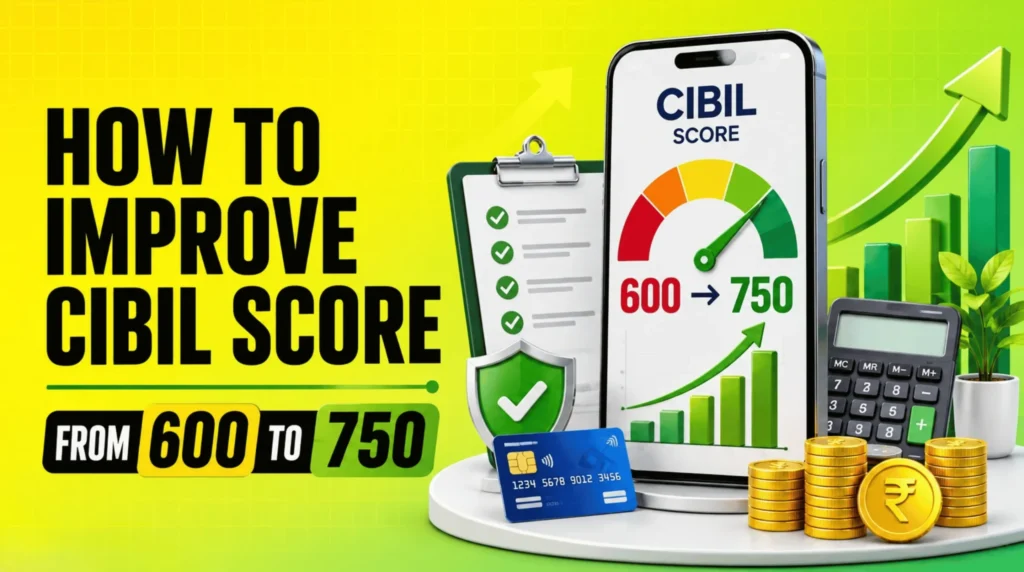
A CIBIL score of 600 can make it harder to get loans or credit cards on favourable terms. If your goal is to reach 750, the answer is not a quick trick. You need to fix the issues affecting your credit profile and maintain good repayment habits.
The good news is that your CIBIL score can improve with consistent credit management. Paying dues on time, keeping credit card balances low and checking your credit report regularly are some of the main steps recommended by CIBIL.
What Does a 600 CIBIL Score Mean?
A CIBIL score ranges from 300 to 900. A higher score generally indicates a stronger credit history and can improve your chances of getting approved for credit.
A score around 600 may indicate problems in your credit history, such as:
- Late or missed EMI payments
- Delayed credit card payments
- High credit card utilisation
- Outstanding dues
- Too many recent credit enquiries
- Errors in your credit report
- Limited credit history
A score of 750 is often viewed as a strong score by lenders, but there is no universal score that guarantees loan approval. Each lender uses its own eligibility criteria. CIBIL says that 79% of loans are sanctioned to consumers with scores above 750.
Also read: How to Get a Loan Without CIBIL Score in India
Why Is Your CIBIL Score Around 600?
Your score may be low because of one or more issues in your credit history.
The main factors include:
- Payment history: Missed or late payments can hurt your score.
- Credit utilisation: Using a large part of your available credit can affect your profile.
- Credit enquiries: Applying for several loans or credit cards in a short period can have a negative effect.
- Credit mix: A healthy mix of secured and unsecured credit can support your profile.
- Credit history: A longer record of responsible credit use can be helpful.
Before trying to increase your score, check your credit report. This helps you find the actual reason behind the low score instead of guessing.
How to Improve CIBIL Score from 600 to 750?
1. Pay EMIs and Credit Card Bills on Time
Payment history is one of the most important parts of your credit profile. Late payments and defaults can negatively affect your CIBIL score.
To avoid missed payments:
- Pay your EMI before the due date.
- Pay your credit card bill on time.
- Set payment reminders.
- Use auto-pay if it suits you.
- Keep enough money in your account for scheduled payments.
Don’t wait until the last day if you can pay earlier.
2. Reduce Your Credit Card Utilisation
Credit utilisation is the amount of your available credit that you are using.
For example, if your credit card limit is ₹1 lakh and you use ₹80,000, your utilisation is 80%.
High utilisation can indicate that you are depending heavily on credit. CIBIL recommends keeping credit balances low.
You can reduce utilisation by:
- Paying down your card balance.
- Avoiding unnecessary credit card spending.
- Paying the full outstanding amount when possible.
- Not treating your entire credit limit as available spending money.
Don’t take a new loan simply to reduce your utilisation.
3. Clear Outstanding Dues
If you have overdue EMIs or credit card payments, deal with them as soon as possible.
Start by checking:
- Total outstanding amount
- Overdue amount
- Due date
- Loan or credit card status
- Any additional charges
After making a payment, check your credit report later to make sure the account information has been updated correctly.
If an account has been reported as settled, written off or otherwise negatively reported, simply paying money does not automatically mean the history disappears. The lender’s reporting and your credit history still matter.
4. Avoid Applying for Too Many Loans or Credit Cards
Every time you apply for credit, the lender may check your credit report. These checks can create enquiries.
Several credit applications within a short period can negatively affect your credit profile. CIBIL recommends applying for new credit in moderation.
Instead:
- Apply only when you actually need credit.
- Compare loan options before submitting applications.
- Avoid applying to many lenders at the same time.
5. Check Your CIBIL Report for Errors
Sometimes your credit report may contain incorrect information.
Check for:
- Accounts you don’t recognise
- Incorrect payment status
- Wrong outstanding amounts
- Incorrect personal details
- Duplicate accounts
- Unauthorised credit enquiries
If you find an error, raise a dispute through the appropriate process. CIBIL provides a facility for consumers to dispute inaccurate information in their credit report.
Correcting an error does not mean your score will automatically increase by a fixed number of points. The effect depends on what was wrong and how it affected your report.
6. Keep Older Credit Accounts When Appropriate
The length of your credit history can be a factor in your credit profile. A longer record of responsible credit management can be useful.
This does not mean you should keep every credit card forever.
If an old account has no annual fee and is useful to you, closing it unnecessarily may not be helpful. Consider the account’s cost and your overall credit needs before closing it.
7. Maintain a Healthy Credit Mix
Your credit profile can include different types of credit, such as:
- Home loans
- Car loans
- Personal loans
- Credit cards
CIBIL considers credit mix as one of the factors affecting the score. A balanced mix of secured and unsecured credit can be positive when the credit is managed responsibly.
However, don’t take a new loan just to create a credit mix. Taking unnecessary debt can create more financial pressure.
8. Monitor Joint and Co-Signed Accounts
If you are a joint borrower, co-signer or guarantor, another person’s repayment behaviour can affect your credit profile.
Check these accounts regularly for:
- Missed payments
- Overdue amounts
- Changes in loan status
Don’t assume that someone else’s loan cannot affect your CIBIL score if your name is connected to the account.
How Long Does It Take to Improve CIBIL Score from 600 to 750?
There is no fixed timeline for moving from 600 to 750.
The time depends on why your score is low and how serious the problem is.
For example:
- High credit utilisation may improve after you reduce outstanding balances and the updated information is reported.
- Incorrect information may be corrected after a successful dispute.
- A history of late payments or defaults can take longer to recover from.
- A thin or new credit history requires more time to build.
Some current guides suggest improvement can become visible within a few months, but reaching a particular score such as 750 cannot be guaranteed within a fixed number of months.
So, avoid promises such as “increase your CIBIL score by 150 points in 30 days.”
The better approach is to focus on consistent behaviour.
What Not to Do While Improving Your CIBIL Score
Avoid these common mistakes:
- Don’t miss EMI or credit card payments.
- Don’t keep high credit card balances.
- Don’t apply for several loans at once.
- Don’t take unnecessary loans just to improve your credit mix.
- Don’t ignore incorrect information on your credit report.
- Don’t assume paying one overdue bill will immediately take your score to 750.
Improving a credit profile is a gradual process.
A Simple Plan to Improve Your CIBIL Score
This Month
- Check your CIBIL score and credit report.
- Identify overdue accounts.
- Check for errors.
- Set reminders or auto-pay for upcoming payments.
- Start reducing high credit card balances.
Next 3–6 Months
- Pay every EMI and credit card bill on time.
- Keep credit card utilisation under control.
- Avoid unnecessary credit applications.
- Monitor your credit report.
- Keep existing credit accounts in good standing.
Over the Longer Term
Continue the same habits:
- Pay every bill on time.
- Borrow only when needed.
- Keep credit balances manageable.
- Monitor joint and co-signed accounts.
- Check your credit report periodically.
There is no shortcut that can replace a clean repayment history.
Common Mistakes That Can Delay CIBIL Score Improvement
Paying Only the Minimum Amount
Paying the minimum due can prevent a missed payment, but it does not solve high credit card debt.
Check instead: Your total outstanding balance and whether you can pay it down.
Applying for More Credit to Improve Your Score
Taking a new loan or credit card only to build your score can create unnecessary debt and enquiries.
Check instead: Whether you actually need the new credit.
Ignoring Old Credit Problems
An old overdue account can continue to affect your credit profile.
Check instead: Your complete credit report and the status of old accounts.
Expecting an Instant Increase
Your score does not rise by a guaranteed number of points after one payment.
Check instead: Your overall credit behaviour over time.
Conclusion
Improving a CIBIL score from 600 to 750 takes consistent credit management rather than a quick fix. Start by checking your report, clearing overdue dues, paying every bill on time and keeping your credit utilisation under control.
Avoid unnecessary borrowing and monitor your credit report regularly. Over time, these habits can help you build a stronger credit profile and improve your chances of getting credit on better terms.
Q1. Can I increase my CIBIL score from 600 to 750?
Yes, it is possible to improve a 600 CIBIL score, but reaching 750 is not guaranteed or immediate. Focus on timely payments, lower credit utilisation, fewer unnecessary enquiries and accurate credit-report information.
Q2. How long does it take to improve a CIBIL score from 600 to 750?
There is no fixed timeline. It depends on the reasons for your low score, your repayment history and how consistently you manage credit going forward.
Q3. How can I improve my CIBIL score quickly?
Start by paying overdue amounts, making all future payments on time, reducing high credit utilisation and correcting errors in your credit report. These steps can help, but no legitimate method guarantees a quick increase of a specific number of points.
Q4. Does paying credit card bills on time improve CIBIL score?
Yes. Timely repayment helps build a positive payment history, which is an important factor in your CIBIL score.
Q5. Does reducing credit card utilisation improve CIBIL score?
Keeping your credit utilisation low can support a healthier credit profile. CIBIL specifically advises consumers to keep their balances low and control credit utilisation.