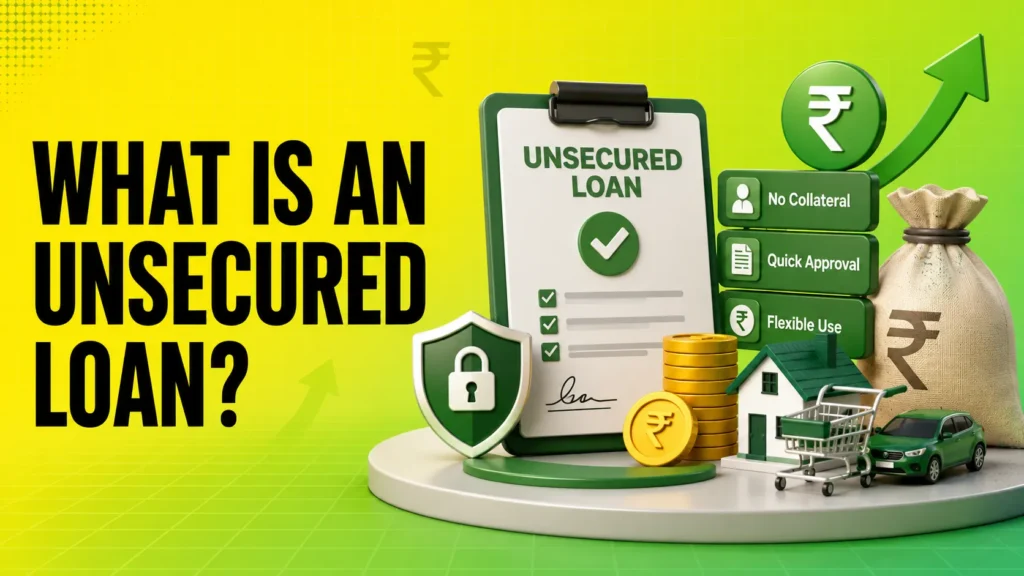
An unsecured loan is a loan that you can take without pledging an asset as collateral. The lender mainly looks at your income, credit history, repayment capacity and other financial details before approving the loan.
Personal loans are one of the most common examples. Since the lender does not have an asset as security, unsecured loans can carry higher interest rates than some secured loans.
Table of Contents
Quick Overview
- An unsecured loan does not require collateral such as property or gold.
- Lenders assess your credit profile and repayment capacity.
- Personal loans and credit card borrowing are common examples.
- Interest rates may be higher because the lender takes more credit risk.
- Your income, credit history and existing debts can affect approval.
- Missing payments can hurt your credit history.
- Always compare the total repayment cost, not just the EMI.
What Is an Unsecured Loan?
An unsecured loan is a loan that does not require collateral. Collateral is an asset that a borrower pledges to secure a loan. Examples include property, gold or certain financial assets. With an unsecured loan, the lender does not take such an asset as security. Instead, it evaluates whether you are likely to repay the loan based on your financial profile.
Simple Example
Suppose you need ₹2 lakh for a personal expense.
You apply for a personal loan without pledging your house, car or gold.
The lender may check your:
- Income
- Credit history
- Existing EMIs
- Employment or business stability
- Repayment capacity
If you meet its criteria, the loan can be approved without collateral.
Also read: What Is a Loan
How Does an Unsecured Loan Work?
The basic process is simple:
- You apply for the loan.
- The lender checks your financial profile.
- The lender decides the loan amount, interest rate and tenure.
- The loan is approved and disbursed if you meet the requirements.
- You repay the loan through scheduled EMIs or payments.
Because there is no collateral, the lender has to assess your ability to repay more carefully.
A strong credit profile and stable income can improve your chances of getting suitable loan terms.
What Are the Types of Unsecured Loans?
Several common financial products can be unsecured.
1. Personal Loan
A personal loan is commonly used for expenses such as medical costs, weddings, travel, education or other personal needs.
It generally does not require collateral.
2. Credit Card
Credit card borrowing is generally unsecured. You can use the card up to your approved credit limit and repay the amount according to the card’s terms.
If you carry a balance, interest and other applicable charges can make the borrowing expensive.
3. Education Loan
Some education loans may be available without collateral, particularly for smaller loan amounts or under specific lender conditions.
The exact requirement depends on the lender and loan amount.
4. Consumer Durable Loan
You may use financing to purchase products such as a smartphone, television or appliance and repay the amount through EMIs.
5. Unsecured Business Loan
Some lenders offer business loans without requiring property or another asset as collateral. Approval can depend heavily on business financials, credit history and repayment capacity.
Secured vs Unsecured Loan
The main difference is collateral.
| Feature | Secured Loan | Unsecured Loan |
|---|---|---|
| Collateral | Required | Not required |
| Lender’s security | Asset is pledged | No specific asset pledged |
| Interest rate | Often lower | Often higher |
| Approval factors | Asset + borrower profile | Mainly borrower profile |
| Common examples | Home loan, gold loan | Personal loan, credit card |
| Risk to pledged asset | Yes | No specific collateral is pledged |
Secured loans can offer lower rates because the lender has an asset as security. Unsecured loans remove that requirement but can cost more because the lender takes greater credit risk.
What Are the Benefits of an Unsecured Loan?
No Collateral Required
You do not have to pledge your property, gold or another asset.
This can be useful if you do not own a suitable asset or do not want to put one at risk.
Easier Access to Funds
For eligible borrowers, the application can be simpler because there is no collateral valuation or asset-related documentation.
However, approval speed varies by lender and loan product.
Flexible Use
Personal loans can often be used for different legitimate personal expenses, subject to the lender’s terms.
No Specific Asset Is Pledged
If you take an unsecured loan, there is no specific collateral attached to the loan.
That does not mean you can stop repayment without consequences.
What Are the Risks of an Unsecured Loan?
The convenience of an unsecured loan comes with some trade-offs.
Higher Interest Cost
Unsecured loans often have higher interest rates than comparable secured borrowing because the lender does not have collateral.
A higher rate can increase your total repayment significantly.
Stricter Credit Requirements
Lenders may place greater importance on your credit history, income and repayment capacity.
A weaker credit profile can make approval harder or result in less favourable terms.
Lower Loan Amount in Some Cases
The amount you can borrow depends on your income, credit profile, lender policies and other factors.
You may not qualify for a large loan without suitable financial strength.
Credit Score Impact
Missing EMI payments can negatively affect your credit history when reported by the lender.
That can make future borrowing more difficult or expensive.
Additional Charges
The interest rate is not always the only cost.
Check for:
- Processing fees
- Late payment charges
- Prepayment or foreclosure charges, where applicable
- Other fees mentioned in the loan agreement
Who Is Eligible for an Unsecured Loan?
Eligibility varies between lenders.
However, lenders commonly consider factors such as:
- Age
- Income
- Employment or business stability
- Credit history
- Existing loans and EMIs
- Repayment capacity
- Loan amount requested
For example, a salaried applicant with stable income and a good repayment history may have a stronger application than someone with irregular income and high existing debt.
There is no single credit score or income level that guarantees approval across all lenders.
How Much Does an Unsecured Loan Cost?
Do not judge a loan only by its EMI.
Consider the complete borrowing cost.
For example, suppose you borrow ₹1 lakh and repay it through monthly EMIs.
Your actual cost can include:
Principal + Interest + Applicable Fees and Charges
A longer tenure may reduce your monthly EMI but increase the total interest paid.
Before accepting a loan, compare:
- Interest rate
- Loan tenure
- EMI
- Total repayment
- Processing fee
- Late payment charges
- Prepayment conditions
This gives you a better idea of what the loan will actually cost.
What Should You Check Before Taking an Unsecured Loan?
Use this simple checklist before applying:
1. Borrow Only What You Need
Avoid taking a larger loan simply because you qualify for it.
2. Compare Total Repayment
A lower EMI does not always mean a cheaper loan.
Check how much you will pay in total.
3. Check the Interest Rate
Compare offers from suitable lenders rather than accepting the first offer.
4. Check the Fees
Look beyond the advertised interest rate.
Read the loan agreement for processing and other applicable charges.
5. Check the Tenure
A longer tenure can reduce the monthly burden but may increase the overall interest cost.
6. Make Sure the EMI Fits Your Budget
Your loan payment should leave enough room for regular expenses, savings and unexpected costs.
7. Read the Loan Terms
Check the repayment schedule, late charges and prepayment conditions before accepting the loan.
For applicable retail and MSME term loans, RBI’s framework also provides for a Key Facts Statement (KFS) containing important loan information.
What Happens If You Do Not Repay an Unsecured Loan?
Unsecured does not mean consequence-free.
If you miss repayments, the lender may charge applicable late fees or other charges. Continued default can also affect your credit history.
The lender can follow the recovery and legal processes available under the loan agreement and applicable law.
So, even though no specific asset is pledged, repayment remains your responsibility.
Is an Unsecured Loan Right for You?
An unsecured loan may make sense when you need funds and do not want to pledge an asset.
It can also be useful when the loan amount is manageable and you have stable repayment capacity.
Before borrowing, ask yourself:
- Do I really need the loan?
- Can I comfortably pay the EMI every month?
- Have I compared the total cost?
- Is there a lower-cost secured option available?
- What happens if my income falls temporarily?
The right choice depends on your financial situation, not just how quickly the loan can be approved.
Common Mistakes to Avoid
Choosing Only by EMI
A low EMI can hide a longer repayment period.
Check instead: total interest and total repayment.
Borrowing More Than Necessary
A higher loan means a higher repayment obligation.
Check instead: the exact amount you need.
Ignoring Fees
A loan with a slightly lower interest rate may not always be cheaper after fees.
Check instead: the complete cost of borrowing.
Missing EMI Dates
Late payments can result in charges and may affect your credit history.
Check instead: set reminders or use an appropriate automatic payment facility.
Conclusion
An unsecured loan is a loan that does not require collateral. Instead, lenders assess factors such as your income, credit history and repayment capacity before deciding whether to approve it.
Personal loans and credit card borrowing are common examples. Before taking one, compare the interest rate, total repayment, fees, tenure and EMI. A loan is affordable only when the repayment fits comfortably into your budget.
Frequently Asked Questions
Q1. What is an unsecured loan
An unsecured loan is a loan that does not require you to pledge an asset as collateral. The lender mainly evaluates your credit profile and repayment capacity.
Q2. Is a personal loan an unsecured loan?
Yes, personal loans are commonly unsecured. However, the exact structure can vary by lender and product.
Q3. Is an unsecured loan better than a secured loan?
Not always. An unsecured loan does not require collateral, but it may have a higher interest rate. A secured loan may offer lower borrowing costs but requires an asset as security.
Q4. Does an unsecured loan require a CIBIL score?
Lenders commonly consider credit history and credit scores when evaluating unsecured loan applications. However, eligibility requirements vary between lenders.
Q5. What are the main risks of an unsecured loan?
The main risks include higher interest costs, repayment pressure, additional charges and possible damage to your credit history if you miss payments.