Lorem ipsum dolor sit amet, consectetur adipiscing elit. Ut elit tellus, luctus nec ullamcorper mattis, pulvinar dapibus leo.
When you borrow money or buy an expensive product on credit, you may not have to pay the entire amount at once. Instead, the amount can be divided into smaller payments that are made at fixed intervals. These payments are called installments.
Installments are common with personal loans, home loans, car loans, consumer purchases and other forms of credit. Understanding how an installment works can help you compare loan offers, manage monthly expenses and avoid focusing only on the EMI amount.
Table of Contents
Quick Overview
- An installment is a scheduled payment made toward an amount owed over a specific period.
- Loan installments generally include principal and interest.
- An EMI (Equated Monthly Installment) is a type of installment paid every month.
- The installment amount can depend on the loan amount, interest rate and repayment tenure.
- A longer tenure can reduce the monthly payment but may increase the total interest paid.
- Missing an installment can result in additional charges and may affect your credit history.
- Before choosing a repayment plan, check the total repayment amount, fees, interest and prepayment conditions.
What Is an Installment?
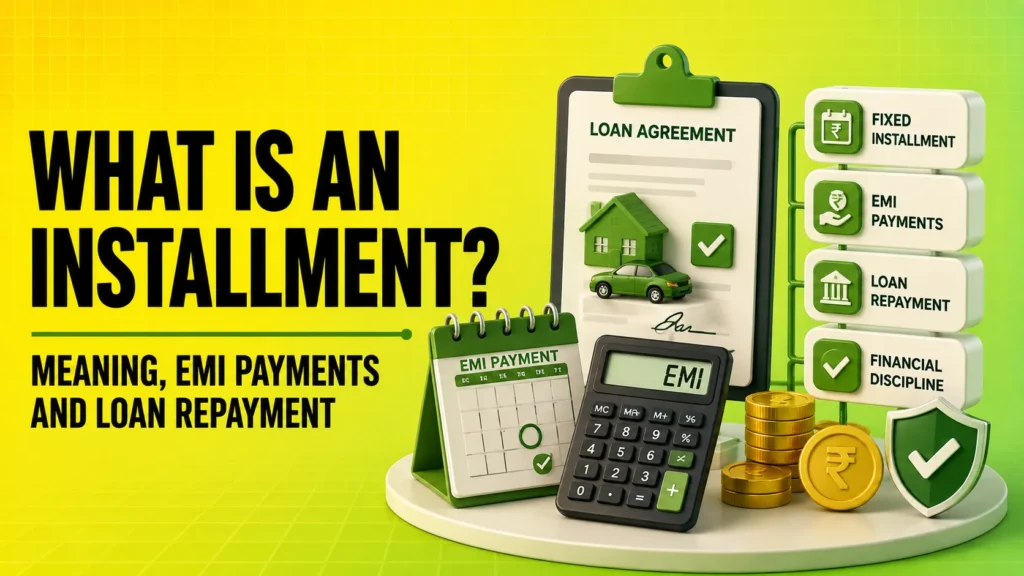
An installment is a scheduled payment made in parts instead of paying the full amount at once.
For example, suppose you buy a product worth ₹60,000 and agree to pay it in 12 monthly payments. Instead of paying ₹60,000 immediately, you make a payment every month according to the agreed repayment schedule.
In loans, an installment is usually made up of two main components:
- Principal: The amount borrowed that you need to repay.
- Interest: The cost charged by the lender for providing the loan.
The exact structure depends on the loan agreement. Some installment plans may also involve applicable fees, taxes or other charges.
Also read: What is a loan
Simple Example of an Installment
Suppose you borrow ₹1 lakh and agree to repay it in 10 scheduled payments.
Your repayment could be divided into multiple installments rather than requiring you to return the entire ₹1 lakh immediately.
If interest applies, the total amount you repay will generally be higher than ₹1 lakh.
[Internal Link: What Is a Loan]
How Does an Installment Work?
An installment arrangement divides a payment obligation into several scheduled payments.
For a typical loan, the process works like this:
- You borrow money from a lender.
- The lender sets the interest rate and repayment tenure.
- A repayment schedule is created.
- You make the required installment on each due date.
- Each payment reduces the amount you owe according to the loan’s repayment structure.
- The loan ends after all required payments and applicable dues are cleared.
For many loans, the monthly payment remains the same under a standard fixed EMI structure. However, the amount or tenure can change in some floating-rate loan arrangements.
RBI guidance for EMI-based floating-rate personal loans requires lenders to consider the borrower’s repayment capacity when a rise in the benchmark rate could increase the EMI or extend the loan tenure.
Also read: What Is EMI?
What Is an Installment in a Loan?
A loan installment is a scheduled amount that a borrower pays to the lender toward repayment of the loan.
For a standard amortising loan, the payment generally covers:
| Component | Meaning |
|---|---|
| Principal | Part of the original amount borrowed |
| Interest | Cost charged on the outstanding loan |
| Other applicable charges | Fees or charges that may apply under the loan agreement |
The proportion of principal and interest can change over the repayment period. In a typical reducing-balance loan, interest is calculated based on the outstanding balance, so the interest component generally falls as the principal is repaid.
For example, your first few payments may contain a larger interest component. As the outstanding principal falls, a greater portion of later payments can go toward principal.
The exact repayment schedule depends on the lender, interest method, loan product and agreement.
Is an Installment the Same as EMI?
No. Installment and EMI are not exactly the same.
An installment is a broader term for a scheduled payment made toward an amount owed. EMI means Equated Monthly Installment, which specifically refers to a scheduled monthly payment used to repay a loan or financed purchase.
| Installment | EMI |
|---|---|
| General term for a scheduled payment | Specific type of installment |
| Can be paid at different intervals | Paid monthly |
| Used for loans and other payment arrangements | Commonly used for loans and financed purchases |
| Amount and frequency depend on the agreement | Usually a fixed monthly amount under a standard EMI structure |
So, every EMI is an installment, but not every installment is necessarily an EMI.
Banks and other lenders commonly use EMIs for personal loans, home loans and car loans. EMIs generally cover both principal and interest.
How Is a Loan Installment Calculated?
For a loan repaid through EMIs, the monthly payment mainly depends on three factors:
- Loan amount
- Interest rate
- Repayment tenure
A commonly used EMI formula is:
EMI = P × R × (1 + R)ⁿ ÷ [(1 + R)ⁿ − 1]
Where:
- P = Principal loan amount
- R = Monthly interest rate
- n = Number of monthly installments
Example
Suppose you take a ₹5 lakh personal loan for 5 years at an assumed interest rate of 12% per year.
Using the standard EMI calculation, the monthly EMI would be approximately ₹11,122.
Over 60 months:
- Total EMI payments: about ₹6.67 lakh
- Principal: ₹5 lakh
- Total interest: about ₹1.67 lakh
These figures are an illustration based on the stated assumptions. Actual repayment can differ because of the lender’s terms, charges, interest calculation method and other applicable costs.
This example also shows why looking only at the EMI can be misleading. A lower monthly payment may result from a longer tenure, but the total interest can increase.
What Factors Affect an Installment Amount?
Several factors can change how much you pay in each installment.
1. Loan Amount
A larger loan generally results in a higher installment if the interest rate and tenure remain the same.
For example, a ₹5 lakh loan will normally have a higher EMI than a ₹2 lakh loan under otherwise similar conditions.
2. Interest Rate
A higher interest rate generally increases the repayment cost.
Even a small difference in the interest rate can become significant over a long loan tenure.
3. Loan Tenure
Tenure is the time allowed to repay the loan.
A longer tenure can reduce the monthly EMI, but you may pay interest for a longer period.
4. Repayment Frequency
Not every installment arrangement is monthly. Depending on the agreement, payments can be scheduled at other intervals.
5. Type of Interest Rate
A fixed-rate loan may provide more predictable payments.
With a floating-rate loan, changes in the applicable interest rate can affect the EMI, tenure or both, depending on the lender’s repayment structure.
Examples of Installment Payments
Installment payments are used across several financial products.
Personal Loan
If you borrow ₹2 lakh for a personal expense, the lender may require you to repay the amount through monthly EMIs over a selected tenure.
Each EMI generally contains principal and interest.
Home Loan
Home loans are usually repaid over longer periods through monthly EMIs.
Because the loan amount and tenure can be large, even a small difference in the interest rate can materially affect the total repayment cost.
Car Loan
A car buyer may finance part of the vehicle’s cost and repay the financed amount through monthly installments.
The down payment, loan amount, interest rate and tenure affect the EMI.
Consumer Purchase
A smartphone, television or appliance may also be purchased through an installment or EMI plan.
Some offers advertise low-cost or zero-cost EMI arrangements, but borrowers should still check processing fees, discounts, taxes and other terms before deciding.
What Does an EMI Installment Include?
A regular loan EMI generally consists of principal and interest.
Suppose your EMI is ₹15,000. The entire ₹15,000 does not necessarily reduce your loan principal by ₹15,000.
Part of the amount may cover interest, while the remaining amount reduces the principal.
As the outstanding principal falls, the interest calculation can also fall in a reducing-balance loan.
This is why borrowers should check the amortisation schedule or repayment schedule rather than assuming that every EMI reduces the principal by the same amount.
Types of Installment Payments
Installments can be structured in different ways depending on the product or agreement.
Monthly Installments
These are paid once every month and are common with loans and EMI purchases.
Fixed Installments
The scheduled payment remains the same throughout the agreed period, subject to the terms of the product.
Variable Installments
The payment can change when certain conditions change, such as the interest rate on some floating-rate loans.
Loan Installments
These are payments made to repay borrowed money over a defined period.
Purchase Installments
These allow consumers to divide the cost of a product or service into multiple payments.
The exact terms depend on the lender, merchant or financing arrangement.
Installment Payment vs Paying in Full
Paying through installments and paying the full amount upfront have different financial effects.
| Factor | Installment Payment | Full Payment |
|---|---|---|
| Initial cash outflow | Lower | Higher |
| Payment period | Spread over time | Paid immediately |
| Interest | May apply | Usually avoided on borrowing |
| Monthly commitment | Yes | No |
| Total cost | Can be higher | Often lower if no discount/other factor applies |
| Cash-flow flexibility | Higher initially | Lower initially |
Installments can make a large expense easier to manage, but convenience can come with an additional borrowing cost.
Before choosing installments, compare the total amount payable, not just the monthly payment.
What Happens If You Miss an Installment?
Missing a scheduled payment can create several problems.
Depending on the agreement and applicable rules, you may face:
- Late payment charges
- Additional interest or other applicable charges
- Continued outstanding dues
- Collection or follow-up activity from the lender
- Negative information in your credit history where reported
A missed payment can also make future borrowing more difficult if it negatively affects your credit profile.
If you know that you may not be able to make an upcoming payment, contact the lender as early as possible instead of simply ignoring the due date.
Installment and Total Loan Cost
A common mistake is to compare loans only by their EMI.
Consider two hypothetical loans:
- Loan A: ₹10,000 monthly EMI for 3 years
- Loan B: ₹8,000 monthly EMI for 5 years
Loan B looks cheaper because its monthly payment is lower. But that does not automatically mean it is cheaper overall.
The longer repayment period may result in substantially higher total interest.
Before choosing a loan, calculate:
Total repayment = Total scheduled installments + applicable charges
Then compare this amount with the amount you actually receive or finance.
This gives you a clearer picture of the cost of borrowing.
Things to Check Before Choosing an Installment Plan
Before accepting a loan or EMI arrangement, check these points:
- Loan or purchase amount – Know exactly how much you are financing.
- Interest rate – Check the applicable rate and how it is calculated.
- Total repayment – Calculate the full amount you will pay.
- Tenure – Compare different repayment periods.
- Processing fee – Check whether a fee is charged upfront.
- Late payment charges – Know the cost of missing a due date.
- Prepayment terms – Check whether you can repay early and what charges or conditions apply.
- Payment date – Make sure the due date fits your cash flow.
- Repayment schedule – Understand how each payment is allocated between principal and interest.
- Key Facts Statement, where applicable – For covered retail and MSME term loans, RBI’s framework requires lenders to provide key loan information in a standardised format.
For floating-rate loans, also understand what happens if the interest rate changes.
Common Mistakes to Avoid
1. Choosing a Loan Only Because the EMI Is Low
A low EMI can result from a longer tenure.
Check instead: total interest and total repayment.
2. Ignoring Additional Charges
The advertised interest rate may not be the only cost.
Check instead: processing fees, applicable taxes, late charges and other costs mentioned in the agreement.
3. Taking a Longer Tenure Without Comparing the Cost
A longer repayment period can make monthly payments easier but may increase the total interest.
Check instead: compare the EMI and total repayment for multiple tenures.
4. Missing the Due Date
Even an occasional missed payment can create unnecessary charges and repayment problems.
Check instead: set up reminders or an appropriate auto-debit arrangement.
5. Assuming Every EMI Is Interest-Free
Some purchases may advertise zero-cost EMI, but the actual offer can have other conditions or charges.
Check instead: compare the cash price, financed amount, processing fee, discount and total amount payable.
When Can an Installment Be a Practical Option?
An installment plan can be useful when:
- The purchase or expense is necessary.
- You have stable income to meet the payments.
- The total borrowing cost is reasonable.
- The installment fits comfortably within your monthly budget.
- You have checked the loan terms and additional charges.
- You have enough financial room for emergencies and other regular expenses.
An installment should not be considered affordable simply because the monthly payment looks small.
The better question is whether you can comfortably meet the payment throughout the entire repayment period without putting essential expenses at risk.
Conclusion
An installment is a scheduled payment used to repay a debt or purchase in parts instead of paying the entire amount upfront. In loans, installments generally cover principal and interest, while an EMI is specifically a monthly installment.
Before choosing an installment-based loan or purchase, look beyond the monthly payment. Compare the interest rate, tenure, total repayment, charges and prepayment terms to understand the actual cost.
Frequently Asked Questions
Q1. What is an installment in simple words?
An installment is a payment made in parts at scheduled intervals instead of paying the entire amount at once. In a loan, each installment helps repay the borrowed amount and applicable interest.
Q2. Is an installment the same as EMI?
No. An installment is a general term for a scheduled payment. EMI stands for Equated Monthly Installment and refers specifically to a monthly payment used to repay a loan or financed purchase.
Q3. What is included in a loan installment?
A loan installment generally includes a portion of the principal and interest. Depending on the agreement, other applicable charges may also affect the amount you need to pay.
Q4. How is an installment amount calculated?
For an EMI-based loan, the amount mainly depends on the principal, interest rate and repayment tenure. A longer tenure can reduce the monthly payment but may increase the total interest paid.
Q5. Can an installment amount change?
It can, depending on the repayment arrangement. For example, changes in the interest rate on certain floating-rate loans can affect the EMI, tenure or repayment structure.