GST affects almost everything we buy — from toothpaste and shampoo to cars, insurance, medicines, hotel rooms, and electronics. But after the latest GST reforms, many people are confused about which item now falls under which tax slab.
That is why having a clear GST rates in India item wise list is useful for buyers, students, small business owners, and taxpayers. In 2026, GST rates are mainly grouped into simple slabs like 0%, 5%, 18%, and 40%, but the exact rate still depends on the product, service, HSN code, and latest government notification.
This guide explains the latest GST slabs in India, item-wise GST rate list, important category changes, and how to check the correct GST rate before billing or buying.
What Is GST Rate in India?
GST rate is the tax percentage charged on the supply of goods and services in India. GST stands for Goods and Services Tax. It replaced many indirect taxes and created one common tax system for most goods and services.
GST is usually charged at different rates depending on the type of item or service. Essential items generally attract lower GST, while luxury and sin goods attract higher GST.
For example:
- Basic food items may be nil-rated or taxed at 5%.
- Many common goods and services fall under 18%.
- Luxury cars, tobacco-related goods, and aerated drinks may fall under 40%.
Latest GST Slabs in India 2026
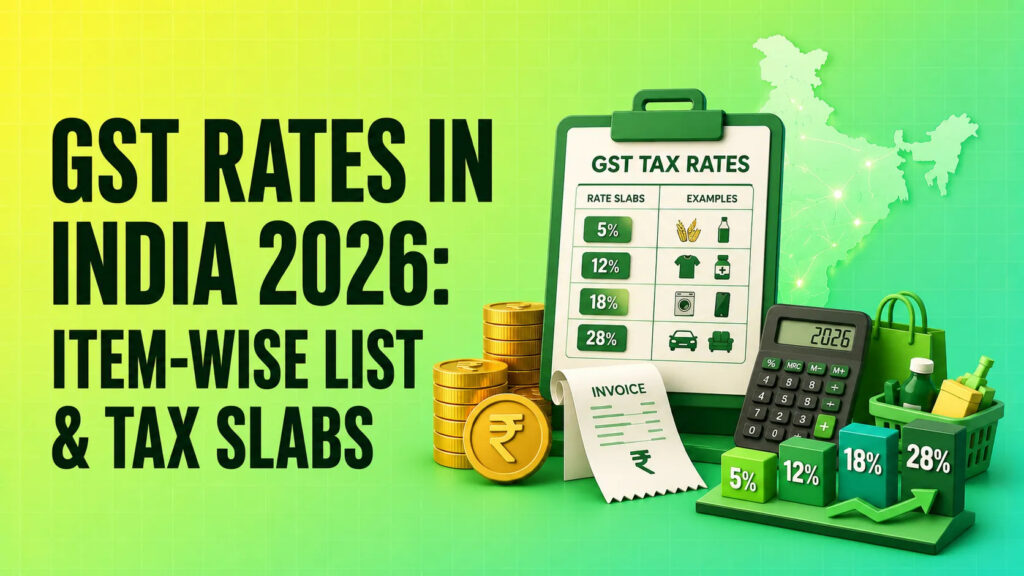
The GST structure in India has been simplified after the latest rate rationalisation. Most goods and services now fall under these major slabs.
| GST Slab | Meaning | Common Examples |
|---|---|---|
| 0% / Nil | No GST or exempt category | Certain food items, Indian breads, specified lifesaving medicines |
| 5% | Essential and common-use items | Packaged food, medicines, personal care items, farm equipment |
| 18% | Standard GST rate | Electronics, auto parts, small cars, many services |
| 40% | Special rate for selected goods | Luxury cars, tobacco products, pan masala, aerated drinks |
Some special rates may still apply to selected items like gold, precious stones, or other notified goods. So, businesses should always verify rates with the correct HSN or SAC code.
GST Rates in India Item Wise List
Here is a simplified item-wise GST rate list for 2026. The rates below are useful for general understanding, but for business billing, always verify the latest official rate.
0% GST Items in India
Nil-rated or exempt items usually include basic essentials and selected healthcare products.
| Item / Category | GST Rate |
|---|---|
| UHT milk | Nil |
| Pre-packaged and labelled paneer/chena | Nil |
| Roti | Nil |
| Chapati | Nil |
| Paratha / Parotta | Nil |
| 33 specified lifesaving drugs | Nil |
| 3 specified lifesaving medicines for cancer, rare diseases, and severe chronic diseases | Nil |
| Individual health insurance policies | Exempt |
| Individual life insurance policies | Exempt |
| Family floater health insurance policies | Exempt |
| Senior citizen health insurance policies | Exempt |
These changes are important for common households because many daily-use and healthcare-related costs become easier to understand under the revised structure.
5% GST Items in India
The 5% GST slab mainly covers essential goods, daily-use products, healthcare items, and agriculture-related equipment.
Food and Daily-Use Items
| Item / Category | GST Rate |
|---|---|
| Packaged namkeen | 5% |
| Bhujia and mixtures | 5% |
| Pasta | 5% |
| Instant noodles | 5% |
| Sauces | 5% |
| Chocolates | 5% |
| Coffee | 5% |
| Cornflakes | 5% |
| Butter | 5% |
| Ghee | 5% |
| Cheese | 5% |
| Dairy spreads | 5% |
Many packaged food items have been brought under the 5% category to reduce the tax burden on common-use products.
Personal Care and Household Items
| Item / Category | GST Rate |
|---|---|
| Hair oil | 5% |
| Shampoo | 5% |
| Toothpaste | 5% |
| Toothbrush | 5% |
| Toilet soap bar | 5% |
| Shaving cream | 5% |
| Bicycles | 5% |
| Bicycle parts | 5% |
| Tableware | 5% |
| Kitchenware | 5% |
| Household articles | 5% |
This category is important because these items are used by almost every household. Lower GST on these products can make daily-use goods more affordable.
Healthcare Items
| Item / Category | GST Rate |
|---|---|
| Most medicines | 5% |
| Medical devices | 5% |
| Surgical apparatus | 5% |
| Dental and veterinary medical apparatus | 5% |
| Glucometer | 5% |
| Blood glucose test strips | 5% |
| Diagnostic kits | 5% |
| Reagents | 5% |
| Corrective spectacles | 5% |
Healthcare-related GST changes are useful for patients because medicines, medical devices, and diagnostic products are common expenses for families.
Agriculture and Farming Items
| Item / Category | GST Rate |
|---|---|
| Tractors | 5% |
| Tractor tyres | 5% |
| Tractor parts | 5% |
| Drip irrigation systems | 5% |
| Sprinklers | 5% |
| Soil preparation machines | 5% |
| Harvesting machinery | 5% |
| Threshing machinery | 5% |
| Composting machines | 5% |
| Specified bio-pesticides | 5% |
| Micro-nutrients | 5% |
Lower GST on agriculture-related items can help farmers reduce input costs on machinery and equipment.
18% GST Items in India
The 18% slab is the standard GST rate for many goods and services. Many earlier high-tax items have been moved into this category.
Vehicles and Auto Items
| Item / Category | GST Rate |
|---|---|
| Small petrol/LPG/CNG cars up to 1200cc and up to 4000mm length | 18% |
| Small diesel cars up to 1500cc and up to 4000mm length | 18% |
| Motorcycles up to 350cc | 18% |
| Three-wheelers | 18% |
| Buses | 18% |
| Trucks | 18% |
| Ambulances | 18% |
| Auto parts | 18% |
Small cars and motorcycles up to 350cc are important for middle-class buyers, so this category is one of the most searched GST updates.
Electronics and Appliances
| Item / Category | GST Rate |
|---|---|
| Air conditioners | 18% |
| TVs | 18% |
| Monitors | 18% |
| Dishwashing machines | 18% |
| Batteries under specified category | 18% |
Electronics and appliances generally fall under the standard GST slab. However, exact classification can depend on product type and HSN code.
Construction and Energy Items
| Item / Category | GST Rate |
|---|---|
| Cement | 18% |
| Coal | 18% |
| Renewable energy devices | 5% |
| Renewable energy equipment | 5% |
| Marble blocks | 5% |
| Granite blocks | 5% |
Cement moving to 18% is an important update for the construction sector because it affects housing, infrastructure, and building costs.
40% GST Items in India
The 40% GST slab is a special rate for selected luxury and sin goods. It is not applied to common-use items.
| Item / Category | GST Rate |
|---|---|
| Pan masala | 40% |
| Cigarettes | 40% |
| Cigars | 40% |
| Manufactured tobacco products | 40% |
| Aerated waters | 40% |
| Caffeinated beverages | 40% |
| Carbonated fruit beverages | 40% |
| Mid-size cars | 40% |
| Large cars | 40% |
| SUVs / MUVs / MPVs under specified conditions | 40% |
| Motorcycles above 350cc | 40% |
| Aircraft for personal use | 40% |
| Yachts and pleasure vessels | 40% |
The 40% slab is mainly used to tax goods that are considered luxury, harmful, or non-essential.
GST Rates on Services in India 2026
GST is also charged on services. Many services now fall under 5% or 18%, depending on the type of service and input tax credit conditions.
| Service | GST Rate |
|---|---|
| Hotel accommodation up to ₹7,500 per unit per day | 5% |
| Gyms | 5% |
| Salons | 5% |
| Barbers | 5% |
| Yoga centres | 5% |
| Beauty and wellness services | 5% |
| Passenger transport services | 5% without ITC or 18% with ITC option |
| Goods Transport Agency | 5% without ITC or 18% with ITC option |
| Multimodal transport without air transport | 5% with restricted ITC |
| Multimodal transport involving air transport | 18% with full ITC |
| Job work for pharmaceutical products | 5% with ITC |
For services, GST rate can depend on whether the supplier is claiming input tax credit. So, service businesses should check the latest SAC-based rate before invoicing.
Latest GST Updates in 2026
Here are the most important GST updates to know in 2026:
- GST structure has been simplified mainly into 5%, 18%, and 40% slabs.
- Many daily-use products such as toothpaste, shampoo, hair oil, soap, and toothbrush moved to 5%.
- Individual life insurance and individual health insurance policies are exempt from GST.
- Most medicines are under 5%, while specified lifesaving medicines are nil-rated.
- Small cars and motorcycles up to 350cc fall under 18%.
- Mid-size cars, large cars, specified SUVs, and motorcycles above 350cc fall under 40%.
- Cement is under 18%.
- Agriculture machinery like tractors, sprinklers, and drip irrigation systems are under 5%.
- Tobacco and pan masala products follow a revised framework from 2026.
- Businesses should use correct HSN/SAC codes before charging GST.
Tobacco and Pan Masala GST Update in 2026
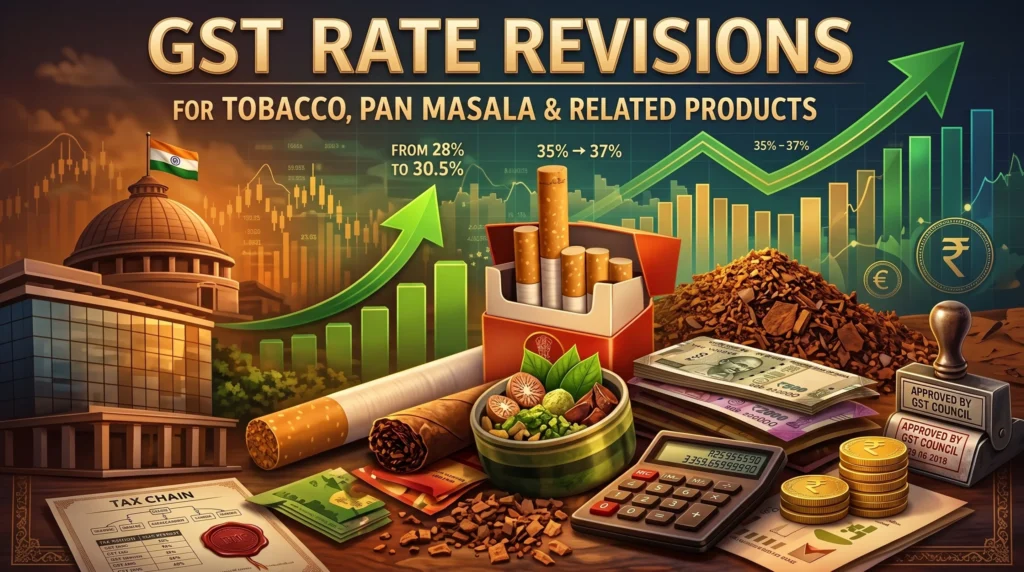
From 2026, specified tobacco and pan masala products are important because they are covered under special GST treatment.
These products include:
- Pan masala
- Unmanufactured tobacco
- Cigarettes
- Cigars
- Other manufactured tobacco products
- Tobacco or nicotine inhalation products
For such goods, GST may be calculated based on RSP-based valuation where notified. RSP means Retail Sale Price. This means tax calculation can depend on the printed retail price instead of only the transaction value, depending on rules and product category.
Businesses dealing in these items should carefully check the latest notification, HSN code, invoicing rules, and return reporting requirements.
How to Check the Correct GST Rate Using HSN or SAC Code
GST rate should not be checked only by product name. The same product category can have different rates depending on description, composition, use, and classification.
To check the correct GST rate:
- Identify whether it is a good or service.
- Find the correct HSN code for goods or SAC code for services.
- Check the latest CBIC/GST rate notification.
- Verify whether the item is nil-rated, exempt, 5%, 18%, or 40%.
- Check whether input tax credit conditions apply.
- For business billing, confirm the rate before issuing invoice.
This is especially important for traders, manufacturers, e-commerce sellers, service providers, and accountants.
GST Rate Change: What Businesses Should Know
If GST rate changes, businesses should not only update prices. They should also update billing systems, invoices, stock records, and GST return reporting.
Important points:
- GST applies based on supply rules.
- Existing stock may be taxed at the new rate when supplied after the effective date.
- Correct HSN/SAC code should be used in invoices.
- Input tax credit rules should be checked if outward supply becomes exempt.
- E-way bill and invoice systems should be updated.
- Businesses should keep rate-change documentation for future reference.
Small businesses should consult a tax professional if they are unsure about classification or ITC treatment.
Why GST Rates Change
GST rates may change because the GST Council reviews tax structure from time to time. The purpose may be to simplify tax slabs, reduce tax on essential goods, support specific sectors, or increase tax on luxury and sin goods.
Common reasons for GST rate changes include:
- Making daily-use goods cheaper
- Reducing tax burden on healthcare
- Supporting agriculture and farmers
- Simplifying compliance
- Removing compensation cess impact
- Applying higher tax on luxury or harmful goods
- Correcting classification issues
This is why GST rates should be checked regularly, especially by businesses.
Conclusion
GST rates in India have become simpler in 2026, but item-wise classification is still important. Most goods and services now fall under nil/exempt, 5%, 18%, or 40% slabs. Essential items, healthcare products, agriculture equipment, and daily-use goods mostly fall under lower GST rates, while luxury and sin goods fall under the higher 40% slab.
For general users, this article gives a simple GST rates in India item wise list. But for business use, invoicing, GST return filing, and tax compliance, always verify the final rate using the correct HSN or SAC code and official GST notifications.
FAQs GST Rates in India 2026
What are the latest GST slabs in India in 2026?
The main GST slabs in India in 2026 are 0% or nil/exempt, 5%, 18%, and 40%. Some special rates may still apply to selected items.
What is the GST rate on daily-use items?
Many daily-use items such as toothpaste, shampoo, hair oil, toilet soap bars, toothbrushes, and shaving cream fall under the 5% GST slab.
What is the GST rate on medicines in India?
Most medicines are taxed at 5%, while specified lifesaving medicines are nil-rated.
Is GST charged on health insurance in 2026?
Individual health insurance policies, family floater health insurance, and senior citizen health insurance policies are exempt from GST.
What is the GST rate on small cars?
Small petrol, LPG, and CNG cars up to 1200cc and up to 4000mm length, and small diesel cars up to 1500cc and up to 4000mm length, fall under 18% GST.
Which items attract 40% GST?
Selected luxury and sin goods such as pan masala, cigarettes, tobacco products, aerated beverages, large cars, specified SUVs, and motorcycles above 350cc fall under 40% GST.
How can I check the correct GST rate for an item?
You can check the correct GST rate by using the item’s HSN code for goods or SAC code for services and verifying the latest official GST or CBIC rate notification.
Are GST rates the same for all services?
No, GST rates on services can differ based on service type and input tax credit conditions. Some services may have 5% without ITC and 18% with ITC options.
Does GST apply on old stock after rate change?
GST generally applies based on supply rules. If goods are supplied after the effective date of a rate change, the revised rate may apply depending on GST rules.
Should businesses rely only on item names for GST rates?
No. Businesses should not rely only on item names. Correct HSN/SAC classification is important for billing, ITC, and GST return filing.