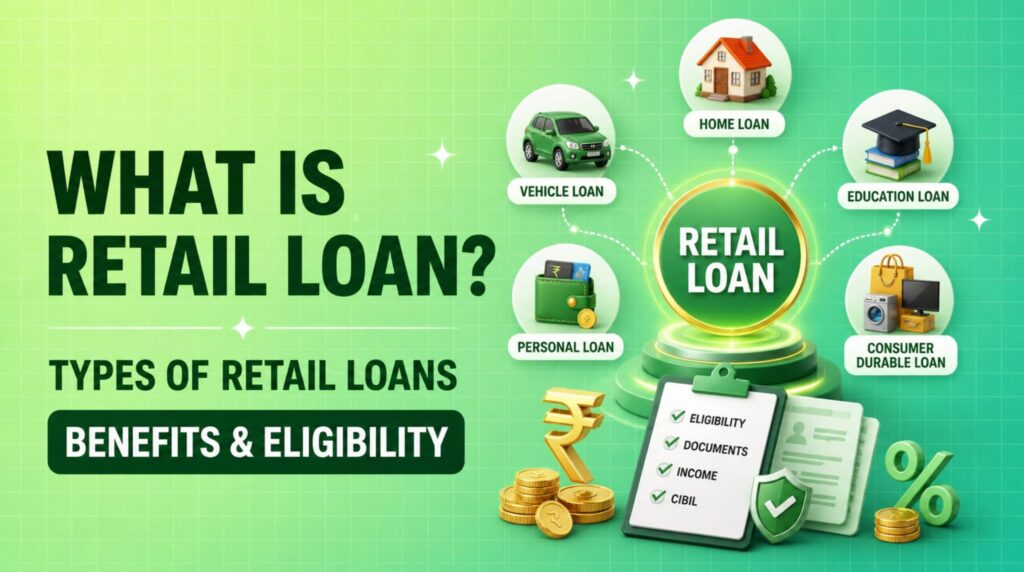
A retail loan is one of the most common financial products used by individuals to manage personal needs, big purchases, emergencies, education, home buying, vehicle purchase, and other lifestyle expenses. In simple words, when a bank, NBFC, or financial institution gives a loan to an individual borrower for personal use, it is generally called a retail loan.
Retail loans are popular because they help people access money without waiting for years to save the full amount. For example, buying a house, funding higher education, purchasing a car, or handling a medical emergency can require a large amount of money. In such situations, retail loans give borrowers financial support with the option to repay the amount through EMIs.
However, before applying for any retail loan, it is important to understand its meaning, types, benefits, eligibility criteria, documents, charges, and repayment terms. This guide explains everything in a simple and beginner-friendly way.
What is a Retail Loan?
A retail loan is a loan offered by banks or financial institutions to individual customers for personal financial requirements. These loans are different from corporate or business loans because they are mainly designed for personal use rather than company or commercial purposes.
Retail loans can be used for different needs such as buying a home, purchasing a vehicle, paying education fees, managing medical expenses, renovating a house, buying consumer goods, or meeting urgent cash requirements.
Depending on the loan type, a retail loan can be either secured or unsecured. A secured retail loan requires collateral, such as property, vehicle, or other assets. An unsecured retail loan does not require collateral, but the lender checks your income, credit score, repayment capacity, and financial profile before approval.
For example, a home loan is usually a secured retail loan because the property acts as collateral. On the other hand, a personal loan is usually unsecured because you do not need to pledge any asset.
How Does a Retail Loan Work?
The working process of a retail loan is simple. First, the borrower chooses the type of loan based on the financial need. After that, the borrower applies to a bank, NBFC, or online lending platform.
The lender checks important details such as income, age, employment type, credit score, existing EMIs, repayment history, and submitted documents. If the borrower meets the eligibility criteria, the lender approves the loan amount.
Once approved, the loan amount is disbursed either directly into the borrower’s bank account or paid to the seller, institution, or service provider, depending on the loan type. For example, in a vehicle loan, the amount may be paid directly to the dealer. In an education loan, the amount may be paid to the educational institution.
After disbursal, the borrower repays the loan through monthly EMIs. Each EMI usually includes two parts: principal amount and interest. The EMI depends on the loan amount, interest rate, and repayment tenure.
Key Features of Retail Loans
Retail loans come with several features that make them useful for individual borrowers. One of the main features is flexible usage. Depending on the loan type, borrowers can use the amount for different needs like housing, education, travel, medical emergencies, weddings, home renovation, or personal expenses.
Another important feature is EMI-based repayment. Instead of repaying the full amount at once, borrowers can repay the loan in fixed monthly instalments. This makes large expenses easier to manage.
Retail loans also offer different tenure options. Some loans, like personal loans, may have shorter tenures, while home loans can have longer repayment periods. The tenure depends on the loan category, lender policy, borrower profile, and loan amount.
Most retail loans also involve interest charges, processing fees, and other applicable costs. Therefore, borrowers should always compare offers before applying.
Types of Retail Loans in India
There are many types of retail loans available in India. Each loan is designed for a specific purpose. Here are the most common types of retail loans.
1. Personal Loan
A personal loan is one of the most popular types of retail loans. It is usually an unsecured loan, which means you do not need to provide collateral. Banks and NBFCs offer personal loans based on your income, credit score, repayment capacity, and employment stability.
Personal loans can be used for many purposes, such as medical expenses, wedding expenses, travel, home renovation, education support, debt consolidation, or emergency needs.
Since personal loans are unsecured, the interest rate is usually higher compared to secured loans. A good credit score and stable income can help you get better loan terms.
2. Home Loan
A home loan is a secured retail loan used to buy, construct, or renovate a residential property. In this type of loan, the property usually acts as collateral until the loan is fully repaid.
Home loans generally come with longer repayment tenures compared to other retail loans. This makes the EMI more manageable for borrowers. However, because the loan amount is usually large, borrowers should carefully check the interest rate, EMI, processing fee, foreclosure charges, and total repayment amount.
A home loan is suitable for individuals who want to buy a house but do not want to pay the entire property cost upfront.
3. Vehicle Loan
A vehicle loan is used to buy a car, bike, scooter, or commercial vehicle, depending on the lender’s policy. In most cases, the vehicle itself acts as collateral for the loan.
Vehicle loans help borrowers purchase a vehicle without paying the full cost at once. The borrower pays a down payment, and the remaining amount is financed by the lender. After that, the borrower repays the loan through EMIs.
The final loan amount depends on the vehicle price, borrower income, credit profile, and lender rules.
4. Education Loan
An education loan helps students and parents manage higher education expenses. This loan can cover tuition fees, hostel fees, books, travel expenses, examination fees, and other education-related costs.
Education loans are commonly used for professional courses, higher studies in India, and foreign education. Some education loans may offer a moratorium period, which means repayment starts after course completion or after the student gets employment, depending on lender terms.
This type of retail loan is useful for students who want to pursue quality education without putting immediate financial pressure on their family.
5. Loan Against Property
A loan against property is a secured retail loan where the borrower pledges residential, commercial, or industrial property to get funds. Since it is backed by collateral, the loan amount can be higher compared to unsecured loans.
This loan can be used for personal needs, education, medical expenses, business expansion, debt consolidation, or other large financial requirements. However, borrowers should be careful while taking a loan against property because failure to repay may put the pledged property at risk.
If you want to understand how to handle such situations and protect your assets, make sure you read this detailed guide now: loan settlement
6. Consumer Durable Loan
A consumer durable loan is used to purchase products like mobile phones, laptops, refrigerators, washing machines, televisions, furniture, and other household items.
These loans are usually available at retail stores, online platforms, or through banks and NBFCs. Some lenders also offer no-cost EMI options, but borrowers should still check processing fees, hidden charges, and total payable amount before applying.
Consumer durable loans are suitable for people who want to buy essential products without paying the full price upfront.
Benefits of Retail Loans
Retail loans offer several benefits to individual borrowers. The biggest benefit is easy access to funds. Whether you need money for a house, car, education, emergency, or personal expense, retail loans make it possible to arrange funds quickly.
Another benefit is flexible repayment through EMIs. Instead of disturbing your savings, you can repay the loan in monthly instalments. This helps manage cash flow better.
Retail loans also provide different options for different needs. For example, if you want to buy a house, you can apply for a home loan. If you need money for urgent expenses, you can apply for a personal loan. If you want to buy a vehicle, you can choose a vehicle loan.
Another advantage is that a retail loan can help build your credit history if you repay EMIs on time. Timely repayment shows lenders that you are a responsible borrower, which may help you in future loan approvals.
Retail Loan Eligibility Criteria
The eligibility criteria for a retail loan can vary from lender to lender. However, most banks and NBFCs usually check some common factors before approving a loan.
The borrower should usually be within the eligible age range decided by the lender. Most lenders also require a stable source of income. Salaried employees, self-employed professionals, and business owners can apply for different retail loans, depending on the product.
Credit score is another important factor. A higher credit score improves your chances of approval and may help you get better interest rates. Lenders also check your existing EMIs and debt obligations to understand whether you can manage a new loan.
Employment stability also matters. Salaried individuals with stable jobs and self-employed individuals with consistent income records usually have better chances of approval.
In simple words, lenders mainly want to know whether you have the ability and willingness to repay the loan on time.
Documents Required for Retail Loan
Documents may differ based on the type of retail loan, lender, and borrower profile. However, some common documents are usually required.
For identity proof, lenders may ask for Aadhaar card, PAN card, passport, voter ID, or driving licence. For address proof, documents like Aadhaar card, utility bill, passport, or rental agreement may be accepted.
Income documents are also important. Salaried individuals may need to submit salary slips, bank statements, and Form 16. Self-employed individuals may need to submit income tax returns, profit and loss statements, balance sheets, and business proof.
For secured loans like home loans or loans against property, property-related documents are also required. For vehicle loans, quotation or invoice from the dealer may be needed.
Before applying, it is always better to check the exact document list from the lender.
Retail Loan Interest Rates and Charges
Retail loan interest rates depend on the type of loan, borrower profile, credit score, income, tenure, lender policy, and whether the loan is secured or unsecured.
Secured loans usually have lower interest rates because the lender has collateral security. Unsecured loans, such as personal loans, may have higher interest rates because they carry more risk for the lender.
Apart from interest, borrowers should also check other charges. These may include processing fee, prepayment charges, foreclosure charges, late payment penalty, documentation charges, and bounce charges.
Many borrowers only look at the EMI amount, but this is not enough. You should also check the total repayment amount, annual percentage cost, and all terms and conditions before finalizing any loan.
Secured vs Unsecured Retail Loans
Retail loans are mainly divided into two categories: secured and unsecured.
A secured retail loan requires collateral. Examples include home loans, vehicle loans, and loans against property. Since the lender has security, the interest rate may be lower and the loan amount may be higher.
An unsecured retail loan does not require collateral. A personal loan is the most common example. In this case, approval depends heavily on your income, credit score, repayment history, and financial stability.
Secured loans are useful for bigger financial needs, while unsecured loans are useful for quick and smaller personal requirements. However, both types should be taken only after checking your repayment capacity.
Things to Consider Before Applying for a Retail Loan
Before applying for a retail loan, you should first understand your actual need. Do not take a loan just because you are eligible. Borrow only the amount you genuinely need and can repay comfortably.
Next, check your EMI affordability. Your EMI should not put too much pressure on your monthly budget. If your existing EMIs are already high, taking another loan can create financial stress.
You should also compare interest rates from different lenders. A small difference in interest rate can make a big difference in total repayment, especially for long-tenure loans.
Check all charges carefully. Processing fees, late payment penalties, foreclosure charges, and hidden costs can increase the overall loan burden.
Most importantly, understand the impact on your credit score. Timely EMI payments can improve your credit profile, but missed payments can damage your credit score and affect future loan approvals.
How to Apply for a Retail Loan Online?
- Choose the type of retail loan you need, such as personal loan, home loan, vehicle loan, education loan, or consumer durable loan.
- Visit the lender’s official website or mobile app to start the online application process.
- Check your eligibility using the lender’s eligibility calculator, if available.
- Fill in basic details such as name, mobile number, income, employment type, loan amount, and repayment tenure.
- Upload required documents like identity proof, address proof, income proof, bank statements, and other loan-specific documents.
- Wait for verification, where the lender checks your documents, credit score, income, and repayment capacity.
- Review the loan offer carefully, including interest rate, EMI, tenure, processing fee, and other charges.
- Accept the offer only after understanding all terms and conditions.
- Complete final formalities, such as e-signing or additional verification if required.
- Receive the loan amount in your bank account or through direct payment as per the lender’s process.
- Apply only through trusted platforms and avoid sharing personal details on unknown or suspicious websites.
Retail Loan vs Personal Loan
Many people get confused between retail loan and personal loan. A retail loan is a broad category that includes many loan types offered to individual customers. A personal loan is only one type of retail loan.
For example, home loan, vehicle loan, education loan, loan against property, and consumer durable loan all come under the retail loan category. But a personal loan is specifically an unsecured loan used for personal expenses.
So, every personal loan is a retail loan, but every retail loan is not a personal loan.
Common Mistakes to Avoid While Taking a Retail Loan
- Borrowing more than required
Taking a higher loan amount increases your EMI and total interest burden. - Choosing a very long tenure only for low EMI
Longer tenure may reduce monthly EMI, but it can increase the total interest you pay over time. - Ignoring hidden charges
Always check processing fees, prepayment charges, foreclosure charges, late payment penalties, and other costs. - Not comparing different lenders
Applying without comparing interest rates, EMI options, and charges may cost you more. - Applying for multiple loans at the same time
Multiple loan applications can create hard enquiries on your credit report and may affect your credit score. - Not checking repayment capacity
Make sure your monthly EMI fits your budget before taking a retail loan. - Missing EMI payments
Late or missed EMI payments can damage your credit score and create financial problems in the future. - Not reading the loan agreement carefully
Always read terms and conditions before accepting the loan offer.
Final Verdict: Should You Apply for a Retail Loan?
A retail loan can be a useful financial tool when used wisely. It helps you manage important expenses like buying a home, purchasing a vehicle, funding education, or handling emergencies. It also allows you to repay the amount through EMIs instead of paying everything upfront.
However, a retail loan should never be taken casually. Before applying, compare lenders, check interest rates, understand charges, calculate EMI, and review your repayment capacity.
If the loan supports a genuine need and fits your monthly budget, it can be helpful. But if the loan is only for unnecessary spending, it may create financial pressure later.
The smart approach is simple: borrow only what you need, repay on time, and always read the loan terms carefully.