Table of Contents
Have you ever heard that a company is launching an IPO and wondered how it is different from buying shares? Understanding the difference between IPO and shares is important for anyone who wants to learn how the stock market works. Although both terms are connected to the stock market, they do not mean the same thing.
A share represents a small ownership stake in a company, while an IPO is the process through which a company offers its shares to the public for the first time. Understanding these terms can help students and beginners learn the basics of stock market investing.
Let’s understand both terms with simple examples.
What Is a Share?
A share is a small unit of ownership in a company. When you buy shares of a company, you become one of its shareholders.
For example, suppose you buy shares of Tata Motors. You own a small part of the company. If the share price increases, the value of your investment may also increase. Some companies also pay dividends to their shareholders.
However, share prices can fall too. You may lose money if you sell your shares for less than what you paid.
Also Read: How to Start Investing in Stocks: Beginner Guide 2026
What Is an IPO?
IPO stands for Initial Public Offering. It is the process through which a private company offers its shares to the public for the first time.
Companies launch IPOs to raise money from investors. They may use this money to expand their business, repay debt or meet other business needs.
Before applying, beginners can read our IPO guide to understand the risks, valuation and important factors to consider.
Also Read: IPO Investing Guide: Should Beginners Apply or Not?
For example, when a company launches an IPO, investors can apply to buy its shares at the announced price or within the given price band. If shares are allotted to them, they become shareholders of that company.
Difference Between IPO and Shares
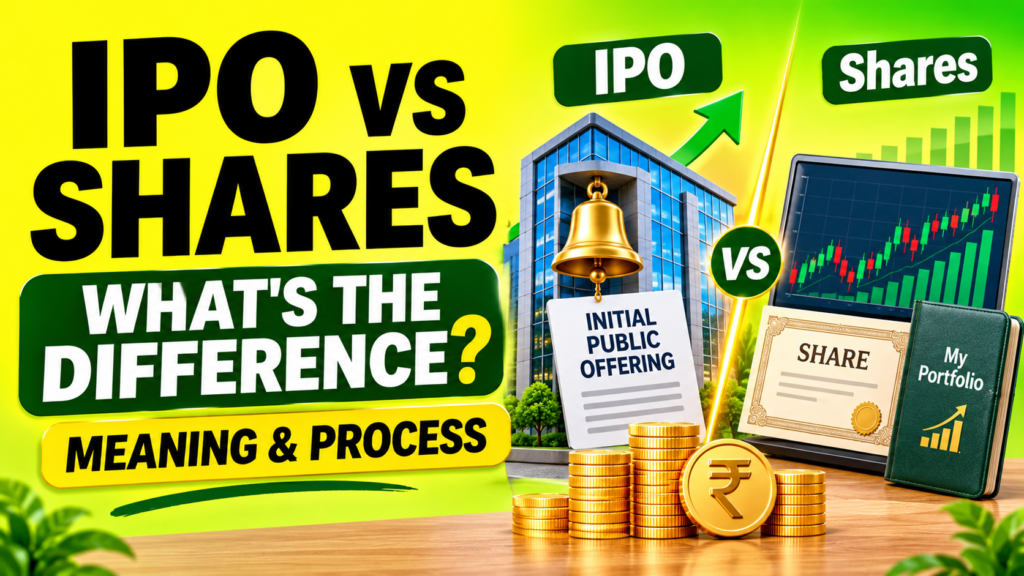
The main difference is that an IPO is a way for a company to offer its shares to the public, while shares represent ownership in that company.
Here are the key differences:
| IPO | Shares |
|---|---|
| IPO means Initial Public Offering. | A share is a unit of company ownership. |
| It is the first public offer of a company’s shares. | Shares can be bought and sold in the stock market. |
| Investors apply during the IPO period. | Investors can buy shares during market trading hours. |
| Shares are offered in the primary market. | Listed shares are traded in the secondary market. |
| Allotment is not guaranteed. | A normal market purchase depends on the buyer, seller and price. |
Simple example: When Tata Technologies launched its IPO in November 2023, investors could apply for its shares through the IPO. After the shares were listed on the stock exchanges, investors could buy and sell them in the stock market.
To understand the different segments of the stock market, you can also read our related guide.
Also Read: Types of Share Market Explained: Primary, Secondary & Beyond
How Does an IPO Work?
If a company decides to launch an IPO, the process generally follows these steps:
Company announces the IPO: It shares details such as the IPO dates, price band and lot size.
Investors apply: Interested investors apply through a broker’s app or another permitted platform. They select the number of lots and approve the payment mandate.
Allotment takes place: The company and its registrar finalise which applicants receive shares.
Shares get listed: Allotted shares are credited to investors’ demat accounts and become available for trading after listing.
What Happens If You Don’t Get IPO Allotment?
Your application does not guarantee that you will receive shares. If an IPO receives more applications than the shares available, it is called oversubscription.
For an oversubscribed IPO, allotment depends on the applicable allocation rules. In the retail category, a lottery-based process may be used when there are more valid applications than the minimum lots available.
When you apply through ASBA or UPI, the application amount is generally blocked in your bank account. If you do not receive an allotment, the blocked amount is released. If shares are allotted, the required amount is debited.
Related Guide: What FPO Stands For: How it Works in Investing?
Can You Make Money from an IPO?
Yes, investors may earn money from an IPO through listing gains or by holding the shares for the long term. However, profit is not guaranteed.
Listing gain happens when a share lists on the stock exchange at a price higher than its IPO issue price.
For example, Tata Technologies had an IPO issue price of ₹500 per share in November 2023. Its shares opened at ₹1,200 on the listing day. Investors who received an allotment could have benefited from this difference, depending on their selling price.
But every IPO does not perform this way. Some shares list below their issue price, which can result in a loss for investors who sell at that price.
Before applying, check the company’s business, financial performance, valuation and IPO documents. Do not invest only because an IPO is popular.
What Happens After an IPO Listing?
After listing, the company’s shares can be traded on stock exchanges such as the NSE and BSE.
There are two important markets to understand:
Primary Market: This is where a company offers new securities to investors for the first time, such as through an IPO.
Secondary Market: This is where investors buy and sell already-listed shares among themselves through stock exchanges.
For example, when you apply for a company’s IPO, you participate in the primary market. When you later buy or sell that company’s listed shares through a broker, you participate in the secondary market.
Should Beginners Invest in IPOs or Shares?
Both IPOs and listed shares can offer investment opportunities, but beginners should understand the risks before investing.
If you are new to the stock market, learning about investment basics, Demat accounts and stock selection can help you make better-informed decisions.
Consider an IPO if you have studied the company’s business, financial details and IPO valuation.
Consider listed shares if you want to choose from companies already trading on the stock exchange and compare their performance.
Do not invest just because friends are applying or social media is discussing an IPO. Share prices can rise or fall, and you may lose money.
Conclusion
The difference between IPO and shares is simple: an IPO is the process through which a company offers its shares to the public for the first time, while a share represents ownership in that company.
Once you understand this difference, it becomes easier to understand how companies enter the stock market and how investors buy and sell shares. Before investing, always research the company and understand the risks.